Category: Luxury

  • This NYC Suburb Is Lowering Rents Here’s How

    This NYC Suburb Is Lowering Rents Here’s How

    im 38505149?width=1280&size=1
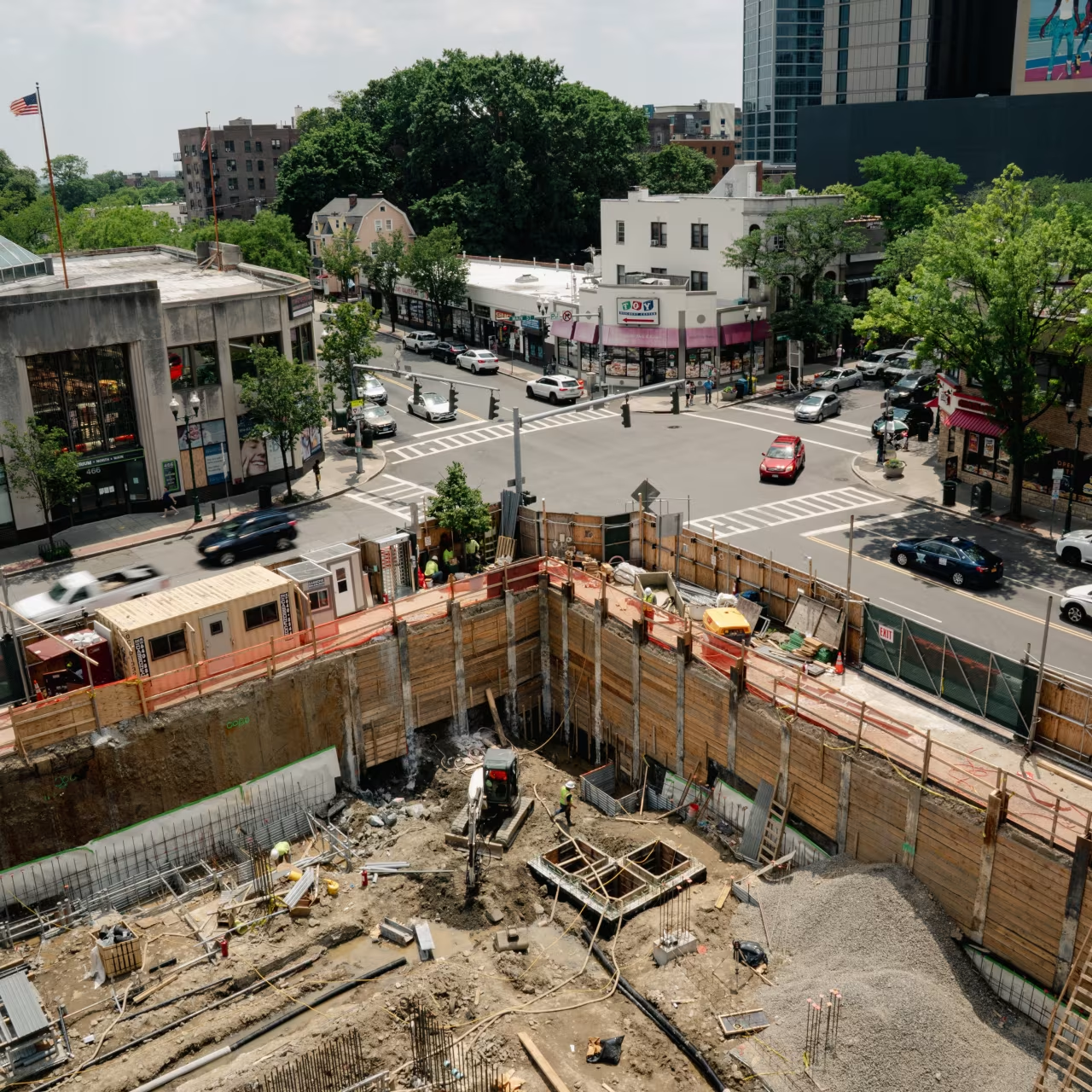
    A new building under construction in New Rochelle, N.Y. © WSJ

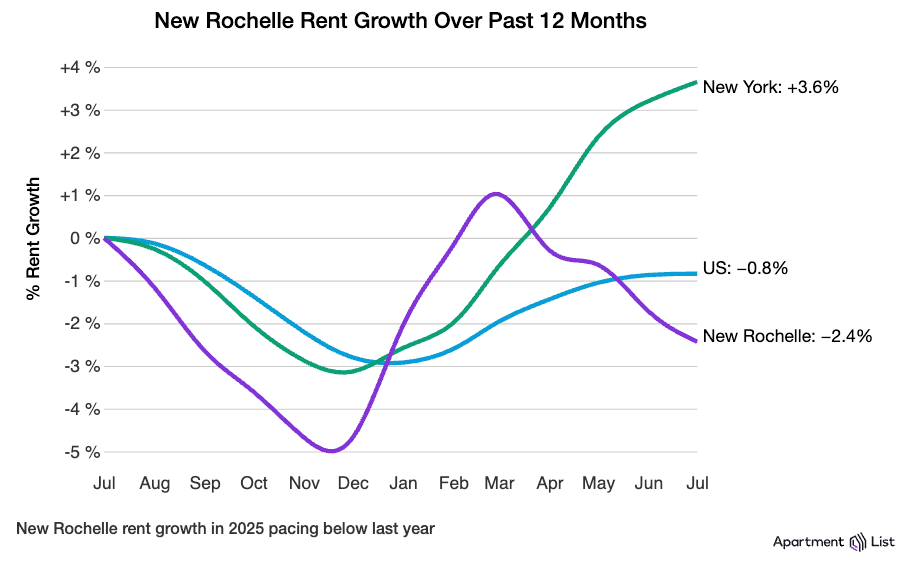
    About 20 miles north of Midtown Manhattan, the city of New Rochelle, NY—home to roughly 85,000 residents—has quietly rewritten the housing playbook, making it a rare example of a suburb where added supply has actually stabilized and even reduced rents. While the broader New York metro and much of the nation grapple with surging rent inflation, New Rochelle has kept rent growth to 1.6% since 2020, and rents have declined slightly from 2020 to 2023.

    According to The Wall Street Journal, New Rochelle added 4,500 new housing units over the past decade, with another 6,500 in the pipeline—a 37% expansion in the city’s housing stock. This surge stands in stark contrast to many U.S. cities, where supply hasn’t kept pace with demand.

    That growth isn’t just in numbers. A range of developers, anchored by RXR as master developer, have led the charge on large projects like One Clinton Park, ThreeHThirty3, and Encore, part of a $2.5 billion redevelopment effort.

    City officials adopted a five-part framework starting in 2015 that paved the way for this transformation:

    A form-based zoning code that specifies building size and design but allows flexibility in use. A single, generic environmental review for an entire redevelopment zone, reducing per-project red tape. A master agreement with a lead developer (RXR) managing multiple publicly owned sites. Tax and financial incentives calibrated to attract investment while protecting taxpayers.

    A thorough fiscal impact analysis to address concerns around schools and municipal services.

    New Rochelle officials guarantee a 90-day approval timeline for qualifying residential projects—far quicker than in New York City or neighboring suburbs.

    Evidence shows these policies paid off. According to Pew Charitable Trusts, from 2017–2021, New Rochelle added housing over twice as fast as the U.S. average. Meanwhile, rents rose just 7% from 2017 to 2023, compared to 31% nationally.

    Apartment List data reinforces that trend: By September 2024, New Rochelle’s median rent had fallen 3% year-over-year and stood 7.2% below the broader New York metro average.

    Developers must set aside 10% of units as affordable housing, with identical features to market-rate units—an effort to promote equity and inclusion.

    In highrise projects like Highgarden Tower, fully affordable buildings offer two-bedrooms for $1,800–$2,500/month, versus market rents of $4,100+ per two-bedroom. This mix has spurred transit-oriented downtown growth and pulled price pressure off older housing.

    Local officials also reinvest developer fee revenues into infrastructure, food services, and down payment assistance programs to support longtime residents.

    New luxury towers like Encore, which opened in late 2023, reached 95% leased by April 2025 with studio rents starting around $2,070/month, one-bedrooms at $2,615, and two-bedrooms at $4,350. These prices remain below many Manhattan equivalents and attractive for professionals pricing out of NYC.
    Screenshot 2025 08 06 at 8.08.58 PM

    Despite success, not everyone is thrilled. Longtime residents have voiced concerns about construction noise, loss of parking, and a changing community fabric. A local resident described new arrivals as “sleepers”—those who live but don’t fully participate in downtown life.

    Investor sentiment is cautious too: At recent real estate panels, multiple brokers warned that thousands of units flooding the local market could pressure rents in the coming years—though most of that pipeline is still planned or under construction.

    New Rochelle’s model—streamlining environmental reviews, standard zoning, developer partnerships, and mixed-income mandates—is drawing attention nationwide. States such as California and Oregon, and even proposals in Washington, D.C., are exploring similar federal incentives and review reforms to ease regional housing shortages.

    By pushing thousands of new apartments through with predictability and speed, while preserving affordability and reinvesting in services, New Rochelle has displayed a rare suburban success story in containing rents. For city and state policymakers nationwide wrestling with affordability crises, it’s a living blueprint for how development can be part of the fix—not the problem.
  • Wyoming’s Secret Weapon in the Battle for Wealthy Homebuyers Is Working

    Wyoming’s Secret Weapon in the Battle for Wealthy Homebuyers Is Working

    In the ever-intensifying race among U.S. states to attract wealthy homebuyers, Wyoming has quietly emerged as a powerful player—and its strategic edge is paying off.

    Thanks to a combination of ultra-friendly tax policies, flexible estate planning laws, and jaw-dropping real estate offerings, Wyoming has become a magnet for high-net-worth individuals looking for more than just mountain views and fresh air. According to data from Realtor.com, the state’s lack of income tax, its embrace of “dynasty trusts,” and its business-friendly stance are helping reshape its luxury real estate market—and its long-term economic trajectory.

    The Tax Strategy Behind Wyoming’s Boom

    Wyoming’s fiscal policies have long made it an appealing destination for the ultra-wealthy. The absence of a state income tax means residents can protect more of their income—whether from capital gains, business ownership, or retirement benefits.

    But the real kicker is the dynasty trust, a powerful financial tool that allows the transfer of wealth from one generation to the next while minimizing estate and gift taxes. According to U.S. Bank, these trusts “facilitate the transfer of wealth to future generations while minimizing taxes,” enabling families to build generational wealth with minimal government interference.

    “Wyoming is the most tax-friendly state,” said Latham Jenkins, a real estate expert at Live Water Jackson Hole, speaking to Realtor.com. “Retirement benefits are not taxed at the state level, and it’s one of the most business-friendly states in the nation.”

    Other states like South Dakota, Nevada, and Delaware also allow dynasty trusts, but few combine that benefit with Wyoming’s overall tax neutrality and lifestyle appeal.

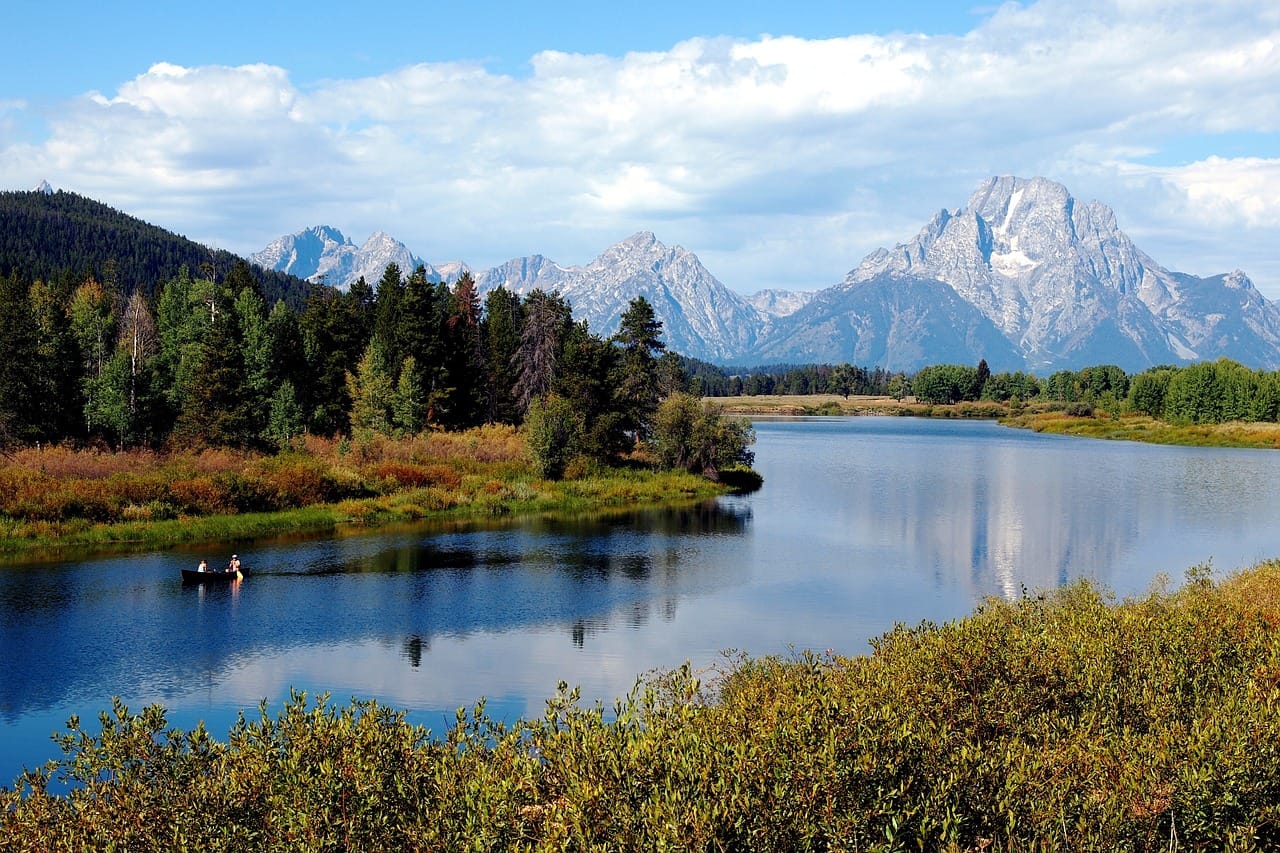
    While the median home price in Wyoming was $495,000 in May 2025, according to Realtor.com, luxury listings are soaring well above that mark—particularly in Teton County, home to the coveted Jackson Hole area and portions of Grand Teton and Yellowstone National Parks.

    The median listing price in Teton County hit $2.95 million, and of the nearly 70 properties for sale in the area in May, 57 were listed above $5 million. The state had a higher proportion of $5 million-plus listings than neighboring Idaho and Montana, with roughly 3% of its 2,200 total listings falling into that ultra-luxury category.

    And it’s not just listings—it’s movement. Jackson Hole recorded 15 sales of homes above $10 million in 2024, per a Compass report.

    Luxury buyers in Wyoming are not your typical mortgage-dependent purchasers. Those shopping at the $10 million-plus level are often paying in cash and planning to hold their properties long-term—drawn by the state’s tax advantages. These buyers tend to be strategic, not speculative.

    Sellers in this tier are also a different breed. Without mortgages, they’re not pressured to sell quickly and can afford to wait for the right offer. This explains the patience visible in the market: homes asking $5 million or more stayed on the market for a median of 187 days—a longer duration than in Idaho or Montana.

    “People are more bullish in their prices and more confident,” said Margi Barrie, a broker at Prugh Real Estate, in an interview with Realtor.com. “A lot of people aren’t leveraged on their property so they can sell them—or not.”

    As of July 2024, Wyoming’s population stood at 587,600, according to the U.S. Census Bureau. While modest in size, the state’s wealth per capita is climbing as affluent buyers move in and make long-term investments—both financial and personal.

    With its pristine natural beauty, elite outdoor lifestyle, and forward-thinking tax structure, Wyoming isn’t just attracting vacationers—it’s drawing America’s wealth builders. And if the current momentum continues, it might become the go-to tax haven in the American West, outpacing better-known alternatives like Florida or Nevada.

    With inflation easing and high-net-worth individuals seeking stability amid economic uncertainty, Wyoming’s luxury market is positioned for continued strength into 2025 and beyond. The combination of low taxation, strong legal frameworks, and high-end inventory makes the state a rare trifecta for real estate investors.

    For the ultra-wealthy looking for a place to park their millions—or even billions—Wyoming might just be America’s best-kept open secret. But it’s working—and the market is responding.

  • The apartment at the very top of the world’s thinnest skyscraper is for sale now for $110 million.

    The apartment at the very top of the world’s thinnest skyscraper is for sale now for $110 million.

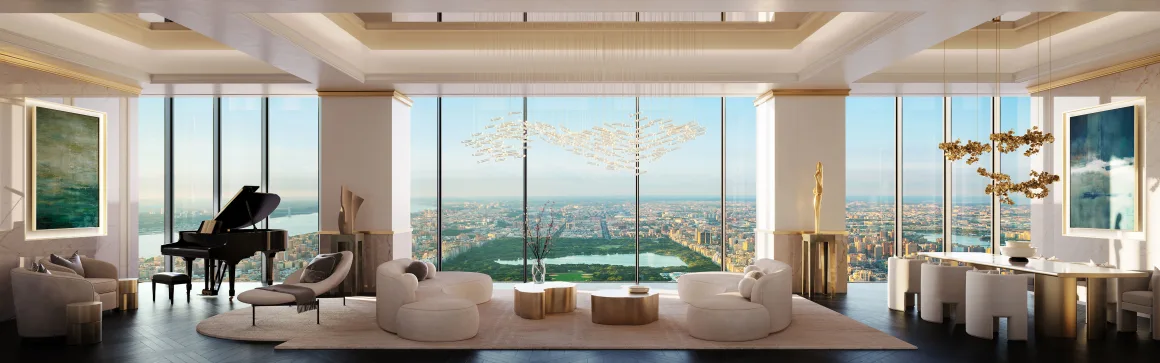
    A penthouse of the “supertall” Manhattan building dubbed the world’s skinniest skyscraper has hit the market at $110 million.

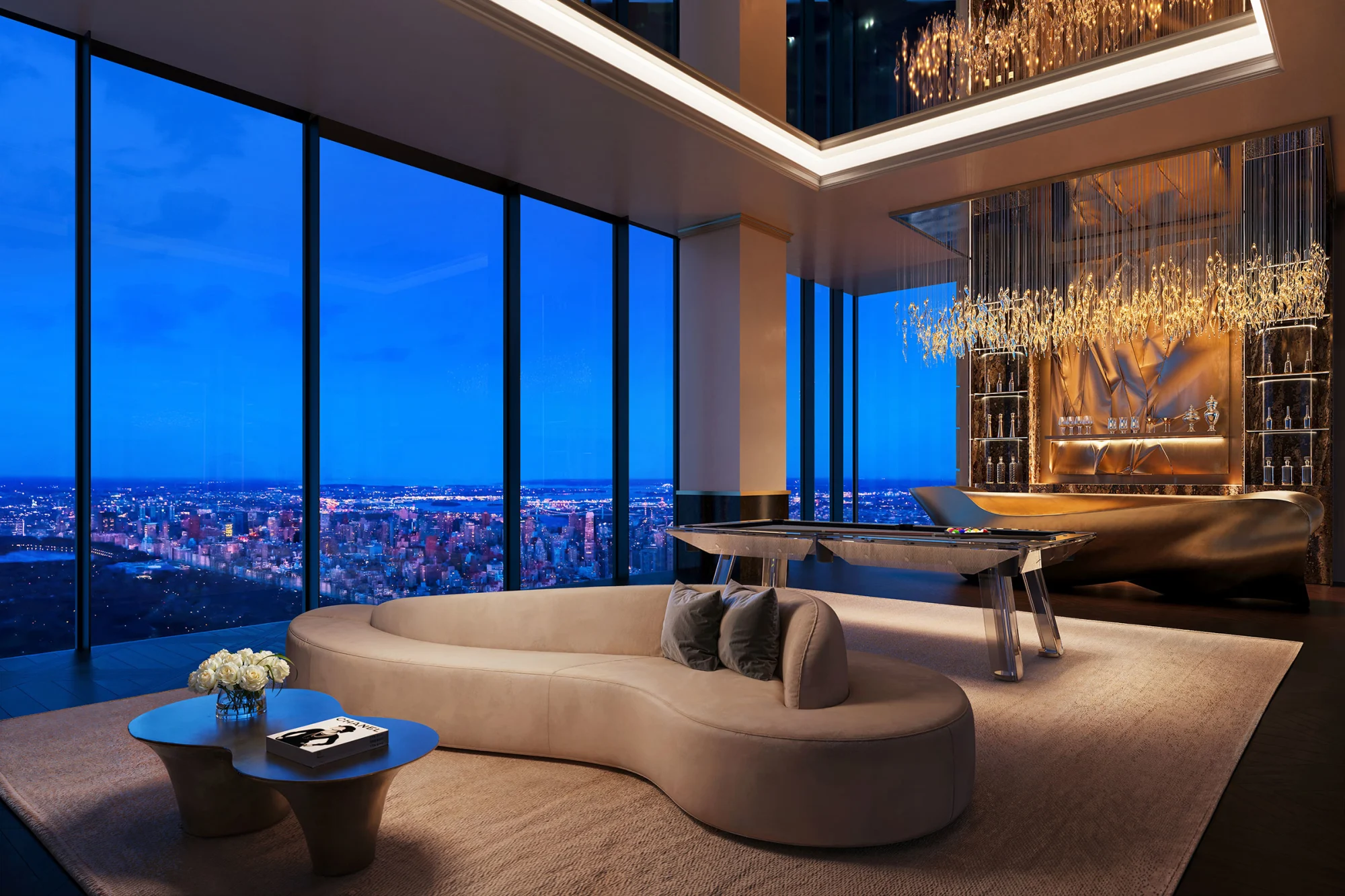
    The four-story home, or “quadplex,” spans floors 80 to 83 of the 1,428-foot-tall building 111 W 57th Street and overlooks Central Park. With interiors designed by Studio Sofield, the suggested floor plans features an “entertaining suite” on the first floor and a “primary suite” on the third floor, while the proposed layout is topped off by a “crown suite” containing a bar and screening room.

    In total, the property features five bedrooms, six bathrooms and two terraces, as well as 360-degree views of New York City.

    f webp
    The penthouse has views overlooking Central Park. Hayes Davidson

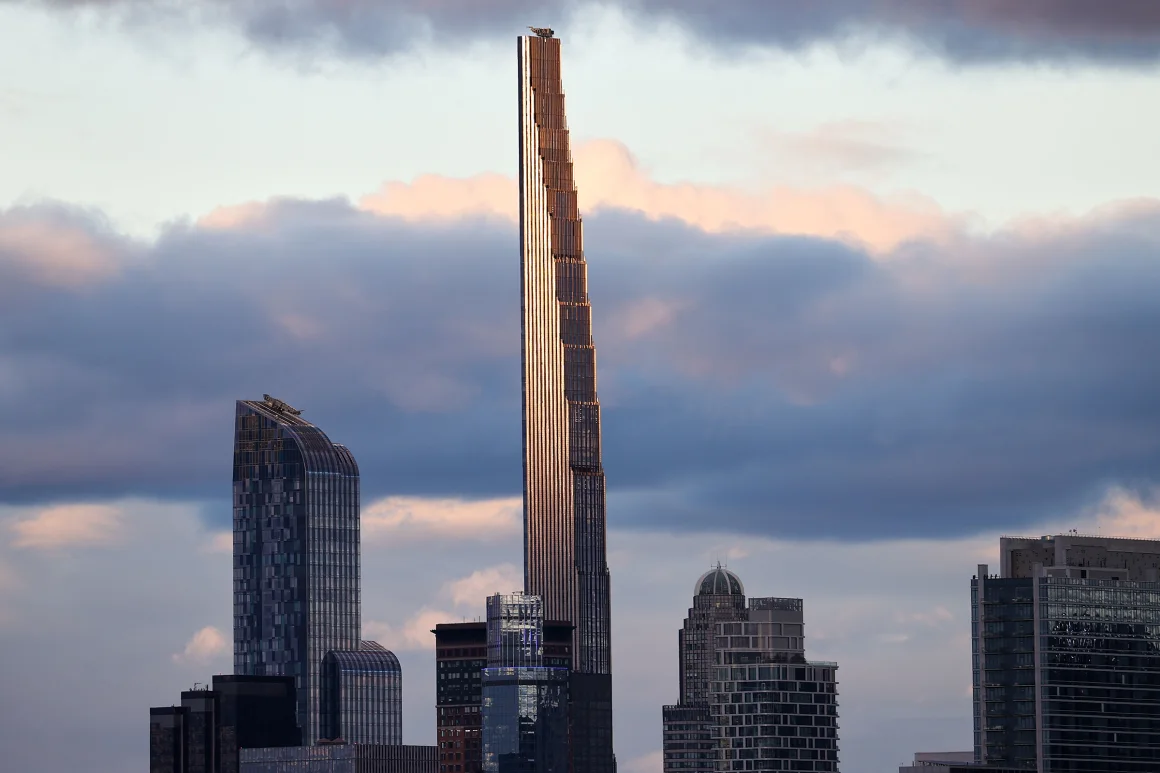
    The building, also known as the Steinway Tower, was completed in 2022 on the site once occupied by the historic Steinway & Sons piano company. Designed by SHoP Architects and Studio Sofield, it is one of the tallest skyscrapers in the Western hemisphere — and the most slender, with a height-to-width ratio of 24:1.

    Its design is meant to evoke New York’s Gilded Age of the late 19th century, when the city experienced a period of unprecedented wealth and a subsequent boom in skyscraper construction, according to the architects.

    The vertiginous tower’s facade appears to change throughout the day as the color and texture of the terracotta blocks shift in the light. Inside, designers created a sense of opulence with materials such as marble, limestone, blackened steel and velvet used in the common spaces, and artworks by the likes of Pablo Picasso and Henri Matisse adorning the walls.

    Its amenities include an 82-foot swimming pool, private dining rooms and a landscaped terrace.

    f webp
    Steinway Tower pictured during sunset in April 2022. Tayfun Coskun/Anadolu/Getty Images

    “We’ve all been to very luxurious places, but I wanted to create a building that could not be anywhere else in the world,” Studio Sofield’s founder, William Sofield, told CNN in 2022. “I know so many people might have multiple homes, who will have apartments here. And I wanted to create a very distinct experience that could only be had in New York.”

    Steinway Tower sits on New York’s Billionaire’s Row, where pencil towers have continued to climb higher, including the nearby Central Park Tower, which is the second-tallest building in the city behind One World Trade Center. Though quadplex apartments are rare, another one on Billionaire’s Row — a 24,000-square-foot apartment at 220 Central Park South —broke records in 2019 when it sold for $238 million to become the most expensive home ever sold in the United States.