LONDON — Britain’s economy is staring down a familiar foe: creeping inflation that threatens to erode living standards and stall recovery. Yet amid the headlines of a 3.4% CPI rise in December 2025—the first uptick in five months—and a slowdown in wage growth to 4.5% annually (regular earnings excluding bonuses) in the three months to November, per the Office for National Statistics (ONS)—a more optimistic path emerges. The UK possesses the structural levers to break free from this inflationary trap without resorting to punitive interest rate hikes or endless fiscal giveaways. The key? A renewed focus on domestic production, export revival, and supply-side reforms that rebuild economic resilience from the ground up.
Chancellor Rachel Reeves, fresh from her Autumn Budget’s £13 billion in targeted relief over three years—including £5.4 billion this year for pocketbook boosts—faces a tough early 2026. Inflation climbed from November’s 3.2% to 3.4% in December, driven by airfares, tobacco duties, and persistent services pressures (4.5% annual rise), according to ONS data released January 21. Economists had penciled in 3.3%, making this a mild surprise that likely keeps the Bank of England on hold at 3.75% for its February meeting, per Reuters polling and City pricing.
Wage momentum has cooled too: Regular pay growth eased to 4.5% from 4.6%, with private-sector earnings dropping sharply to 3.6%—the lowest since November 2020, ONS figures show. Public-sector pay remains elevated at 7.9% due to timing effects from prior awards, but overall trends signal easing labor-market heat. Unemployment held at 5.1%—highest since January 2021—while payrolled employees fell 155,000 year-on-year to November, with provisional December estimates showing another 184,000 drop.
This isn’t the 1970s wage-price spiral redux. Real wages have grown just 9% over the past decade, a far cry from the unchecked rises that fueled stagflation then. Today’s pressures stem from structural imbalances: a chronic trade deficit widened post-2008 financial crisis, when financial services exports—once a sterling stabilizer—plummeted 25% and stagnated. The City lost its allure as a global capital magnet, siphoning fewer foreign inflows and weakening the pound by over 20% against major currencies since the crash peaks.
A depreciated sterling inflates import costs for essentials—food up 0.8% monthly in December, nearly doubled since 2008; clothing and footwear reversing long-term deflation to rise 20% in five years. This feeds services inflation, the economy’s dominant driver. Yet the ONS and Bank of England data point to transience: Headline inflation is forecast to drop sharply in January (potentially 0.5 percentage points, per Resolution Foundation), with the BoE eyeing a return near 2% by mid-2026. Deutsche Bank’s Sanjay Raja predicts the UK’s biggest G7 inflation fall this year, with Q4 forecasts averaging 2.2% (Treasury economists) to 2.1% (OBR November outlook).
Escaping the Whirlpool: Production Over Handouts
Reeves’ £150 energy bill cuts, rail fare freeze, and prescription charge hold are welcome short-term palliatives, but lasting relief demands supply-side boldness. Britain’s post-crisis malaise—widening trade gaps, sterling weakness, import dependence—mirrors vulnerabilities that subsidies alone can’t fix. The answer lies in revitalizing domestic manufacturing and agriculture to reduce reliance on overseas goods, create high-value jobs, and strengthen the currency organically.
Since the 1980s, the UK has shed a million hectares of farmland, per historical data, exacerbating food import exposure. Yet glimmers of reversal exist: Textile production shows tentative growth after decades of decline, with Q3 2025 sales rebounding 4.3% for small-to-mid fashion manufacturers to £500,517 average revenue, per Unleashed reports. Broader manufacturing output grew modestly in late 2025, though confidence dipped amid fragile demand (Make UK/BDO Q4 survey forecasts 0.5% growth in 2025 before a 0.5% contraction in 2026).
Policymakers should accelerate this shift: Targeted incentives for onshore production in essentials—cars, clothing, food—could rebuild supply chains. Challenge the defeatist myth that Britain can’t compete; scale and innovation can offset labor costs if energy prices fall and taxes ease. High electricity bills (among world’s highest) and employment taxes deter investment—abandoning rigid net-zero timelines for pragmatic energy policy could unlock competitiveness without subsidies’ fiscal drag.
Public discourse underscores this: Commentators lament foreign ownership of utilities and manufacturing siphoning dividends abroad, urging British-owned firms to retain profits domestically. Others decry subsidies as non-solutions, advocating deregulation, lower energy costs, and tax relief instead. Freeing food imports could collapse prices short-term, but long-term security demands balanced domestic capacity.
New export powerhouses—beyond stagnant finance—could replace lost sterling inflows. Green tech, advanced manufacturing, and services innovation offer paths if regulations don’t stifle them.
Market Implications and Political Calculus
Sterling held steady post-inflation data at around $1.32 and €1.146 (Wise mid-market January 22), reflecting expectations of temporary blips. BoE futures price one to two cuts in 2026, likely from April if January data confirms cooling. Gilt yields and FTSE sectors sensitive to rates (banks, utilities) show muted reaction, betting on gradual easing.
Politically, 2026 is Reeves’ proving ground: Deliver cost-of-living relief via growth, not handouts, or face voter backlash. As she once advocated “make, sell and buy more in Britain,” returning to that vision—boosting production, jobs, investment—offers sustainable escape from inflation’s grip. Handouts fade; productive capacity endures.
Britain isn’t doomed to perpetual import dependence or sterling weakness. With supply-side courage—lower barriers, energy realism, domestic focus—the UK can rebuild strength, tame prices, and deliver genuine prosperity. The tools are there; the will must follow.
U.S. job growth defied expectations in September, according to a Labor Department report issued nearly seven weeks late due to the government shutdown.
Payrolls rose by a seasonally adjusted 119,000 on the month, the strongest gain since April, the Labor Department said Thursday.
That was well above the gain of 50,000 jobs economists polled by The Wall Street Journal expected to see. The September report covers the month before the recent government shutdown began on Oct. 1.
However August’s payrolls number was revised to a loss of 4,000 jobs, and July’s payrolls were revised slightly lower to a 72,000 gain. That meant employment in July and August combined was 33,000 lower than previously reported.
The unemployment rate, which is based on a separate survey from the jobs figures, rose slightly to 4.4%, reaching the highest level in four years as nearly half a million people joined the labor force. Economists expected the unemployment rate to hold at 4.3%.
Stocks rose sharply Thursday. Investors were already responding enthusiastically prior to the employment report to Nvidia’s strong earnings report late Wednesday, but the jobs figures added fuel to the fire.
Separately, the Labor Department released updated weekly jobless claims that suggest layoffs didn’t rise sharply during the government shutdown, which ended last week. In the week through Nov. 15, 220,000 people newly filed for jobless benefits—broadly in line with the range that held for most of 2025.
But the report also showed that the number of continuing unemployment claims, a measure of the size of the unemployed population, rose by 28,000 to 1,974,000 in the week ended Nov. 8. That was the highest level since November 2021, and reflects a low-hire environment where it has been difficult for those workers who are laid off to find work again.
The latest data will likely do little to resolve the debate at the Federal Reserve, where some policymakers, wary of inflation, want to leave rates on hold, while others are pushing for a rate cut in December as insurance against a labor market deterioration.
Hawks can point to the bump up in job growth as a reason to postpone any further easing, while doves can focus on rise in the unemployment rate, as well as the general trend toward weaker job growth, as reasons to cut. Thursday’s report was the last official snapshot the Fed will see before the next rate-setting meeting in December. As a result of the shutdown, the Labor Department pushed back its release of the November jobs report to Dec. 16, the week after the rate decision. It will also release some October jobs data on that day.
“There’s no sign of a rapid deterioration in the American labor market that warrants a rate cut out of the Federal Reserve,” said Joseph Brusuelas, chief economist at RSM. Thursday’s data point to “sustained modest growth in the economy and employment,” he added.
Interest-rate futures implied the odds of a quarter-point cut at the December meeting stood at about 40% following Thursday’s report, up from about 30% earlier.
In September, employers added jobs at a steady clip in retail, construction, healthcare, leisure and hospitality and government. They let go of workers in transportation and warehousing and temporary help services. Those are often the industries that pull back on hiring first in a slowdown as households and businesses rein in spending.
Though greatly delayed—these numbers were initially scheduled for release on Oct. 3—the September report offered the first official look since before the shutdown on the state of a critical economic marker for investors and policymakers. The Federal Reserve, for instance, uses the job report to help it make decisions about interest rates.
While the federal data are incomplete, there are other signs that the labor market remains unsettled. Major companies including Amazon.com and Target recently announced they were cutting thousands of corporate jobs.
Meantime, consumer sentiment dropped in early November on concerns about the shutdown’s negative economic impact, according to a survey by the University of Michigan. More than 70% of households said they expect unemployment to increase over the next year.
A survey from the National Federation of Independent Business found small-business optimism also declined slightly in October. Owners reported lower sales and reduced profits, NFIB said, and many firms said they were having difficulty finding labor.
The third quarter was largely strong for company earnings—Nvidia reported record sales and strong guidance Wednesday, helping soothe jitters about an artificial-intelligence bubble. But some companies cautioned that consumers are increasingly bifurcated, with high income households spending strongly while younger and lower-income consumers are under strain.
Earlier this week, Home Depot reported lower third-quarter profit and trimmed its full-year outlook, as economic uncertainty, high interest rates and a stagnant housing market prompted homeowners to scale back home improvements.
“Our customers tell us that they remain on the sidelines due to uncertainty and perhaps the hesitation to make larger financial commitments amid an uncertain economic environment,” Chief Financial Officer Richard McPhail said Tuesday.
Target on Wednesday trimmed its profit guidance for this year, saying fewer shoppers visited its stores in the third quarter and those who did spent less. The quarter was volatile because of several external factors, such as the pause in federal food-assistance benefits funding and the government shutdown, according to incoming Chief Executive Michael Fiddelke.
The UK’s economy, long hamstrung by years of socialist-leaning policies and bureaucratic overreach, has officially hit a wall. Official figures from the Office for National Statistics (ONS) confirm that gross domestic product (GDP) flatlined at zero growth in July, a stark comedown from the 0.4% expansion seen in June. This stagnation isn’t some mysterious global anomaly—it’s the predictable fallout from Labour’s high-tax, high-regulation agenda that’s choking off the very enterprise that drives real prosperity.
At the heart of July’s economic paralysis was a brutal 1.3% contraction in the manufacturing sector—the sharpest drop since July 2024—dragging down the broader economy like an anchor. This wasn’t isolated bad luck; broad-based weakness across manufacturing industries, from computer and electronic products (down a whopping 7.0%) to machinery and vehicles, painted a picture of an industrial base under siege. Production output as a whole plummeted 0.9% for the month, with mining and quarrying also slumping 2.0%, partially offset by minor gains in utilities but nowhere near enough to stem the tide.
Liz McKeown, ONS director of economic statistics, laid it bare: “Falls in production were driven by broad-based weakness across manufacturing industries.” Meanwhile, the services sector eked out a meager 0.1% rise, buoyed by a 0.6% retail surge—likely a fleeting summer spending blip—and 0.2% growth in construction. Over the three months to July, GDP inched up just 0.2%, a slowdown from prior quarters, signaling that the post-election “bounce” Labour promised is fizzling out faster than a damp firework.
In a Treasury statement that reeks of deflection, a spokesperson admitted: “We know there’s more to do to boost growth because whilst our economy isn’t broken, it does feel stuck. That’s the result of years of underinvestment, which we’re determined to reverse through our plan for change.” They touted this year’s G7-leading growth (a low bar indeed), five interest rate cuts since the election, and faster real wage rises than under the Conservatives. But let’s cut through the spin: Labour’s inheritance from the previous government was a recovering economy post-Brexit and pandemic, not the basket case they portray. Their “plan for change”—code for more spending, higher employer National Insurance contributions, and regulatory hurdles—is the real culprit, sapping business confidence and investment.
The market’s verdict was swift and unforgiving. The pound weakened 0.2% to $1.355 against the dollar on Friday morning, reflecting investor jitters over Labour’s fiscal recklessness. Borrowing costs have spiked to a 27-year high, a brutal indictment of Chancellor Rachel Reeves’ stewardship that all but guarantees more punishing tax hikes in the upcoming November budget. As Shadow Chancellor Sir Mel Stride aptly put it: “Any economic growth is welcome – but this Government is distracted from the problems the country is facing. While the Government lurch from one scandal to another, borrowing costs recently hit a 27-year high – a damning vote of no confidence in Labour that makes painful tax rises all but certain.”
Two hundred permanent jobs in Manchester will be created through a £4m investment by S&P Global
This isn’t mere stagnation; it’s a self-inflicted wound. Labour’s obsession with “missions” like net zero mandates and worker rights overhauls has businesses paralyzed, hoarding cash instead of hiring or expanding. The CBI’s Ben Jones warned that speculation over new business taxes is “casting a long shadow,” with firms already curbing investment amid Budget uncertainty. Contrast this with the Conservative era, where Brexit unlocked trade freedoms and tax cuts spurred recovery—growth that Labour is now squandering on virtue-signaling policies that reward bureaucracy over bold enterprise.
The data underscores a deeper malaise: UK GDP per head is projected to lag 33% behind pre-2008 trends by year’s end, the worst shortfall in the developed world, thanks to chronic underinvestment in productivity-boosting reforms. Public sentiment echoes the frustration—77% now rate the economy as “poor,” with blame shifting squarely to Starmer and Reeves (42%) nearly on par with the prior Tory government (44%). Labour’s honeymoon is over; their growth “mission” is a bungled mess of poor preparation and misplaced priorities.
What Britain needs isn’t more government meddling or excuses about “underinvestment”—it’s a return to free-market principles: slashing red tape, incentivizing investment through tax relief, and prioritizing skilled jobs over endless welfare expansion. Until Labour wakes up to that reality, the UK will remain stuck in neutral, watching competitors like the U.S. under Trump roar ahead with America First policies that actually deliver.
For much of the past century, in both the United States and elsewhere, the inexorable trend has been for people to move from rural areas and towns to ever larger cities, particularly those with vibrant downtown cores such as New York, Chicago, San Francisco, Seattle, and dozens of other iconic American cities. Most visions of the future still view urban cores as the uncontested centers of production, consumption, and culture, with rural areas, small cities, and suburbs relegated to the backwaters of modernity.
A RealClearInvestigations analysis has found that we may be on the cusp of a new era. Urban cores have started to shrink, losing first to the suburbs, then to ever further exurbs, and now to small towns and even rural areas. For the first time since the 19th century, America’s growth pattern favors smaller metros – Fargo, North Dakota, as opposed to Portland, Oregon – many of which once seemed out of favor.
This transformation can be hard to detect because demographers often discuss metropolitan regions, which put city centers at their cores. But this method of classification masks the trend that much of the growth is at the edges of these areas. In virtually all the fastest-growing metros, it has been the further-out exurbs, themselves until recently rural areas, that have experienced most of the expansion. While Raleigh, North Carolina – a sleepy state capital for much of its history – continues to draw migrants from across the country, the most explosive growth is not occurring in the city center but the surrounding “countrypolitan” towns of Apex, Fuquay-Varina, and Zebulon that offer land and a relaxed rural environment along with access to modern amenities.
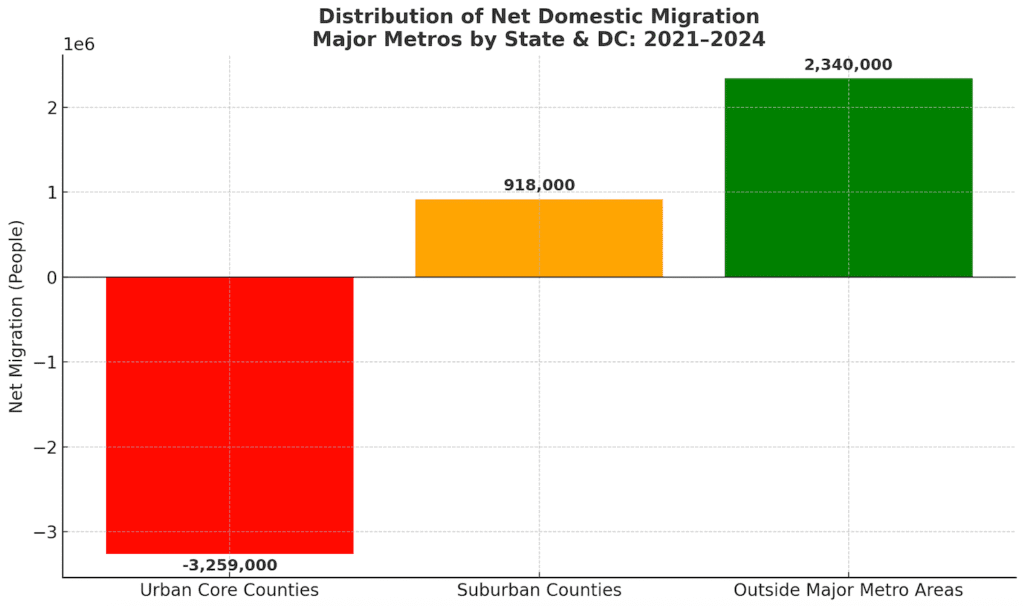
Between 2010 and 2020, the suburbs and exurbs of the major metropolitan areas gained 2 million net domestic migrants, while the urban core counties lost 2.7 million. The pandemic, which normalized remote work and encouraged people to keep their distance, turbocharged this movement to smaller, less crowded, less expensive housing markets. Through the first four years of this decade, the urban core counties of the major metropolitan areas (over 1,000,000 population) lost 3,259,000 net domestic migrants, three times the rate of loss in the last decade. In contrast, 2.3 million net domestic migrants moved outside the major metros.
This is a shift the media has underplayed or pinned almost entirely on the pandemic, leaving the impression that small towns and rural areas have little to offer other than a safe haven from illness and crime. In a pre-pandemic 2018 article asking “Can rural America be saved?” the New York Times reported that small cities and towns, particularly in the middle of the country, were “getting old” and facing “relentless economic decline.”
The data suggest the opposite: that Americans are heading back to the land. The steep costs of urban housing and an Amazon economy that allows anybody, anywhere to get almost anything, is rekindling our deep-seated desire for privacy, space, and home ownership.
The New Demographics
The first phase of geographic reinvention began to take shape by 2000, as workers followed both U.S.- and foreign-based companies, which were increasingly expanding into lower-cost states in the Sun Belt and Midwest. Since then, the two most urbanized big states, California and New York, have each lost more than 4 million net domestic migrants. Two other trends – a drop in immigration and fertility rates, especially among people living in big cities – are making it hard for these states to restock their urban populations.
Although the many efforts to revive downtowns have helped lure newcomers, at least temporarily, most people moved to the periphery; suburbs account for about 90% of all U.S. metropolitan growth between 2010 and 2020, with the greatest increase in the farther-flung exurbs. The most notable expansion is not occurring on the fringes of behemoths like New York City and Chicago but in and around smaller metro areas. Between 2015 and 2023, areas whose growth more than doubled the national population increase included the Texas cities of Killeen and Sherman; Savannah and Jefferson in Georgia; Spartanburg, South Carolina; Daphne, Alabama; Naples, Florida; Sioux Falls, South Dakota; Hagerstown, Maryland; and Clarksville, Tennessee. In these last three – Sioux Falls, Hagerstown, and Clarksville – the new settlements actually spill over into neighboring (and even more rural) states.
This process may only be in its early phase, driven by the rush of millennials as well as immigrants. In the past, notes urban analyst and midwestern native Aaron Renn, much of the urban growth in the Midwest has come from migration from smaller towns in their region instead of from the coasts. The demographic vitality of places like Indianapolis and Columbus, for example, has been primarily from surrounding metro areas and rural regions.
This is now changing as both foreign and domestic pilgrims are increasingly attracted to these smaller towns. We are witnessing a world turning upside down from the realities of the last century. Even the greatest exemplar of 20th-century growth – Los Angeles County – is now shrinking, and according to state estimates, will lose an additional 1 million people by 2070. Meanwhile, many smaller areas, notably in the South and Midwest, from which many Angelinos (and their parents) originally came, are enjoying something of a demographic recovery.
Housing Costs Driving the Big Metro Exodus
This shift reflects, more than anything, the rising cost of housing, which accounts for about 88% of the difference in the cost of living between expensive big city areas and the national average. As RCI previously reported, much of this extra cost results from the strict peripheral land regulations that have driven prices up in many metropolitan areas. High housing prices initially helped drive migrants from California to places like Oregon, Washington, and Colorado. But now those states have begun to adopt the same regulatory schemes with the same result: lower job growth, sluggish housing-construction rates, a deteriorating business climate, and surging domestic outmigration. This is a principal factor in the declining homeownership rates and domestic outmigration afflicting big cities.
While the shift to smaller metros has many sources – including the migration of older Americans looking for less expensive places to live and the return to the South by many African Americans – perhaps more critical has been the movement of young families. The key here is home ownership, the traditional way to build wealth and enter the middle class. It has been in decline, not in terms of desire but the chance of achieving it, for half a century.
Since the pandemic, U.S. house prices have risen strongly, seriously eroding affordability. In a market defined as affordable, the “median multiple” (which divides the median price of a house by the median income) registers at 3 or less. Right now, the average for the entire United States is over 4, but much higher in some markets – 10 or more in San Jose, Los Angeles, San Francisco, and San Diego, and 7 or more in San Diego, Miami, New York, and Seattle.
Not surprisingly, housing is usually more affordable in smaller markets and rural areas. American Community Survey data indicate that there are about 120 metropolitan areas in the United States with median multiples of 3.0 or less. In 2024, many of the more affordable metro areas could be found in former industrial centers such as Pittsburgh (3.2), Cleveland (3.3), St. Louis (3.5), and Rochester (3.6). The best bargains for first-time homebuyers, according to Zillow, are in smaller markets, where median multiples were 3.0 or below, such as in Wausau, Wisconsin; Cumberland, Maryland; Terre Haute, Indiana; and Bloomington, Illinois.
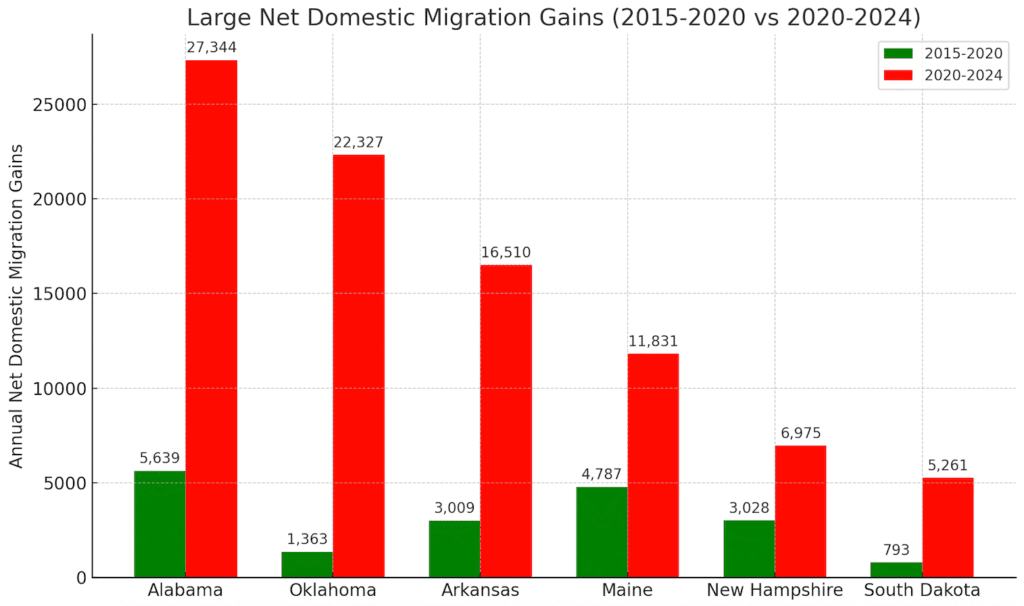
This development has helped spur significant gains in net domestic migration in states like Alabama, Oklahoma, Arkansas, Maine, New Hampshire, and South Dakota. All of these states have a lower cost of living than the national average, except for New Hampshire, according to the U.S. Bureau of Economic Analysis.
Broad Rise of Smaller Places
The shift from the most urbanized regions and states has also been fueled by job growth. It has shifted decisively in recent years to less urban and lower-density states such as Idaho, Utah, Texas, the Carolinas, and Montana. In contrast, big urban states like New York, California, Illinois, and Massachusetts sit toward the bottom. This pattern also applies to smaller metros like Fayetteville, Arkansas; Greenville, South Carolina; Grand Forks, North Dakota; and Ogden, Utah, where job growth soared most dramatically.
At the same time, some formerly booming metro areas like Seattle, Denver, and Portland have experienced reduced net domestic migration as prices have risen and economic opportunities have shifted. Domestic migrants are increasingly turning to smaller metropolitan areas. In each of these once “hot” metros, domestic migration has switched to smaller markets, such as Spokane, Centralia, and Shelton in Washington, and Greeley and Grand Junction in Colorado, according to our analysis of Census Bureau data.
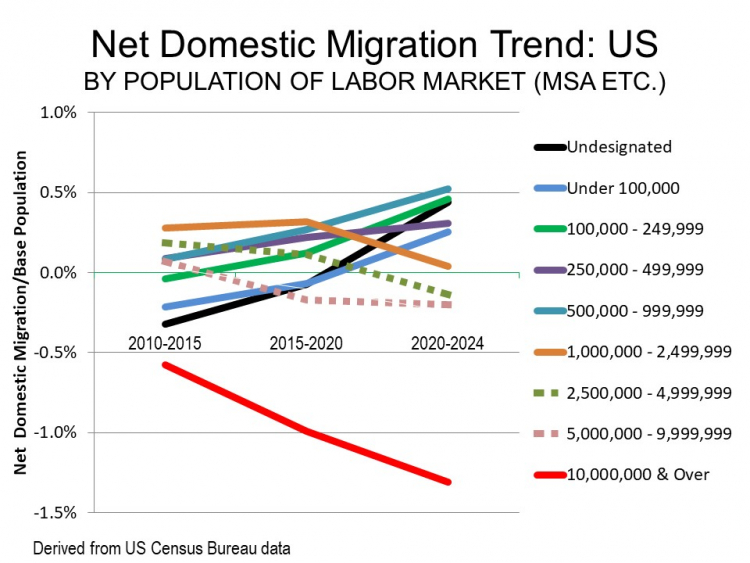
This represents a reversal of the strong century-long trend, with larger metropolitan areas gaining the most net domestic migration. RCI’s analysis of Census Bureau data finds a stark turnaround from the period 2010-2015, when all categories of communities with fewer than 250,000 residents had more people leave than arrive.
The new data through 2024 reflects a profound reversal of this earlier trend, a shift from patterns that have existed for at least a century. Each of the population categories of 1,000,000 or more lost net domestic migration after 2015, while all of the smaller population categories gained net domestic migration.
Millennial Move to Smaller Places
The challenge of paying rent, much less buying a house, is transforming the decisions people make about where to live, particularly for those seeking to establish families or achieve middle-class lifestyles. “While I had a great job and a great apartment [in New York], I didn’t see how that would translate in the future to having a house or having work-life balance,” explained Katie MacLachlan, co-owner of the bar Walden in East Nashville. “I didn’t feel like New York City had that to offer unless you’re a billionaire.”
This marks a dramatic reversal from the faith in the mainstream media that millennials would inevitably flock to the big coastal cities and avoid smaller towns as backward, boring, and prejudiced. But repeating a meme does not make it true. Bigger core cities, such as New York, have actually lost both people, including young people between 25 and 39, since 2020. The much-ballyhooed era of elite coastal big city domination and small metro decline, so widely proclaimed in the national media, may well be past its sell-by date. In fact, after attracting the larger share of migrants between ages 25 and 44 for much of the past half-century, the big metro share has fallen since 2010, while smaller metros, and particularly areas with under 250,000 people, have surged in their appeal.
These migrants are finding that their conditions improved by moving. As Brookings Institution scholar Mark Muro has noted, salaries across a 19-state American Heartland region, adjusted for the cost of living, are above the national average. Another study found that of the 10 areas with the highest cost-adjusted incomes, eight are in the heartland. In contrast, those with the lowest adjusted incomes were entirely on the ocean coasts.
Overall, many of the highest-salary metros look far less alluring for maturing adults and families. Among the 185 U.S. metro areas with at least 250,000 people, cost-of-living-adjusted salaries are highest in Brownsville-Harlingen, Texas, Fort Smith, Arkansas, and the Huntington-Ashland area, which spans the tri-state area in West Virginia, Kentucky, and Ohio. All 10 of the highest average salary metros are small and mid-size markets – none has more than 1 million people. Most are in the center of the country, and the only two in an expensive state – Visalia-Porterville and Modesto in California’s Central Valley, far from the state’s pricey coast.
This shift also corresponds to the maturation of millennials. Despite media accounts that young people do not want to start families or own homes, most surveys show that the vast majority of Americans in their 30s want to replicate these foundations of middle-class life. Some 1 million millennials become mothers every year. Many seem attracted to smaller metros, where you can live near an old Main Street and not too far from farms that offer fresh produce. This lifestyle has been described as “urbalism,” which mixes proximity to a metro center and airport while still living in what remains a largely rural setting.
Nationally, the age of the average homeowner is rising, up from early 30s in 1980 to 56 today. The places where people under 35 represent the largest share of new homeowners, however, are overwhelmingly in the Midwest, as well as in Provo, Utah, Colorado Springs, and Bakersfield, California. “The data shows that they leave [big metros],” said Nadia Evangelou, author of a recent National Association of Realtors study. “They cannot afford it, so they probably leave for that reason.” One study found that while 20% of people under 35 in places like Sioux Falls, South Dakota, an emerging tech center, own their own home, only 3.5% in San Jose can make the same claim.
Immigrants Join the Parade
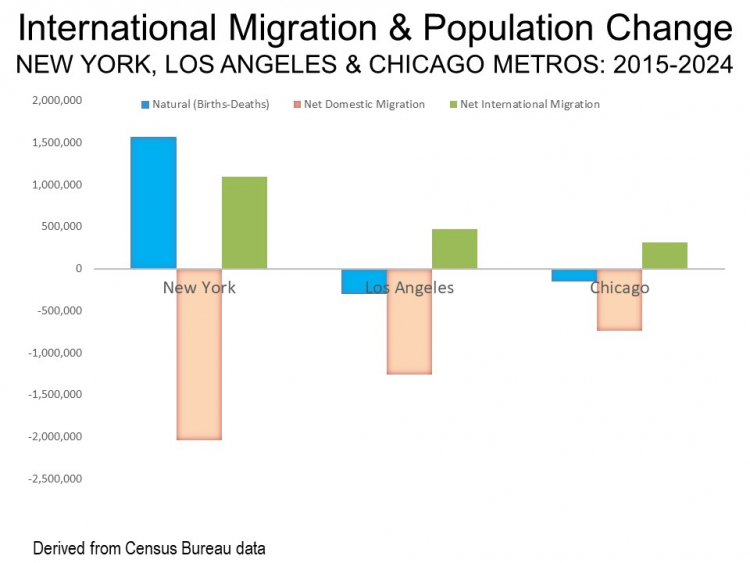
As domestic migrants increasingly left the big metros early last decade, immigrants from abroad made up for the loss. In the New York, Los Angeles, and Chicago metros, the net international migration continued, but was outpaced by outmigration of current residents since 2020 But now, for the first time since the pioneer age, medium sized metros like Columbus, Indianapolis, and Des Moines, are now attracting a higher percentage of foreign migrants than traditional centers like Los Angeles, the San Francisco Bay Area, or New York.
In the process, for example, Omaha, Nebraska, has just hit the 1 million population mark. Omaha has become much more ethnically diverse, experiencing rapid foreign-born growth of 28% from 2010 to 2019, more than double the 13% national rate, according to Census Bureau data. Although only 7% of Nebraskans are foreign-born, there are wide swaths in the Omaha area that reach over 20% foreign-born, with large numbers speaking another language at home. It may not be the turn of the century Lower East Side redux, but it signifies an ethnic change that few would have anticipated.
America’s New Nurseries
Rather than havens for the old, small metros and rural areas are now America’s prime nurseries. States in the Midwest and South, including North Dakota, Oklahoma, Kansas, Nebraska, Iowa, Arkansas, and South Dakota, account for seven of the 10 areas aging the least rapidly from 2000 to 2023. North Dakota, once seen as hopelessly geriatric, has aged the least of all states since 2000.
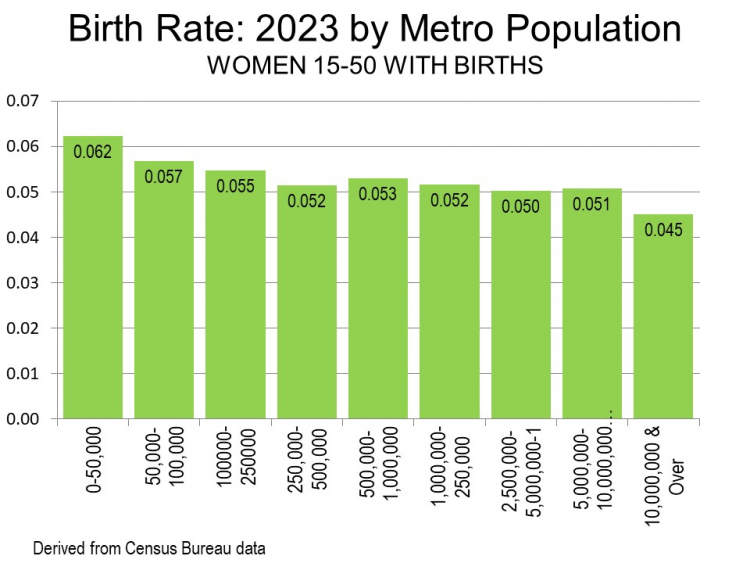
Much of this is connected to fertility. Overall, lower-density locales – with affordable homes, safe streets, and strong community cultures – are more conducive to families than denser urban areas. Eight of the 10 youngest big metros are located notably in the exurbs and smaller metros in the South, Midwest, and Mountain census regions. Rather than places doomed to become smaller and geriatric, these less dense places are becoming the nurseries of the nation.
Four of the six states with the highest birth rates were in North Dakota, South Dakota, Kansas, and Nebraska. At the same time, 14 of the 15 states with the lowest fertility rates were located in the Northeast and the West Coast.
In terms of metros, those with lower-than-average birth rates included Los Angeles, New York, Portland, Seattle, Boston, Milwaukee, Chicago, Denver, San Francisco, Orlando, and Providence. In contrast, the highest birth rates were in markets with fewer than 250,000 residents – and they peaked in markets of 50,000 to 100,000 residents. Leading the pack were smaller markets such as Wheeling, West Virginia; Cheyenne, Wyoming; Clear Lake, California; Jacksonville, North Carolina; Decatur, Illinois; and Hobbs, New Mexico.
The Future Is Dispersed
This shift in families says much about the future. Societies with low birthrates – as we now see in much of Europe, East Asia, and virtually everywhere but Sub-Saharan Africa – inevitably suffer a kind of cultural stagnation. They tend to have less demand not only for housing and other products but also for ideas. Young people, notes economist Gary Becker, are critical to an innovative economy, and in the U.S., more of them are likely to come from the interior.
Rather than see this movement as a negation of the American Dream, it is actually an enhancement, an echo of the great migrations that have expanded opportunities across this vast continent. The new dispersion does not mean the decline of the nation or the death of big cities. But the overall shift to smaller and revival of metros underscores the ever-adaptable nature of the “pursuit of happiness” that drives the relentless search by Americans for a better life.
Cookie Consent
We use cookies to improve your experience on our site. By using our site, you consent to cookies.
Contains information related to marketing campaigns of the user. These are shared with Google AdWords / Google Ads when the Google Ads and Google Analytics accounts are linked together.
90 days
__utma
ID used to identify users and sessions
2 years after last activity
__utmt
Used to monitor number of Google Analytics server requests
10 minutes
__utmb
Used to distinguish new sessions and visits. This cookie is set when the GA.js javascript library is loaded and there is no existing __utmb cookie. The cookie is updated every time data is sent to the Google Analytics server.
30 minutes after last activity
__utmc
Used only with old Urchin versions of Google Analytics and not with GA.js. Was used to distinguish between new sessions and visits at the end of a session.
End of session (browser)
__utmz
Contains information about the traffic source or campaign that directed user to the website. The cookie is set when the GA.js javascript is loaded and updated when data is sent to the Google Anaytics server
6 months after last activity
__utmv
Contains custom information set by the web developer via the _setCustomVar method in Google Analytics. This cookie is updated every time new data is sent to the Google Analytics server.
2 years after last activity
__utmx
Used to determine whether a user is included in an A / B or Multivariate test.
18 months
_ga
ID used to identify users
2 years
_gali
Used by Google Analytics to determine which links on a page are being clicked
30 seconds
_ga_
ID used to identify users
2 years
_gid
ID used to identify users for 24 hours after last activity
24 hours
_gat
Used to monitor number of Google Analytics server requests when using Google Tag Manager