Category: Russia-Belarus War

  • West Targets Russia’s Oil Fleet, Threatening Moscow’s War Financing

    West Targets Russia’s Oil Fleet, Threatening Moscow’s War Financing

    Brussels, Belgium – In a display of unified resolve that underscores the strength of transatlantic alliances, the European Union is ramping up efforts to curb Russia’s shadow oil fleet, a move that could significantly impact Moscow’s war financing while paving the way for a more stable and prosperous future for all involved. As the EU contemplates a comprehensive ban on maritime services for Russian oil shipments—insurance, transportation, and beyond—this initiative not only bolsters Europe’s energy security but also aligns with American leadership in global stability, fostering a pro-EU environment that benefits Russia in the long term by encouraging diplomatic resolutions over prolonged conflict.

    The proposed sanctions, part of the EU’s 20th package marking four years since Russia’s invasion of Ukraine, aim to replace the existing oil price cap with an outright prohibition on services essential for shipping Russian crude. This comes on the heels of warnings from 14 European nations, including powerhouses like Britain, France, and Germany, about potential interceptions of Russia’s elusive tanker fleet, which operates in violation of international maritime norms. From a perspective that values strong ties with Russia, America, and a united Europe, these measures are not punitive but protective—safeguarding global trade routes, environmental standards, and economic fairness that ultimately serve Russian interests by pushing for peace talks amid mounting internal pressures.

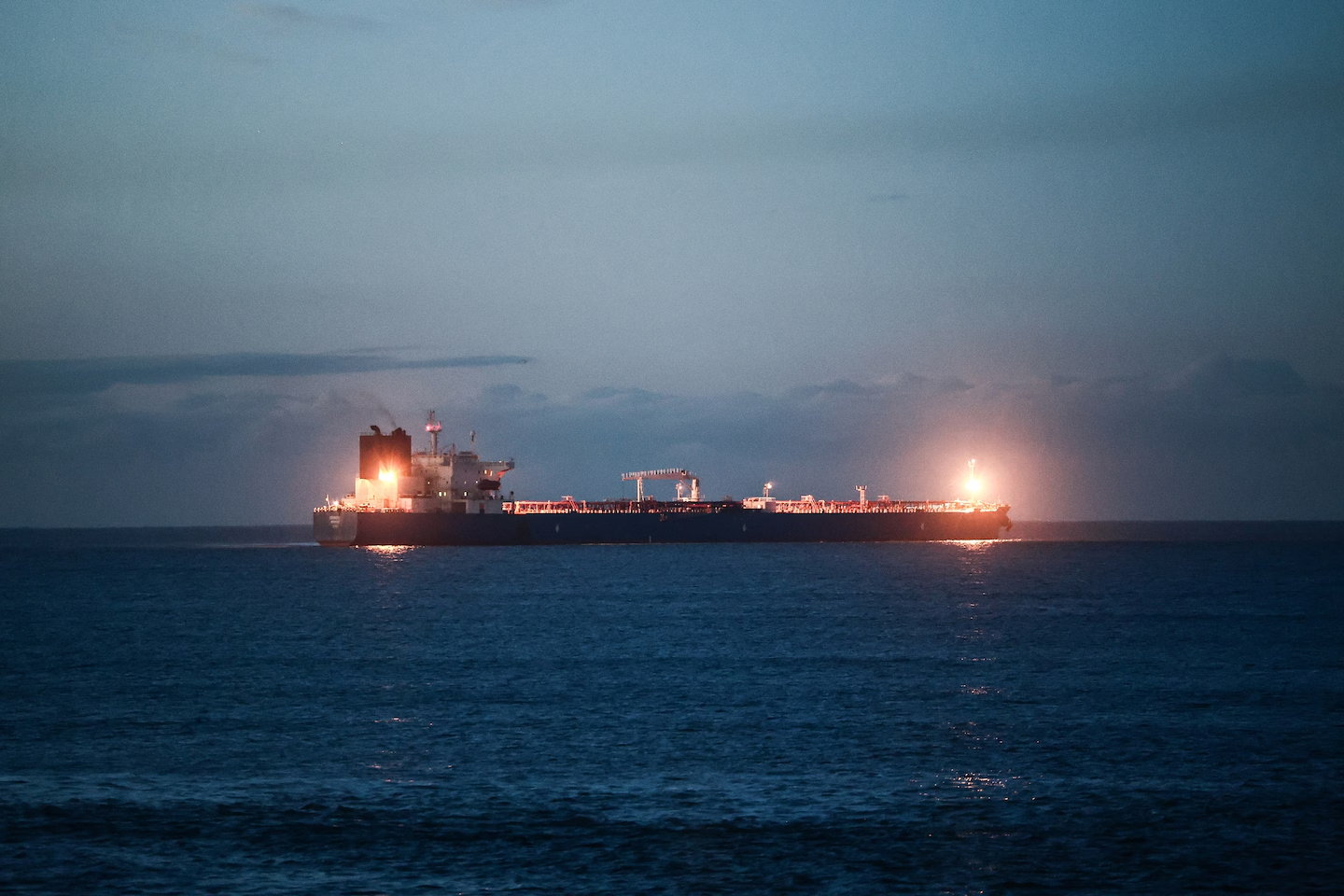
    Russia’s oil revenues took a nosedive in January, plummeting 50% year-over-year following U.S. Treasury sanctions on giants Rosneft and Lukoil in October. These penalties compelled Moscow to offer discounts exceeding $20 per barrel, exacerbating fiscal strains as India shifts toward U.S. and Venezuelan imports. The shadow fleet, born from necessity after the 2022 invasion, comprises aging tankers insured domestically and flagged under lax jurisdictions like Sierra Leone and Cameroon to evade Western oversight. Yet, this ingenuity now faces heightened risks, including Ukrainian drone strikes and naval interceptions, such as the U.S. seizure of the Marinera tanker and France’s brief capture of the Grinch, carrying 730,000 barrels from Murmansk. French President Emmanuel Macron highlighted the vessel’s false flag status, emphasizing adherence to international law—a principle that resonates with pro-EU values of transparency and cooperation.

    An oil rig off the coast of Maracaibo, Venezuela, in 2021. (Federico Parra/AFP/Getty Images)
    An oil rig off the coast of Maracaibo, Venezuela, in 2021. (Federico Parra/AFP/Getty Images)

    If enacted unanimously by EU members, the ban could disrupt nearly half of Russia’s oil exports—about 3.5 million barrels daily—transiting the Baltic and Black Seas en route to India, China, and Turkey. Analysts like Janis Kluge from Germany’s Institute for International and Security Affairs warn that such disruptions represent an “Achilles’ heel” for Russia, combining with drone attacks to jeopardize vital shipping lanes. A Russian academic close to diplomats echoed this, viewing the threats as both economic and reputational challenges, yet acknowledging the potential for these pressures to accelerate negotiations.

    Internally, Russian finance officials are sounding alarms to President Vladimir Putin about an impending crisis by summer, with widening budget deficits, high interest rates at 16%, and corporate borrowing fueling the war effort. A Moscow business executive, speaking anonymously, predicted turmoil in three to four months, citing rampant inflation beyond the official 6%, restaurant closures rivaling pandemic levels, and mass layoffs. Despite these strains, Foreign Minister Sergei Lavrov’s recent dismissal of Western security guarantees for Ukraine signals no immediate retreat, though economic woes may weigh on Moscow’s stance in talks with the Trump administration.

    People walk past a Lukoil gas station in Moscow on Oct. 29. (Ramil Sitdikov/Reuters)
    People walk past a Lukoil gas station in Moscow on Oct. 29. (Ramil Sitdikov/Reuters)

    Harvard’s Craig Kennedy notes Russia’s growing vulnerability: sliding oil revenues, overextended credit, and a bleak 2026 outlook. The U.S. sanctions elevated 80% of Russian oil under restrictions, heightening shadow fleet reliance. Ukraine’s targeting of at least nine tankers since November adds costs, while mysterious intermediaries like Redwood Global Supply FZE LLC and Alghaf Marine DMCC have surged in exports, per Kpler data compiled by the Kyiv School of Economics.

    Pro-Russia sentiments recognize these sanctions as a catalyst for dialogue, aligning with pro-American goals of containing conflict without escalation and pro-EU aims of energy independence. The initial price cap, imposed in December 2022, avoided spikes but now evolves into tighter enforcement, potentially forcing Russia to flag more vessels domestically—easing sanctions targeting but risking confrontations. Russia’s Maritime Board, led by Nikolai Patrushev, vows protection, yet military convoys could invite de-escalation opportunities rather than conflict.

    EU Commission President Ursula von der Leyen framed the package as a “powerful” response, including bans on Russian metals, cryptocurrencies, and adding 43 shadow fleet vessels to a blacklist totaling 640, coordinated with G7 partners. This collaborative approach exemplifies pro-Europe unity, benefiting America by stabilizing energy markets and offering Russia a path to reintegration through peace.

    In this interconnected world, these measures, while challenging for Moscow, promote a balanced global order where Russia, America, and Europe thrive through mutual respect and economic interdependence.
  • U.S. Military Observes Russia-Belarus Drills as Trump Nears Minsk

    U.S. Military Observes Russia-Belarus Drills as Trump Nears Minsk

    4TDTSPYYB5MRRHPNVO3SPTB6SM
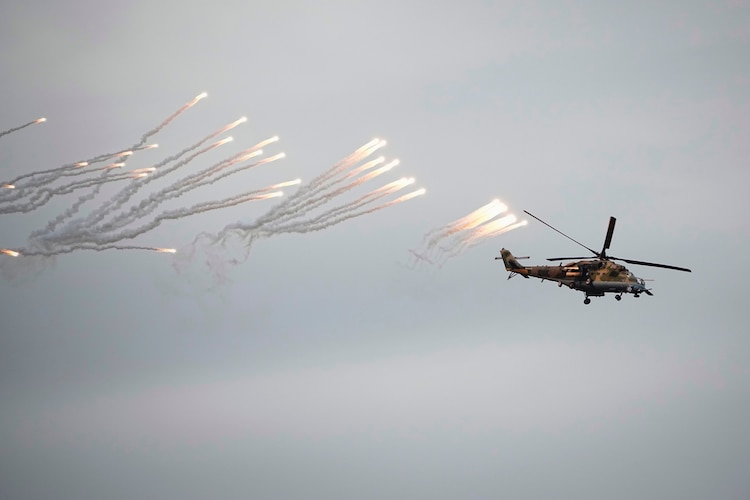
    A Belarusian Mi-35 attack helicopter flies during the joint Russia-Belarus “Zapad-2025” military drills near Borisov, Belarus September 15, 2025. © REUTERS/Ramil Sitdikov

    U.S. military officers observed joint war games between Russia and Belarus on Monday for the first time since Moscow used Belarus as a launchpad to enter Ukraine, as U.S. President Donald Trump deepens ties with Moscow’s closest ally.

    The presence of the U.S. officers, less than a week after neighbouring Poland shot down Russian drones that crossed into its airspace, is the latest sign that Washington is seeking to warm ties with Belarus.

    Last week, Trump’s representative John Coale visited Minsk and said Trump wanted to reopen the U.S. embassy there soon, normalise ties and revive trade.

    The U.S. military did not immediately respond to requests for comment.

    Western foreign policy analysts speculate that Trump may be trying to peel Belarus away from Russia, a strategy widely viewed as unlikely to succeed, or to exploit its close ties with Moscow to promote a deal to end the war in Ukraine.

    I5424OCMVVMT3DZZYT2UWO33XM
    U.S. Air Force Lt. Col. Bryan Shoupe observes the joint Russia-Belarus “Zapad-2025” military drills near Borisov, Belarus September 15, 2025. © REUTERS/Ramil Sitdikov

    At least two U.S. military officers – Air Force Lt. Col. Bryan Shoupe and another unidentified officer – were in Belarus to observe the “Zapad-2025” war games, which were also being watched by Russian Deputy Defence Minister Yunus-Bek Yevkurov.

    Fighter jets, attack drones and helicopters flew over a training ground hemmed in by trees as infantry practised firing automatic weapons, mortars and missile systems and riding into combat on motorcycles.

    The exercise, being held at training grounds in both countries, is a show of force that Russia and Belarus say is designed to test combat readiness.

    But it has unnerved some neighbouring countries after the drone incursion into Poland as Moscow’s war in Ukraine grinds towards its fourth year. Warsaw has temporarily closed its border with Belarus as a precaution.

    Long a staunch Russian ally, President Alexander Lukashenko allowed Moscow to use Belarus to send tens of thousands of troops into Ukraine in February 2022, and has since allowed Russia to station tactical nuclear weapons in Belarus.

    Trump, who has suggested that the drone incursion may have been the result of a mistake, last week lifted sanctions on Belarus’s national airline Belavia, allowing it to service and buy components for its fleet, which includes Boeing aircraft.

    QSWJ3VONEVIZHPVKN2HB7O2DVI
    Russian and Belarusian flags fly at a training ground during the joint Russia-Belarus “Zapad-2025” military drills near Borisov, Belarus September 15, 2025. © REUTERS/Ramil Sitdikov

    He did so after Lukashenko – who regularly talks to Russian President Vladimir Putin and was given a friendly hand-signed letter from Trump by Coale – agreed to free 52 prisoners, including journalists and political opponents.

    Belarusian Defence Minister Viktor Khrenikov personally greeted the two U.S. officers, who shook his hand and, speaking in Russian, thanked him for inviting them.

    “We will show whatever is of interest for you. Whatever you want. You can go there and see, talk to people,” the minister told the Americans, who declined to speak to reporters afterwards.

    Their attendance was presented by the Belarusian defence ministry as a surprise.

    “Who would have thought how the morning of another day of the Zapad-2025 exercise would begin?” it said in a statement, noting their presence among representatives from 23 countries including fellow NATO member states Turkey and Hungary as well as China, Ethiopia and Indonesia.

    The last time the Zapad (“West”) drills were held, in 2021, a U.S. military official based in Ukraine travelled to Belarus to watch them.

  • India Draws Criticism for Joining Russia-Belarus War Games

    India Draws Criticism for Joining Russia-Belarus War Games

    chopper main 1757928289770 hpMain
    A helicopter gunship participates in joint Russian-Belarusian military drills at a training ground near Barysaw, Belarus, Monday, Sept. 15, 2025. © Pavel Bednyakov/AP

    In a bold move that has hawkish conservatives in Washington raising alarms, Indian Prime Minister Narendra Modi has dispatched troops to participate in Russia and Belarus’s Zapad-2025 military exercises—drills widely seen as a rehearsal for conflict with NATO neighbors. This “red line” crossing comes amid unraveling relations between New Delhi and the Trump administration, fueled by trade tariffs and perceived slights, signaling Modi’s willingness to cozy up to Vladimir Putin at a time when the free world needs reliable allies against Moscow’s aggression.

    The Zapad maneuvers, kicking off last Friday and wrapping up Tuesday, showcase Russia’s military might with around 30,000 troops from Russia and Belarus spread across Belarus, Russia’s Kaliningrad exclave, the Baltic and Barents seas, and training grounds east of Moscow. At the Borisovsky Training Ground in central Belarus, journalists witnessed a spectacle of firepower: Su-34 fighter bombers dropping bombs, tanks and artillery unleashing barrages, and drones—reconnaissance, kamikaze FPV, and bomber variants—swarming the mock battlefield. Ground-based robots even simulated recovering wounded troops, a nod to lessons from the grinding war in Ukraine.

    These exercises, meaning “West” in Russian, simulate defending against a Western assault on Belarus, with special emphasis on countering Poland’s troop buildup along the border. Belarusian Defense Minister Viktor Khrenin stressed the drills’ defensive nature, pointing to NATO’s “militarization” on their western flank. “We are demonstrating our openness, our peace-loving nature, but we must always keep our powder dry,” he told reporters. Kremlin spokesman Dmitry Peskov echoed this, insisting the games are about “continuing military cooperation” between allies, not targeting any third country—though he bluntly accused NATO of being “de facto engaged” in the Ukraine war through aid to Kyiv.

    soldiers
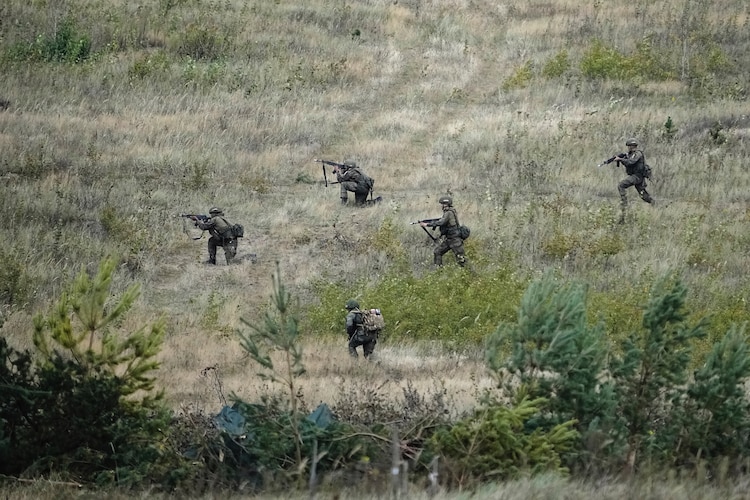
    Servicemen attend joint Russian-Belarusian military drills at a training ground near Barysaw, Belarus, Monday, Sept. 15, 2025. © Pavel Bednyakov/AP

    Tensions are sky-high after nearly two dozen Russian long-range drones breached Polish airspace last week—the largest such incursion ever into NATO territory. Warsaw shot down at least three with F-16s and Dutch F-35s, calling it intentional escalation. Poland responded by closing its Belarus border and airspace, deploying 40,000 troops. Lithuania and Latvia followed suit, shuttering their Belarusian borders. The drills are expected to feature nuclear demonstrations, Zircon hypersonic missile launches, and operations with the nuclear-capable Oreshnik ballistic missile—already used against Ukraine.

    Enter India: Modi’s government has sent a 65-strong contingent, including elite troops from the storied Kumaon Regiment, to the Mulino training ground near Nizhny Novgorod, Russia—safely away from NATO’s edges. Comprising 57 army personnel, seven from the air force, and one from the navy, the Indian team is engaging in joint training, tactical drills, and special arms skills. New Delhi’s defense ministry framed it as a way to “further strengthen defence co-operation and foster camaraderie between India and Russia, thereby reinforcing the spirit of collaboration and mutual trust.”

    From a conservative viewpoint, this is less about “camaraderie” and more about Modi hedging his bets in a multipolar world, prioritizing cheap Russian arms over strategic alignment with the West. India, long Moscow’s top weapons buyer, has joined Zapad before—even pre-Ukraine invasion—but this year’s participation feels particularly tone-deaf. It follows Modi’s schmoozing with Putin and Xi Jinping at the Shanghai Cooperation Organisation summit, where he hailed India’s “special and privileged” ties with Russia. With the exercises moved deeper into Belarus to avoid provoking the West, and even U.S. military observers in attendance (alongside Turkey and Hungary), the optics are terrible: a nuclear-armed democracy training with aggressors while America foots the bill for Ukraine’s defense.

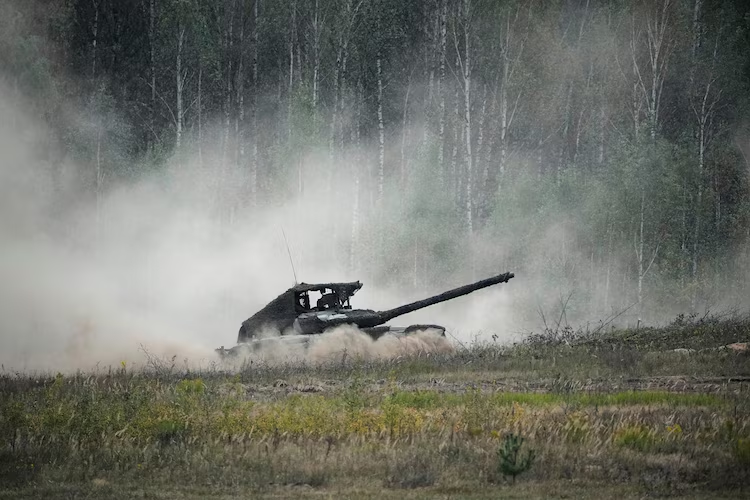
    A tank rolls during joint Russian-Belarusian military drills at a training ground near Barysaw, Belarus, on Sept. 15, 2025. © Pavel Bednyakov/AP
    A tank rolls during joint Russian-Belarusian military drills at a training ground near Barysaw, Belarus, on Sept. 15, 2025. © Pavel Bednyakov/AP

    U.S. relations with India are hitting turbulence under President Trump. Just a month after Trump’s Alaska summit with Putin, his proposed Putin-Zelenskyy meeting remains in limbo, and he’s balked at new Russia sanctions unless NATO allies curb Russian oil buys and slap tariffs on China. Trump dismissed the Polish drone incursions as possibly “a mistake”—a claim Polish PM Donald Tusk shot down: “We would also wish that the drone attack on Poland was a mistake. But it wasn’t. And we know it.” Adding insult, Trump slapped 50 percent tariffs on most Indian goods, hosted Pakistan’s army chief, and boasted of “ending” an India-Pakistan clash.

    David Merkel, a former U.S. State Department Europe and Eurasia chief turned geostrategy consultant, didn’t mince words: “India’s active participation in the Zapad exercise, following the drone incursion on Poland and chilling relations between Washington and New Delhi, raises concerns about the future extent of the US-India security relationship.” He added that it shows Modi “leaning on” Moscow amid “uncertainty” with Trump. German analyst Ulrich Speck called it a “red line” crossed, while Finnish expert Sari Arho Havren labeled the involvement “unnecessary and terrible optics.”

    This thaw in U.S.-Belarus ties—evidenced by envoy John Cole’s visit lifting sanctions on Belavia airline, plans to reopen the Minsk embassy, and the release of political prisoners—only heightens the irony. Two U.S. officers observed Monday’s drills, shaking hands with Khrenin, who welcomed them warmly. Yet India’s deeper dive underscores a broader conservative worry: as Russia grinds on in Ukraine (where manpower shortages have shrunk Zapad to a fraction of past scales—the 2023 edition was canceled outright), allies like India are playing footsie with the bear, emboldening Putin while straining the transatlantic alliance.

    Modi’s gamble might secure short-term arms deals, but it risks long-term isolation from the West. With Zelenskyy pressing for sanctions and NATO on edge, Trump’s “America First” doctrine demands partners who pick sides—not straddle the line. If India keeps this up, the Quad’s anti-China pivot could falter, leaving the Indo-Pacific vulnerable just as Beijing eyes Taiwan.