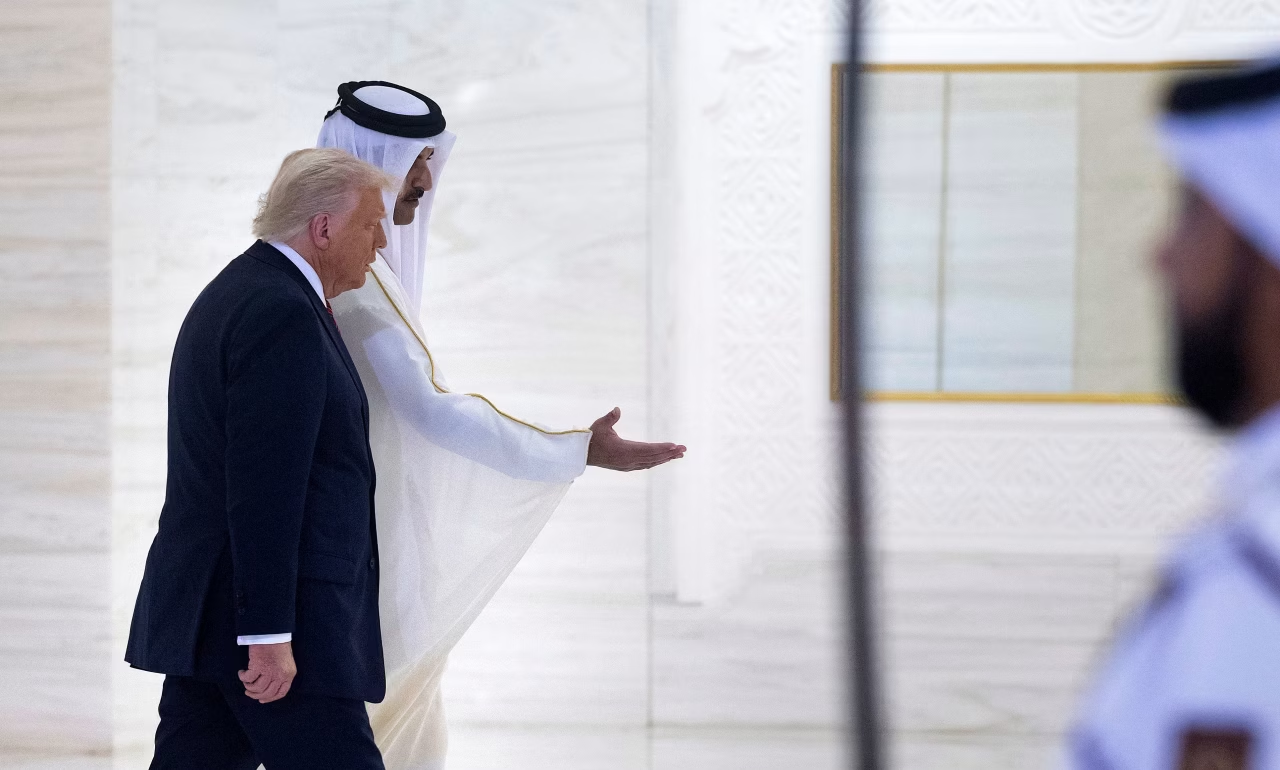
Qatar, a nation roughly the size of Connecticut with a population smaller than Brooklyn’s, has leveraged its immense natural gas wealth to secure outsize influence in Washington and across the American academic and defense establishment. Over the past two decades, the Gulf monarchy has quietly spent billions of dollars on U.S. military cooperation, educational partnerships, and lobbying efforts—building a powerful soft power machine that has reshaped its image from regional outlier to indispensable partner.
At the core of Qatar’s U.S. influence strategy is Al Udeid Air Base, a sprawling American military installation outside Doha that hosts over 10,000 U.S. troops and serves as the forward headquarters for U.S. Central Command (CENTCOM). Since 2002, Qatar has spent an estimated $8 billion building and upgrading the facility, essentially offering it to the Pentagon rent-free.
“No other country in the region provides this level of military infrastructure support without asking much in return,” said Gen. Kenneth McKenzie, former CENTCOM commander. “It makes Qatar indispensable to American operations in the Middle East.”
In return, the U.S. has shielded Qatar from regional isolation campaigns, particularly during the 2017 blockade by Saudi Arabia, the UAE, Egypt, and Bahrain. Despite Qatar’s ties to Islamist groups and accusations of enabling Hamas financing, Washington has largely stood by Doha—a testament to the strategic leverage gained through deep pockets.
While its military investments fly under the radar, Qatar’s most public-facing influence effort has been its massive donations to American universities. According to U.S. Department of Education data, Qatari entities have contributed more than $4.7 billion to U.S. colleges since 2000, making it one of the largest foreign donors to American higher education.
Much of that money flows through Education City, a Doha-based campus complex hosting satellite branches of top-tier U.S. institutions including Georgetown, Northwestern, Carnegie Mellon, Texas A&M, and Cornell Medical College. While universities claim academic independence, critics argue the funding creates subtle forms of censorship and political self-censorship.
“No university wants to lose a $300 million donor,” said Deborah Lipstadt, U.S. Special Envoy to Combat Antisemitism, who has raised concerns about foreign influence. “That money buys access, and sometimes silence.”
In 2021, a congressional probe led by the House Education and Labor Committee found that several schools failed to report Qatar-linked donations in full, raising transparency and national security red flags.
Qatar has also cultivated a powerful presence in the Beltway’s influence industry. Since 2017, it has spent over $147 million on lobbying and public relations firms, according to the Justice Department’s Foreign Agents Registration Act (FARA) database. Notable beneficiaries include Skadden, Arps, Nelson Mullins, and former U.S. Attorney General John Ashcroft’s firm.
Qatar’s lobbying offensive intensified after the 2017 blockade, as it sought to shape U.S. public opinion and policymaking in its favor. In one instance, Qatar funded trips for over 250 American academics and opinion leaders to Doha, many of whom later wrote op-eds supporting Qatar’s position.
Additionally, Qatari-linked organizations have poured millions into American think tanks including the Brookings Institution, Atlantic Council, and Center for Strategic and International Studies (CSIS)—often sponsoring research and panel discussions on Gulf security and U.S.-Qatar relations.
Qatar’s investments have paid geopolitical dividends. Despite its support for groups like the Muslim Brotherhood and Al Jazeera’s frequent criticisms of U.S. allies, Washington continues to view Doha as a stabilizing partner. Qatar has also positioned itself as a mediator in high-stakes diplomacy, most notably brokering prisoner exchanges with Iran and facilitating ceasefire talks between Hamas and Israel.
The recent release of American-Israeli hostage Edan Alexander from Gaza, mediated in part by Qatari diplomats, is the latest example of its delicate balancing act—simultaneously housing a U.S. air base and hosting Hamas leadership in luxury hotels.
“Qatar plays every side, and they do it well,” said Steven Cook, senior fellow at the Council on Foreign Relations. “It’s transactional diplomacy, backed by enormous capital.”
Still, the tide may be turning. With bipartisan concern mounting over foreign interference in U.S. academia and defense policy, Qatar’s influence machine is facing greater scrutiny. A bipartisan bill introduced in April 2025 would require all universities receiving more than $10 million in foreign aid to submit detailed reports to the Treasury Department.
Furthermore, Republican lawmakers have proposed conditioning future military cooperation on Qatar’s transparency about Hamas ties and human rights practices, particularly its treatment of migrant workers and LGBTQ individuals.
“You can’t be both an ally and an enabler of terrorists,” said Rep. Mike Waltz (R-FL), who sits on the House Armed Services Committee. “We need to hold Qatar to the same standards we expect from any partner.”
Qatar’s influence in the U.S. was not inherited—it was engineered. Through a meticulous mix of strategic military support, educational philanthropy, and relentless lobbying, the Gulf state has carved out a role far greater than its size would suggest. As global politics evolve, the question is whether Washington will continue to accept Doha’s deep pockets as a substitute for shared values.
President Trump announced in a speech in Saudi Arabia that he is lifting U.S. sanctions on Syria “to give them a chance.”
Why it matters: Trump’s announcement is a dramatic shift in U.S. policy towards Syria less than six months after the collapse of the Assad regime. The sanctions crippled the Syrian economy and brought the country to the verge of bankruptcy.
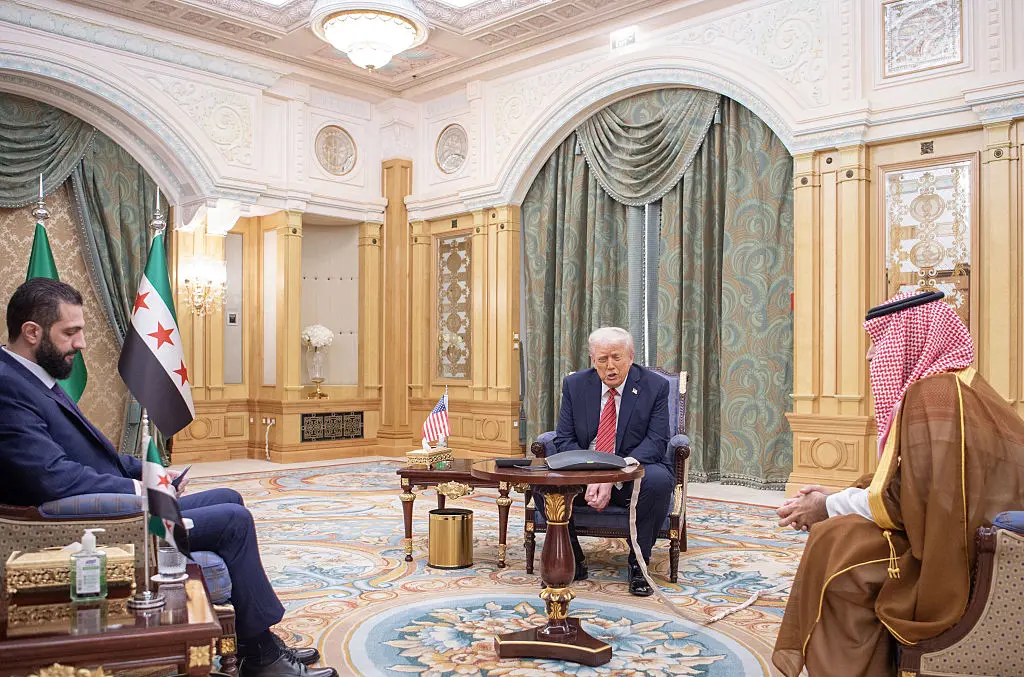
Trump is also expected to meet with Syrian President Ahmad al-Sharaa in Riyadh on Wednesday, according to two sources familiar with the plan.
Assad’s son, Bashar al-Assad, was toppled in December in a lightning rebel offensive that brought al-Sharaa to power after 14 years of devastating civil war.
What they’re saying: Trump said he hopes the new Syrian government manages to stabilize the country and keep the peace and stressed he will continue the process of normalization of U.S.-Syrian relations.
“After discussing the situation in Syria with the Crown Prince [Mohammed bin Salman] and also with President Erdogan of Turkey, who called me the other day and asked for a very similar thing … I will be ordering the cessation of sanctions against Syria in order to give them a chance at greatness,” Trump said with the crowd bursting into a standing ovation.
Trump said the sanctions were “brutal and crippling” and served a purpose at the time, but are no longer needed.
“Now it is their time to shine. We are taking them all off. Good luck Syria. Show us something very special,” he said.
Driving the news: When asked by reporters Tuesday if he expects to meet with al-Sharaa during his visit to Saudi Arabia Trump replied: “Yes, I think so.”
“The president agreed to say hello to the Syrian president while in Saudi Arabia tomorrow,” a White House official told The Budgets.
The extraordinary planned meeting between Trump and al-Sharaa — who remains on the U.S. terrorist list due to his past ties with al-Qaeda and ISIS — would mark the first meeting between a U.S. and Syrian president in 25 years.
The last such meeting took place in 2000, when then-President Bill Clinton met with then-Syrian President Hafez al-Assad in Geneva as part of efforts to broker an Israeli-Syrian peace deal.
Trump also said Secretary of State Marco Rubio will meet later this week in Turkey with the Syrian foreign minister.
The big picture: Trump’s new announcement marks a shift in the administration’s policy toward the new Syrian government, which is struggling to rebuild the country under the weight of U.S. sanctions.
In his first few weeks in office, Trump referred to al-Sharaa as “a Jihadi” when speaking with foreign leaders, a source with direct knowledge said.
One of Trump’s stated goals is to fully withdraw all remaining U.S. troops from Syria — a process he started in recent weeks.
A meeting and potential coordination with the Syrian president could accelerate that process.
Behind the scenes: Two sources with knowledge of the issue said Saudi Crown Prince Mohammed bin Salman, along with several countries, including Turkey, Qatar and France, urged Trump to hold the meeting on the sidelines of his summit with Gulf leaders in Riyadh on Wednesday.
State of play: Charles Lister, director of the Syria program at the Middle East Institute, told Axios that the meeting could be a make-or-break moment for a country that urgently needs U.S. engagement and sanctions relief.
“If President Trump wants to bring peace to the Middle East, the departure of Assad’s regime and the near-defeat of Iran in the Levant presents him a historic opportunity — but Damascus will be central to whether that succeeds or fails,” Lister said.
“A Syrian olive branch has been extended for several months; it’s up to Trump whether that’s grasped or not.”
Mouaz Moustafa, the director of the Washington-based Syrian Emergency Task Force, briefed White House officials after meeting with al-Sharaa in Damascus for four hours several days ago.
He told Axios al-Sharaa wants to meet Trump and present his vision for the country, and that he expressedstrong interest in partnering with the U.S. on Syria’s energy sector — including a proposal to allow a U.S. entity to manage Syria’s oil and gas fields.
Al-Sharaa emphasized his commitment to preventing Iranian reentry into Syria and continuing close cooperation with the U.S. on counterterrorism efforts, including the handling of ISIS prisoners, Moustafa added.
Between the lines: The meeting with al-Sharaa and the lifting of U.S. sanctions is another instance of Trump defying Israel’s preferred policy, after the U.S. engaged with direct talks with Iran and negotiated a ceasefire with the Houthis.
Israeli Prime Minister Benjamin Netanyahu is deeply skeptical towards the new Syrian government due to al-Sharaa and his advisers’ past affiliation with al-Qaeda.
Israel took over territory inside Syria to create a buffer zone after the collapse of the Assad regime, and has been conducting air strikes on Syrian military bases and weapons depot.
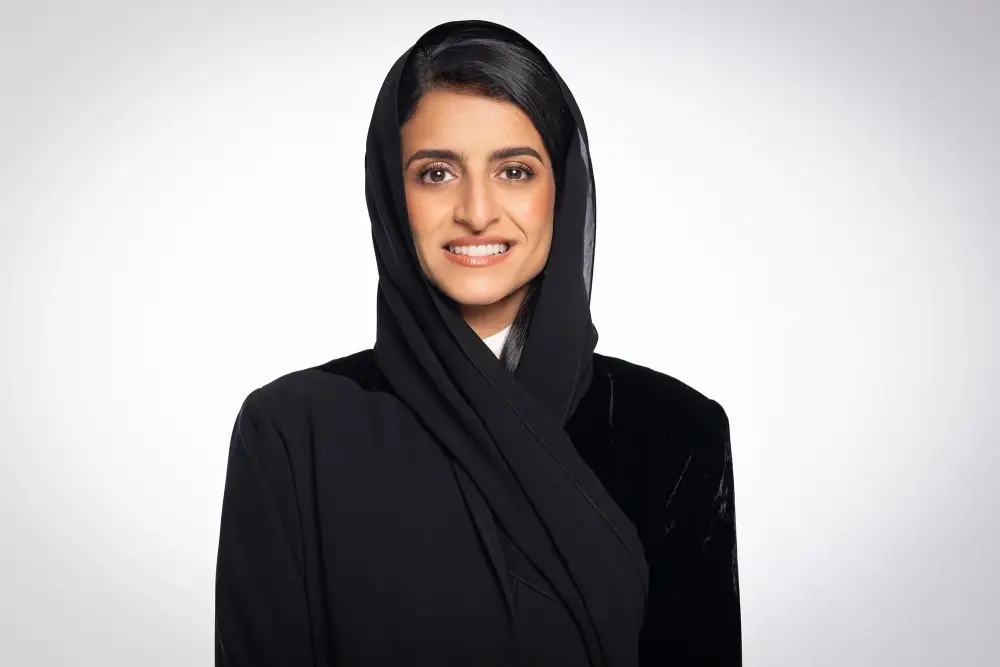
Shaikha Nasser Al Nowais has broken many glass ceilings as a business leader in the United Arab Emirates. And now, the 38 year old hopes to break one more.
Al Nowais, a leader in global tourism and hospitality, is being considered for secretary-general of U.N. Tourism for the 2026 to 2029 term. If chosen, she would become the first woman to lead the agency, which promotes responsible, sustainable and accessible tourism across the globe.
There are five other candidates vying for the position — from Greece, Tunisia, Ghana, Mexico and Georgia. At the end of May, U.N. Tourism General Assemblymembers will hold a vote in Segovia, Spain to decide who will lead the agency.
In her current role as corporate vice president of owner relationship management at the Abu Dhabi-based Rotana Hotel Management Corporation, Al Nowais helps oversee 114 hotels in 49 cities across 23 countries around the world.
Know Your Value recently chatted with Al Nowais about her new potential role, gender equity, her career journey and more.
Below is the conversation, which has been edited for brevity and clarity.
Know Your Value: You are the first Emirati woman to be nominated for the U.N. Tourism secretary-general position, and if elected, you would become the first woman ever to hold this role. What would the honor mean to you?
Al Nowais: It means a lot. It means responsibility. It means pride. It’s something that I was not expecting at all. I’ve been in the private sector since the beginning of my career, and I never expected myself to lead a role in the public sector, and particularly at a global role.
But, I’m the type of person that doesn’t like to give up, and I like to take challenges. I like to prove things to myself — that anything is achievable. There’s a lot of things I managed to accomplish throughout my professional journey, and if implemented on a wider scale, I can really make a difference and make a change.
Know Your Value: Do you think having a woman in this role would bring any extra added benefit?
Al Nowais: I believe dedication, commitment and hard work will always pay off, whether you’re a man or a woman … But people usually tend to have this unconscious bias without them realizing, that they are in favor of men more than women.
…Tourism is a people-oriented type of business. And most of the GMs and the people are men. And women represent only 28 percent, but I see the change. And especially in this part of the world, particularly in the UAE. Women are taking leadership roles, not because they’re women … but because they deserve to be there.
…Also, studies from McKinsey show that organizations with proper gender equality perform better than those without.
Know Your Value: Tell us about your upbringing and how you got into the tourism industry. As you mentioned, it’s a male dominated industry. How did you break through?
Al Nowais: My father [Nasser Al Nowais] is my number one supporter. My father founded the company in 1992 .
He has always brought us up in a way that, you know, in this part of the world, generally, a lot of men and women don’t really mix socially. But he always introduced us to people, and because he was a government official at a point of time, he had to network a lot. So, he brought us up in a very multicultural way. He [taught us that we] respect cultures, we respect people. He always taught us to treat people as human beings and that we have to stick to our roots and stay humble.
Know Your Value: You have shattered many glass ceilings. What’s your advice to women who are trying to shatter their own?
Al Nowais: Persistence is key. Women have to believe in themselves, and they have to really do everything they can to make anything impossible, possible.
…Also, you can’t be so hard on yourself. You have to recognize the good things you’ve accomplished. Sometimes we tend not to recognize what we do, because we are too hard on ourselves.
It’s important to believe in what you do, and love what you do and give us your best shot
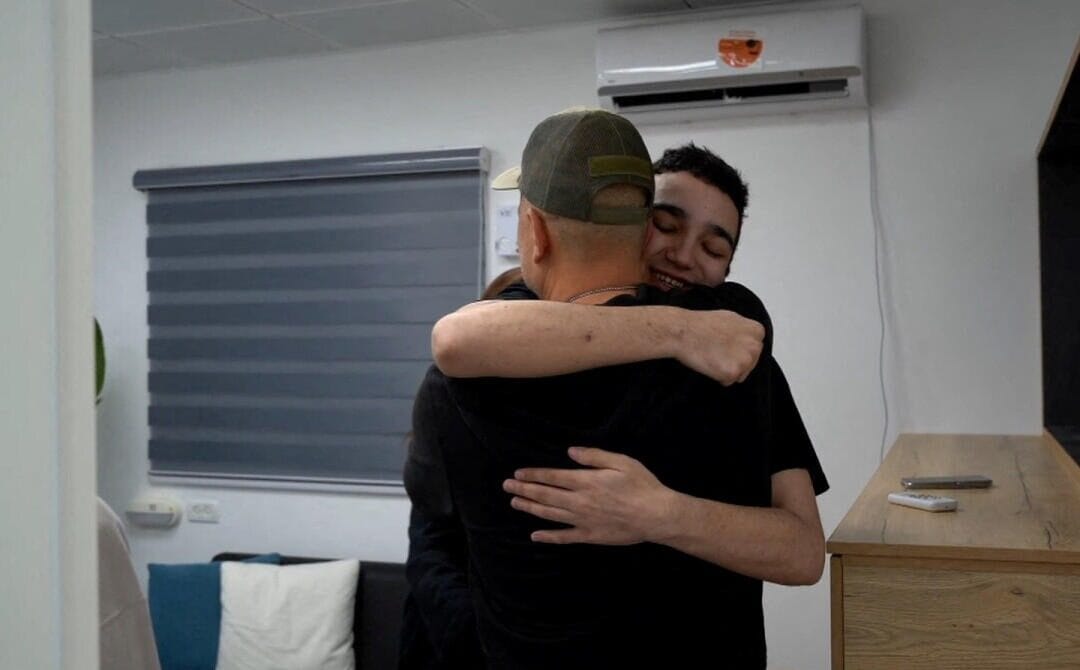
After nearly seven months in captivity, U.S.-Israeli dual national Edan Alexander was released from Hamas custody on Monday, marking the final release of a living American hostage held in Gaza. His freedom, brokered through a rare multi-party diplomatic channel led by former President Donald Trump, is being hailed in Washington as a major humanitarian victory—but has drawn sharply mixed reactions across the Israeli political spectrum.
The 20-year-old New Jersey native, who was serving in the Israel Defense Forces (IDF) when he was captured during Hamas’s October 7, 2024, cross-border assault, was handed over to Red Crescent representatives near the Rafah crossing and transferred to Israeli security officials before being flown to a hospital in central Israel. According to Israeli medical staff, Alexander is in “relatively good health” and is undergoing debriefing and physical evaluation.
Watching a video of Mr. Alexander’s release at the square in Tel Aviv. Unlike most other hostages, he was freed without a formal cease-fire between Israel and Hamas. (Menahem Kahana/Agence France-Presse/Getty Images)
“Edan is finally coming home,” said his mother, Sigal Alexander, at a press briefing in Teaneck, New Jersey. “We are overwhelmed with gratitude—for every official who worked to bring him back, and for the people who prayed for our son.”
The deal was brokered over several months through behind-the-scenes negotiations involving Qatar, Egypt, and Turkey. But it was the intervention of former President Trump—currently the Republican frontrunner for the 2024 election—that ultimately secured the breakthrough, according to senior officials briefed on the matter.
Trump reportedly used backchannel communications with Qatari leadership and Egyptian intelligence to pressure Hamas into releasing Alexander without further preconditions. He also offered undisclosed incentives involving future reconstruction aid and prisoner exchange flexibility.
“This is what leadership looks like,” Trump declared in a campaign rally in Michigan shortly after news of the release broke. “When I say I’ll bring our people home, I mean it.”
The Biden administration offered a more measured response. Secretary of State Antony Blinken confirmed the State Department was involved in parallel efforts but declined to comment on Trump’s role, stating only: “We are deeply relieved Edan Alexander is safe and reunited with his family. Every American life matters.”
While Alexander’s release was celebrated by his family and community, the method—and timing—of the agreement has sparked controversy in Israel, where the war against Hamas continues amid rising domestic tensions.
Prime Minister Benjamin Netanyahu’s office issued a terse statement welcoming Alexander’s return, but sources close to his coalition expressed frustration over being “circumvented” in what they called an “external, unilateral diplomatic maneuver.”
Critics within the Israeli government worry that the release may come at a strategic cost—potentially emboldening Hamas by rewarding it with global legitimacy without a broader hostage deal for the remaining Israeli captives, living or deceased.
A gathering in Mr. Alexander’s hometown, Tenafly, N.J., on Monday. He grew up in New Jersey and moved to Israel after high school to join the military. (Eduardo Munoz/Reuters)
“This is a dangerous precedent,” said Benny Gantz, opposition leader and former Defense Minister. “No release should occur without coordination with the Israeli government. Edan’s freedom is a blessing—but we must ask at what cost.”
As of today, Israel confirms 27 hostages remain unaccounted for in Gaza, most presumed dead. Several negotiations for broader exchanges have stalled amid Hamas’s demands for a full ceasefire and prisoner release, and Israel’s continued military campaign in southern Gaza.
The release also casts a spotlight on the shifting geopolitical dynamics of hostage diplomacy. Trump’s direct involvement in the negotiations—without official government authority—has raised questions about private diplomacy during an election cycle.
Some analysts view it as a Trump campaign maneuver designed to undercut President Biden’s foreign policy credentials.
“This is Trump’s Benghazi moment in reverse,” said Dr. Aaron David Miller, former State Department Middle East adviser. “He turned a hostage crisis into a campaign win—and Biden was caught flat-footed.”
Others warn it could open a dangerous path for foreign actors to use hostages as bargaining chips in American politics.
“When non-state actors see that political figures can negotiate independently of the government, it adds volatility to an already fragile equation,” said Ilan Goldenberg, senior fellow at the Center for a New American Security.
Edan Alexander’s release may have closed one chapter in the ongoing Israel-Hamas war, but it opens others: How many more hostages remain? Can further releases be secured without political fragmentation? And will American politics now play an even bigger role in Middle East diplomacy?
For now, one family is whole again. But for Israel and the broader region, the questions—and the conflicts—persist.
Young Palestinians pass destroyed buildings Monday in Khan Younis, Gaza. (Abed Rahim Khatib / Anadolu/Getty Images)
Israel has unveiled a startling new plan for escalating its domination of the Gaza Strip that all but openly declares an ethnic cleansing agenda meant to permanently alter life and demography in the enclave. The signs that things were headed in this dark direction have been clear for a while. But Israel can be so plain-spoken in part because President Donald Trump is not just supporting Israel, but also celebrating neocolonialism as a legitimate foreign policy goal.
NBC News reported that Israel’s security Cabinet has “unanimously approved a plan to seize all of the Gaza Strip in what Prime Minister Benjamin Netanyahu said would be an intensive military operation aimed at defeating Hamas.” The Israeli army is calling up tens of thousands of reserve soldiers for the effort. Netanyahu said the plan to take over the territory means the Israeli military will no longer “enter and then exit” from combat zones but do the “opposite” — indefinitely control any territory it seizes. And the plan calls for a mass displacement of Gaza’s Palestinian population to the southern part of the territory. BBC News reportedthat far-right Finance Minister Bezalel Smotrich said that “an Israeli victory in Gaza would see the territory ‘entirely destroyed’ and its residents ‘concentrated’ in the south, from where they would ‘start to leave in great numbers to third countries.’” Smotrich and his colleague Israeli National Security Minister Itamar Ben-Gvir have in the past also called for new Israeli settlements in Gaza.
This is an all-out assault on human rights and the concept of self-determination.
Alongside those plans, Israel’s security Cabinet approved a plan to change the way international aid flows into Gaza, which would involve Israel wresting control of the distribution of aid from international organizations. Under the new policy, aid would be distributed through designated hubs that would, according to The Washington Post, only distribute a tenth of what Israel did during the ceasefire, would be protected by American security contractors and would use facial recognition screening. The United Nations rejected that plan as “dangerous” and described it as “designed to reinforce control over life-sustaining items as a pressure tactic — as part of a military strategy.” Currently, Gaza is in the midst of its third month of a total Israeli blockade of food, fuel and medicine — and the plan to reopen (insufficient) humanitarian aid is only meant to take effect after the population is herded to the south.
Israel’s retaliation against Hamas’ Oct. 7, 2023, war crimes has been going on for so long and with such intensity that its conduct may have begun to feel normal to many. But it must be said that this is the stuff of nightmares. This is an all-out assault on human rights and the concept of self-determination, and the U.S. cannot claim credibility on those matters either while supporting it.
Israeli officials say there is a “window of opportunity” for a new ceasefire deal during Trump’s visit to the Middle East next week that could forestall the occupation plan, but there’s little reason to be optimistic given Netanyahu’s decision to unilaterally renege on the last one. Hamas has also said that there was “no point” to negotiations while the blockade remained in place.
Israel’s starvation and bombardment regime — which many human rights organizations, human rights experts and genocide scholars have described as genocidal — has long telegraphed an agenda to render Gaza uninhabitable and force one of two outcomes: death or displacement. But this plan of calling up reservists for indefinite occupation is new. I asked Yousef Munayyer, the head of the Palestine/Israel Program at the Arab Center Washington D.C., whether Gaza is entering a categorically new phase since Israel began its response to the Oct. 7 attacks.
“It is and isn’t. In some ways it is, because now you have the Israeli government and the security Cabinet within the Israeli government formally adopting this as a plan and making very clear their intentions to the public,” Munayyer said. “But I would also argue that this has been the intention all along, if you judge them by their actions and their lack of willingness to articulate a vision for Gaza that was different than this.”
In other words, Israel is feeling more empowered to be forthright about its endgame of making Gaza uninhabitable for Palestinians.
Daniel Levy, president of the U.S./Middle East Project and a former Israeli peace negotiator under Prime Ministers Ehud Barak and Yitzhak Rabin, told me Israel has gotten here by constantly pushing the boundaries of how it can mistreat the Palestinians since Hamas’ attacks and seeing what happens. “Israel has been consistently testing the waters of what it could get away with, whether impunity is still in place,” Levy wrote in an email. “Each time the answer comes back that there is no meaningful pressure.” Each subsequent move, he wrote, “brings into sharper focus the prospect of mass displacement or mass ethnic cleansing.”
The permissiveness began under President Joe Biden, who offered unconditional support for Israel as it began its brutalization of Gaza and offered only modest public criticism and a one-off suspension of one shipment of munitions to Israel as it leveled the territory. It’s unclear how Biden would have reacted to these latest plans — if that “red line” that never emerged under his watch would have finally made an appearance.
The situation is ripe for a bigger, more permanent Israeli presence in Gaza than its pre-2005 settlements in the enclave.“The International arena is different in terms of a U.S. and Western zeitgeist, which is far more indulgent of aggressive and excessive Israeli actions,” Levy wrote in that email. “Israeli society is in some ways more divided, but in others, more unified in its willingness to support extreme and genocidal measures against Palestinians.”
“Things are far more fluid than in the past, with a far more zero-sum mindset guiding policy,” he added.
Munayyer and Levy noted that Trump’s own language has likely emboldened Israel to be blunter and more aggressive. Specifically, Trump’s idea to transform Gaza to create a Middle Eastern “Riviera” there, populated by “international people.” Trump’s erasure of Palestinians and fantasy of a new population dovetails with the right-wing segment of the Israeli government who want to annex Gaza. As Trump talks about taking control of the Panama Canal and Greenland and tries to undercut Ukraine’s position in peace negotiations with Russia, Israel may be wagering that it has a rare window of impunity for territorial control and possible annexation. Unfortunately, that calculation may be sound.
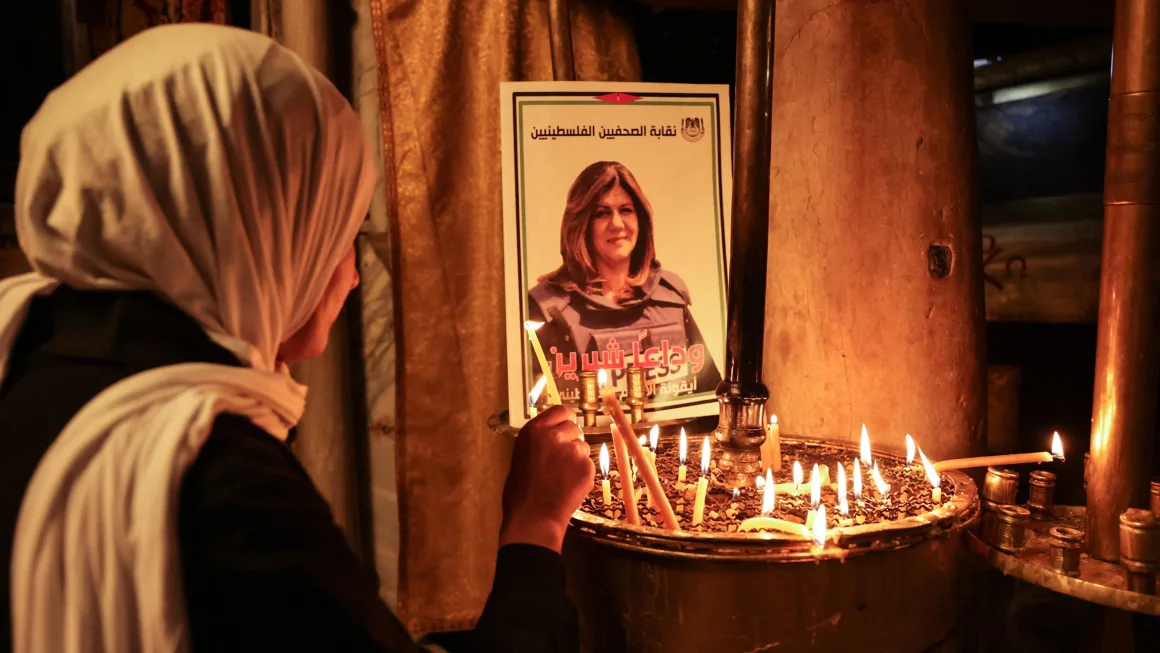
A new documentary about the 2022 killing of Al Jazeera correspondent Shireen Abu Akleh claims to have identified the Israeli soldier who fired the fatal shot.
Additionally, the film alleges that while the Biden administration had initially concluded an Israeli soldier intentionally shot at Abu Akleh, despite the fact she was identifiable as media, it publicly declared that there was “no reason to believe” her killing was “intentional.”
The documentary, produced by independent news outlet Zeteo and titled “Who Killed Shireen?,” follows former Wall Street Journal Middle East reporter Dion Nissenbaum and longtime foreign correspondent Conor Powell as they and fellow journalists seek to figure out who killed Abu Akleh and how the Biden administration handled the investigation into her killing.
Abu Akleh, a Palestinian journalist with US citizenship, was a well-known and respected correspondent for Al Jazeera. She was shot while covering an Israeli military operation targeting militants in Jenin in May 2022. When she was killed, she was wearing protective gear identifying her as a member of the press.
In the immediate aftermath of her death, Israeli officials suggested crossfire from Palestinian militants fighting with Israeli soldiers nearby could have been to blame. Shortly thereafter, however, investigations by CNN and other outlets found that the only militants in the area could not have reached Abu Akleh from where they stood when she was killed. CNN further concluded that she was killed in a targeted attack, based on eyewitness statements and analysis from audio forensic and explosive weapons experts.
The Israel Defense Forces eventually said there was a “high possibility” Abu Akleh was killed by Israeli fire, but said they would not charge any soldiers as there “was no suspicion that a bullet was fired deliberately” at anyone identified as a journalist and the soldier thought he was shooting at militants who were firing upon him. An Israeli military spokesperson later apologized for the journalist’s death and said the soldier responsible “did not do this on purpose.”
But one subject interviewed for the documentary, identified only as a “key Biden administration official,” says that based on where the soldiers and the reporters were located at the time, “it was an indication that it was an intentional killing” and that the soldier would have been able to clearly see Abu Akleh was a noncombatant.
“Whether or not they knew it was her or not, can very well be debated, but they would have absolutely known that it was a media person or a noncombatant at a minimum,” the anonymous Biden administration official states. “Absolutely knew that it was non-combatant, and every indication was that it was media. It was clear within all optics from that distance and location and the visual capabilities of that day.”
The documentary does not detail how the official knows this information, although a source close to the documentary told CNN the official had “direct knowledge” of the Biden administration’s internal assessments of Abu Akleh’s death.
As for who fired the fatal shots, an unidentified Israeli soldier interviewed in the documentary, who said he served alongside the soldier responsible for the slaying, identified the soldier by name and said he was a member of an elite commando unit called Duvdevan. (Because CNN has not been able to verify the reporting, we are not naming the soldier.)
“When you open the corner and you have this second to take a decision, to take a shot and you see someone who hold a camera or something that, you know, point at you, you don’t need more than that to shoot the bullet,” the anonymous soldier says in the documentary.
The soldier identified as Abu Akleh’s killer “wasn’t happy” to discover he killed a journalist, the fellow soldier says, but “he wasn’t like, you know, eating himself from the inside, like thinking about, ‘Oh, what have I done,’ or something like that.”
Abu Akleh’s alleged shooter was later killed by an explosive device buried in the road during a June 2024 military operation in Jenin, the documentary notes. His family has said in interviews with Israeli media that he died while rescuing military medics, who’d been injured by a separate explosion allegedly planted by Palestinian militants.
Reached for comment, the IDF said “Zeteo has decided to publish the name of the IDF soldier who fell during an operational activity, despite the family’s request not to publish the name, and even though they were told that there is no definitive determination regarding the identity of the individual responsible for the shooting that caused the journalist’s death. The IDF shares in the family’s grief and continues to support them.”
A State Department investigation into Abu Akleh’s death, released in July 2022, found that the IDF was “likely responsible” for the shooting, but that there was “no reason to believe” the soldier intentionally targeted her.
However, the unidentified Biden administration official alleges in the documentary that despite those findings, the administration’s assessment was ultimately publicly presented as the shooting having been “a tragic accident versus being an intentional killing of the individual.” He alleges the alteration was made because of “pressure within the administration to not try and anger the government of Israel too much by trying to force their hand at saying that they’d intentionally killed a US citizen.”
The State Department did not respond to a request for comment. The Department of Justice, which was reportedly working on its own investigation, declined to comment.
Since Abu Akleh’s death, the situation on the ground in the region for reporters has changed dramatically. In May 2024, Al Jazeera was officially banned from Israel and the West Bank, with its offices in Ramallah at one point sealed shut by the IDF.
In Gaza, press watchdog groups say at least 175 reporters, photographers, producers and other journalists have been killed since Israel began its military campaign following Hamas’s October 7, 2023, attacks on Israel.
In some cases, Israel has claimed that the journalists killed were working with militant groups. Nevertheless, the war in Gaza has become the deadliest conflict on record for members of the media.
In the documentary, Democratic Sen. Chris Van Hollen of Maryland, who has long advocated for more accountability following Abu Akleh’s death, said he believes “if the US had been more effective and more forceful in insisting that the rules of engagement changed after the killing of Shireen Abu Akleh,” then further civilian deaths could have been avoided.
Abu Akleh’s family echoed that sentiment in a statement to CNN: “Our calls for justice have never been about one individual soldier, but rather for the entire chain of command—those who gave the orders, those who covered it up, and those who continue to deny responsibility — be held to account for the killing of Shireen Abu Akleh on May 11, 2022 . Only then can there be any hope for real closure, not just for Shireen, but for every journalist and family seeking truth.
“Regardless if the soldier’s identity is known or whether he is dead or alive doesn’t change the fact that Shireen was intentionally targeted and killed, and that happened within a system that enables impunity.”
The United States and Houthis in Yemen reached a deal to halt American airstrikes against the group after the Iranian-backed militants agreed to cease attacks against American vessels in the Red Sea, President Trump and Omani mediators said Tuesday.
Mr. Trump broke the news of the truce during an unrelated Oval Office meeting with Canada’s prime minister, surprising even his own Pentagon officials.
“They just don’t want to fight,” Mr. Trump said. “And we will honor that and we will stop the bombings. They have capitulated, but more importantly, we will take their word. They say they will not be blowing up ships anymore.”
But despite his claim of success, it remained unclear whether the United States had achieved its objective of stopping the Houthis from impeding international shipping after a costly seven-week bombing campaign.
The Houthis themselves stopped short of declaring a full cease-fire, saying that they would continue to fight Israel. And Houthi officials and supporters swiftly portrayed the deal as a major victory for the militia and a failure for Mr. Trump, spreading a social media hashtag that read “Yemen defeats America.”
For more than a year, the Houthis have been firing projectiles and launching drones at commercial and military ships in the Red Sea in what the militia group has described as a show of solidarity with Gaza residents and with Hamas, the militant group controlling the Palestinian territory.
In mid-March, the United States began striking hundreds of targets to try to reopen international shipping lanes. The campaign has cost well over $1 billion, congressional officials said they learned in closed-door briefings with Pentagon officials last month. The rate of munitions used in the campaign has caused concern among some U.S. military strategists, who are worried it could undermine readiness for a potential conflict with China.
After Mr. Trump unexpectedly broke the news of the deal between the Houthis and the United States, Oman’s foreign minister, Badr Albusaidi, said his country had mediated the agreement.
“In the future, neither side will target the other, including American vessels, in the Red Sea and Bab al-Mandab Strait, ensuring freedom of navigation and the smooth flow of international commercial shipping,” he said in a statement on social media.
For his part, Mohammed Al-Bukhaiti, a senior Houthi politician, said that if the United States halted its attacks on Yemen, the Houthis would halt their attacks on a smaller group: “American military fleets and interests.”
However, Mr. Al-Bukhaiti said the Houthis would continue military operations until Israel lifted its siege on Gaza, “no matter the sacrifices, even if we have to fight until Judgment Day.”
His statement left unclear whether the Houthis would stop attacking other vessels in the crucial shipping lane. The Houthis have said that they were targeting only ships with links to Israel or the United States, but the militia has in the past targeted vessels with no obvious link to either. In an interview with The New York Times on Tuesday, Mr. Al-Bukhaiti did not answer specific questions as to whether the group would continue to attack Israeli-linked ships.
Mahdi al-Mashat, another senior Houthi official, made clear the group intended to retaliate against Israel for its bombing of the main international airport in Yemen on Tuesday. Mr. al-Mashat said the response from the Houthis would be “earth-shattering, painful, and beyond the capability of the Israeli and American enemy to bear.”
Mohammed Ali Al-Houthi, a senior member of the group, also described Mr. Trump’s announcement as a “victory” for the Houthis, implying in a social media post that the agreement meant that the United States was no longer supporting Israel’s battle against the Houthis.
The U.S. Central Command, responsible for operations against the Houthis, referred questions about the agreement to the White House. The White House declined to elaborate on Mr. Trump’s remarks or respond to inquiries about what the administration would do if the Houthis continued strikes against Israeli vessels.
Mr. Trump, who is prone to make offhand remarks that can upend foreign policy, appeared to catch his own Defense Department off guard. Three Pentagon officials said Tuesday afternoon that the military had yet to receive word from the White House to end its offensive operations against the Houthis. The officials were scrambling to figure out how Mr. Trump’s announcement had changed military policy.
The new U.S. truce with the Iranian-backed militants comes as American officials are working to negotiate a deal to curb Tehran’s nuclear ambitions, and the agreement with the Houthis could play a role in those broader discussions.
Two Iranian officials said on Tuesday that Iran used its influence with the Houthis as part of Oman’s effort to broker a cease-fire and get them to stop firing on U.S. ships. The officials, one in the foreign ministry and one with the Revolutionary Guards, spoke on the condition of anonymity to discuss sensitive matters.
The Houthis receive weapons and funding from Iran, and are part of a network of what is regionally known as Iran’s axis of resistance. A recent social media post by Defense Secretary Pete Hegseth threatened action on Iran over Houthi attacks on American ships.
For the past few weeks, Iranian officials have publicly distanced themselves from the Houthis, saying Iran has no control over the group and that their actions are a response to the war in Gaza. Iran’s supreme leader, Ayatollah Ali Khamenei, said in mid-March that “Houthis act independently based on their own interests and personal views,” and denied Iran had any proxy militia in the region.
Ahmad Zeidabadi, a prominent reformist analyst, wrote on social media that the cease-fire news between the United States and Houthis was “the best news for him” and the worst news for hard-liners in Iran who support proxy militias in the region.
Still, national security experts cast doubt that an agreement would lead to a long-term cessation of attacks in the Red Sea. Mr. Trump’s announcement came just hours after the Houthis released a statement that said it was fighting a “holy war in aid of the wronged Palestinian people in Gaza” and confronting an “Israeli-American-British” enemy.
The Houthis have described their attacks as an attempt to pressure Israel into increasing the flow of humanitarian aid to Gaza, where more than two million Palestinians have struggled to obtain food and water — a blockade that has only deepened recently.
Palestinians in Gaza have been under siege by Israel since Hamas carried out a deadly attack in southern Israel in October 2023 and took hostages. Israeli and Houthi forces have also conducted strikes against each other.
“I would anticipate the Houthis will continue to look to strike Israel, as well as what the group calls ‘Israeli-linked’ ships in the Red Sea,” said Gregory Johnsen, a former member of the U.N. Security Council’s Panel of Experts on Yemen. “If that happens, what does the U.S. do: restart the strikes or let Israel deal with the Houthis?”
He also expressed skepticism that the commercial shipping industry would return to the Red Sea en masse, given that the Houthis “haven’t been defeated or degraded to the point that they can’t carry out these attacks.”
“They’ve only promised not to, and whether or not the shipping industry is willing to take the Houthis word for it remains to be seen,” he said.
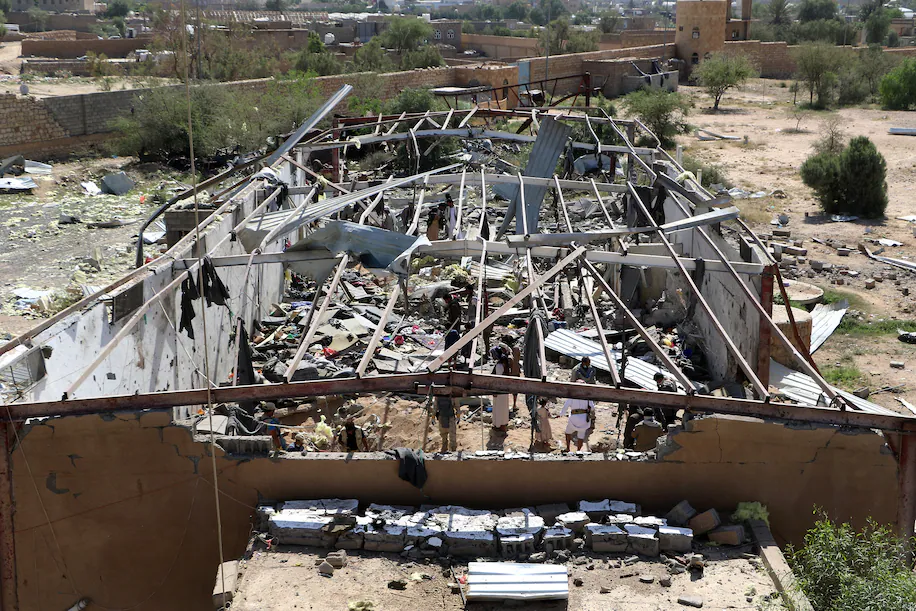
A U.S. airstrike in Yemen on Monday appears to havekilled at least three dozen people in a Houthi-run compound that human rights researchers say has been used for years as a detention center and at times for military purposes, according to images of the aftermath reviewed by The Washington Post.
Houthi rebels say at least 68 people were killed and dozens more were injured in what they said was a U.S. strike on a prison holding African migrants. The Post’s analysis of visuals found at least 38 people who appeared to be dead and 32 injured, numbers that are almost certainly an undercount given the limited available imagery.
It is not clear from the videos who among the dead are civilians; no military equipment or garb is visible in any visuals reviewed by The Post. Visuals could be located from only one of the two buildings that were destroyed in the attack.
The Houthis have targeted American military forces in the Red Sea, as well as commercial vessels and Israeli military sites to protest the ongoing war in Gaza, which has killed many thousands of civilians. In mid-March, the Trump campaign launched “Operation Rough Rider,” targeting Houthi rebel leadership and infrastructure.
Central Command, which oversees U.S. operations in the Middle East, has not said what it was targeting in the recentstrike but is “aware of the claims of civilian casualties”and is assessingthem, a defense official has said. The U.S. military has said its Yemen operations are executed with “detailed and comprehensive intelligence” to minimize risk to civilians.
The current functions of the compound in northwest Yemen could not be independently determined. The United Nations has described it as having once included a military barracks and more recently as a migrant detention center. One human rights researcher told The Post that it ceased serving military purposes a decade ago, while another said it is used by the Houthis for other purposes and “the migrants are only a front.”
Analysts and current and former U.S. officials said the strike appears to add to mounting evidence that the Trump administration has not prioritized minimizingcivilian casualties in its ongoing air campaign against the Houthis. The Defense Department is moving to dismantle efforts focused on reducing civilian harm in U.S. military operations, The Post has reported, so commanders can focus more on “lethality”when conducting military strikes.
“This strike in particular and the campaign in Yemen in general clearly show a higher tolerance for civilian casualties than previously seen in Yemen and even in the wars against ISIS,” a U.S. official familiar with the campaign said, speaking on the condition of anonymity to discuss ongoing operations. The same official confirmed that Monday’s strike was carried out by the United States.
The videos provide a graphic view of the carnage. “I’m dying now,” one man tells the person filming the video, his body pinned between two slabs of concrete. Dozens of people are crushed by debris, their limbs protruding from the dust. Some are dismembered in the blast. Other remains are likely buried or in parts of the building not visible in the imagery.
Emergency workers sift through the debris, looking for survivors among scattered mattresses, clothes and plastic bowls. The videos and photos were released either by Houthi-owned channels or journalists subject to strict Houthi oversight.
Satellite imagery taken after the strike in the southwest outskirts of the city of Saada shows two large buildings destroyed inside a walled compound occupying about 50 acres, known as Saada City Remand Prison. Both buildings are similar in design and about 120 feet long and just over 500 feet apart, separated by a road.
Other buildings in the same compound were struck in January 2022 by Saudi forces, killing at least 91 detainees and wounding at least 236, according to the U.N. human rights office. At the time, the compound held 1,300 pre-trial detainees and 700 migrants, the U.N. said. It was one of the deadliest strikes of a years-long Saudi-led campaign against the Houthis, which received substantial U.S. assistance.
After the 2022 attack, a Saudi military spokesman said the site was a legitimate target because it was used by the Houthis for military purposes.
Houthi militants used the detention center in northwestern Yemen for military purposes up until 2015 or 2016, when it was converted to a prison, said a Yemen human rights researcher who spoke on the condition of anonymity for fear of retribution.The other Yemen-based researcher, Adnan Al-Gabarni, called the compound an important site and said much is unknown about it.
Representatives from the International Committee for the Red Cross have conducted regular visits to the prison complex since 2018; they declined to comment on the internal conditions of the facility. Visiting the site after the Saudi strike, U.N. human rights representatives said in a report that they saw no signs the compound had a military function.
The Saudi bombing had “catastrophic results for vulnerable migrants being detained by the Houthis,” said Christopher Le Mon, former deputy assistant secretary of state for democracy, human rights and labor in the Biden administration. Speaking about the U.S. military, he said, “It’s just inconceivable that the military wouldn’t have anticipated a serious risk of civilian casualties.”
An ICRC delegation visited the site on Monday following the strike. The ICRC said teams from the Yemen Red Crescent Society had evacuated wounded migrants to two hospitals nearby.
Travelers from African countries have transited through the desert corridor for decades, according to a 2023 Human Rights Watch report, which estimated that more than 90 percent of those en route to Saudi Arabia come from Ethiopia. They have been routinely detained by Houthi forces, who are under increasing pressure from Saudi authorities to stop illegal migration, and often subjected to torture and abuse while detained at centers like the one in Saada, according to the rights monitor.
“African migrants locked up in a prison in northern Yemen are not a lawful military objective,” said Brian Finucane, a former legal adviser at the State Department, noting that the U.S. military has not publicly identified what its target was or whether it was a mistake.
The number of civilians killed in Yemen has exponentially increased in the weeks since the campaign began. According to Airwars, a Britain-based watchdog organization, U.S. strikes were estimated to have killed 27 to 56 Yemeni civilians in March. The nonprofit Yemen Data Project estimates that at least 97 strikes in March killed 28 people and wounded 66. The casualty toll in April to date is believed to be much higher.
The Houthis said more than 70 people were killed by an airstrike on a Houthi-controlled oil port on April 18.
After Monday’s strike, video released by the Houthi-owned al-Masirah television channel showed remnants of munitions and what appeared to be at least two craters where the building once stood. The visual evidence indicates multiple U.S.-manufactured GBU-39s were dropped, said Trevor Ball, a former Army explosive ordnance disposal technician. The guided munitions are designed to be capable of reducing risk to civilians with precision targeting and a relatively small size.
Photo from the scene of the strike published by Yemen’s Mine Action Program, YEMAC, shows fragments of U.S.-made GBU-39 bombs, according to weapons expert Trevor Ball. At least two fuze wells indicate at least two munitions were used.
There are no clear signs in the images that the damaged building had any military use, Ball said. The foundation is basic concrete, and the inside appeared to be sleeping quarters.
Pentagon spokesman Sean Parnell said Tuesday the U.S. has struck 1,000 targets, or about 23 per day, since March 15. That pace has raised questions among some experts about whether commanders and analysts can properly assess targets.
“They’ve had some questionable strikes already, and with the operation tempo, chance of mistakes and shortcuts are just going to increase,” Ball said.
Democratic lawmakers last week said they were alarmed by what they called an apparent “serious disregard” for innocent life following reports of deaths in other strikes.
Israel had planned to strike Iranian nuclear sites as soon as next month but was waved off by President Trump in recent weeks in favor of negotiating a deal with Tehran to limit its nuclear program, according to administration officials and others briefed on the discussions.
Mr. Trump made his decision after months of internal debate over whether to pursue diplomacy or support Israel in seeking to set back Iran’s ability to build a bomb, at a time when Iran has been weakened militarily and economically.
The debate highlighted fault lines between historically hawkish American cabinet officials and other aides more skeptical that a military assault on Iran could destroy the country’s nuclear ambitions and avoid a larger war. It resulted in a rough consensus, for now, against military action, with Iran signaling a willingness to negotiate.
Israeli officials had recently developed plans to attack Iranian nuclear sites in May. They were prepared to carry them out, and at times were optimistic that the United States would sign off. The goal of the proposals, according to officials briefed on them, was to set back Tehran’s ability to develop a nuclear weapon by a year or more.
Almost all of the plans would have required U.S. help not just to defend Israel from Iranian retaliation, but also to ensure that an Israeli attack was successful, making the United States a central part of the attack itself.
For now, Mr. Trump has chosen diplomacy over military action. In his first term, he tore up the Iran nuclear deal negotiated by the Obama administration. But in his second term, eager to avoid being sucked into another war in the Middle East, he has opened negotiations with Tehran, giving it a deadline of just a few months to negotiate a deal over its nuclear program.
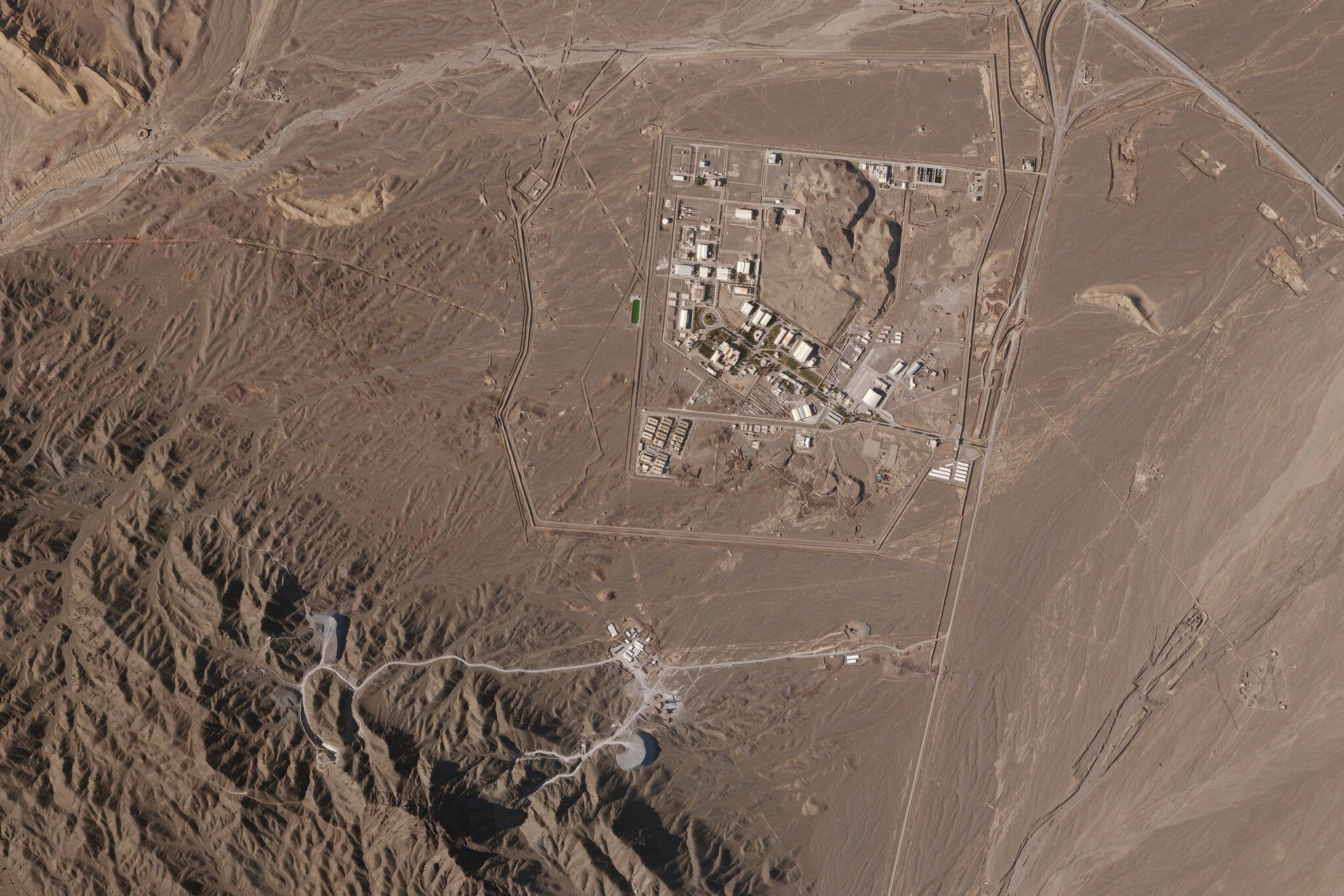
Uranium enrichment facilities at Natanz, Iran, last year.Credit…Planet Labs
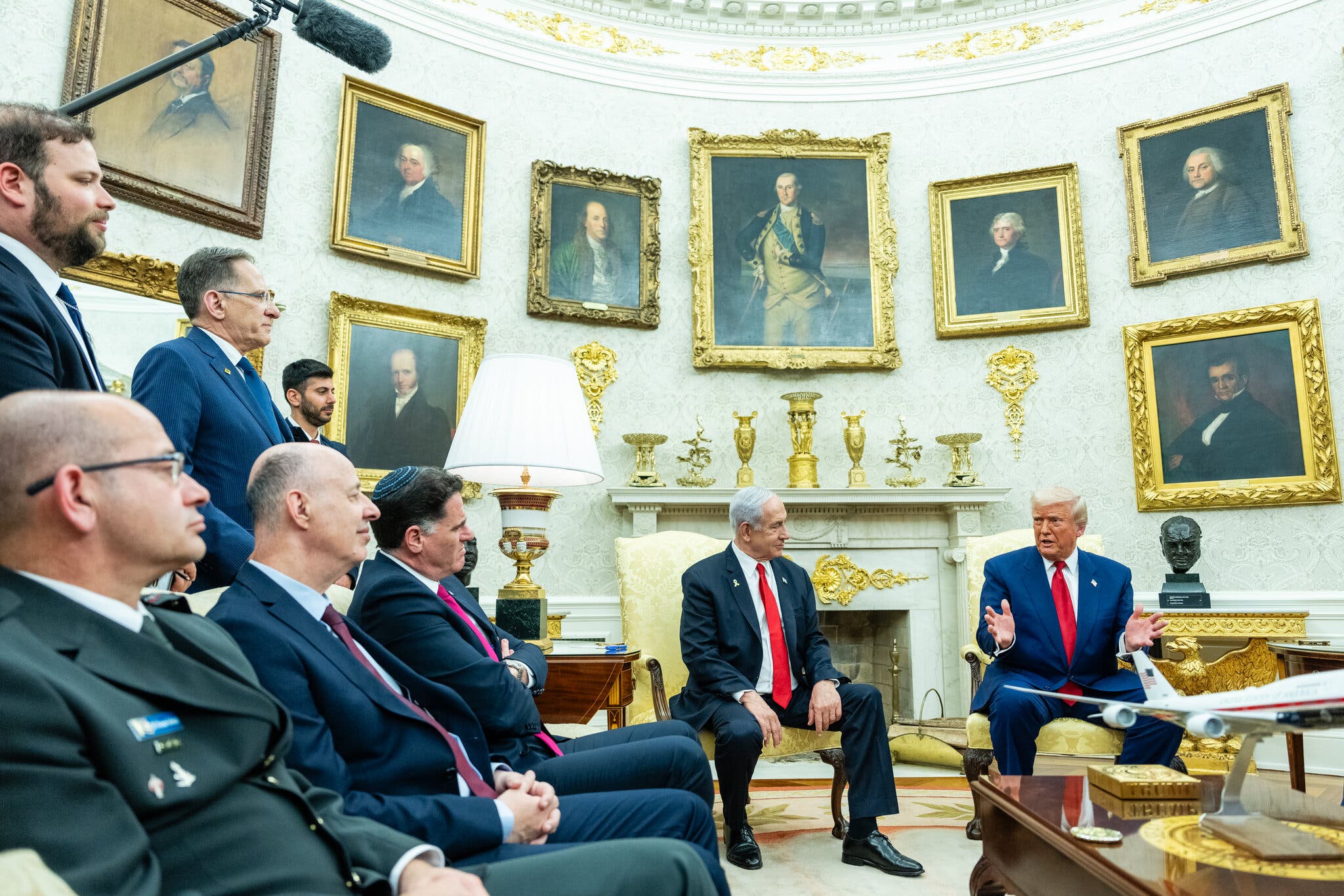
Earlier this month, Mr. Trump informed Israel of his decision that the United States would not support an attack. He discussed it with Prime Minister Benjamin Netanyahu when Mr. Netanyahu visited Washington last week, using an Oval Office meeting to announce that the United States was beginning talks with Iran.
In a statement delivered in Hebrew after the meeting, Mr. Netanyahu said that an agreement with Iran would work only if it allowed the signers to “go in, blow up the facilities, dismantle all the equipment, under American supervision with American execution.”
This article is based on conversations with multiple officials briefed on Israel’s secret military plans and confidential discussions inside the Trump administration. Most of the people interviewed spoke on the condition of anonymity to discuss military planning.
Israel has long planned to attack Iranian nuclear facilities, rehearsing bombing runs and calculating how much damage it could do with or without American help.
But support within the Israeli government for a strike grew after Iran suffered a string of setbacks last year.
In attacks on Israel in April, most of Iran’s ballistic missiles were unable to penetrate American and Israeli defenses. Hezbollah, Iran’s key ally, was decimated by an Israeli military campaign last year. The subsequent fall of the government of President Bashar al-Assad in Syria eliminated a Hezbollah and Tehran ally and cut off a prime route of weapons smuggling from Iran.
Air defense systems in Iran and Syria were also destroyed, along with the facilities that Iran uses to make missile fuel, crippling the country’s ability to produce new missiles for some time.
Initially, at the behest of Mr. Netanyahu, senior Israeli officials updated their American counterparts on a plan that would have combined an Israeli commando raid on underground nuclear sites with a bombing campaign, an effort that the Israelis hoped would involve American aircraft.
But Israeli military officials said the commando operation would not be ready until October. Mr. Netanyahu wanted it carried out more quickly. Israeli officials began shifting to a proposal for an extended bombing campaign that would have also required American assistance, according to officials briefed on the plan.
Some American officials were at least initially more open to considering the Israeli plans. Gen. Michael E. Kurilla, the head of U.S. Central Command, and Michael Waltz, the national security adviser, both discussed how the United States could potentially support an Israeli attack, if Mr. Trump backed the plan, according to officials briefed on the discussions.
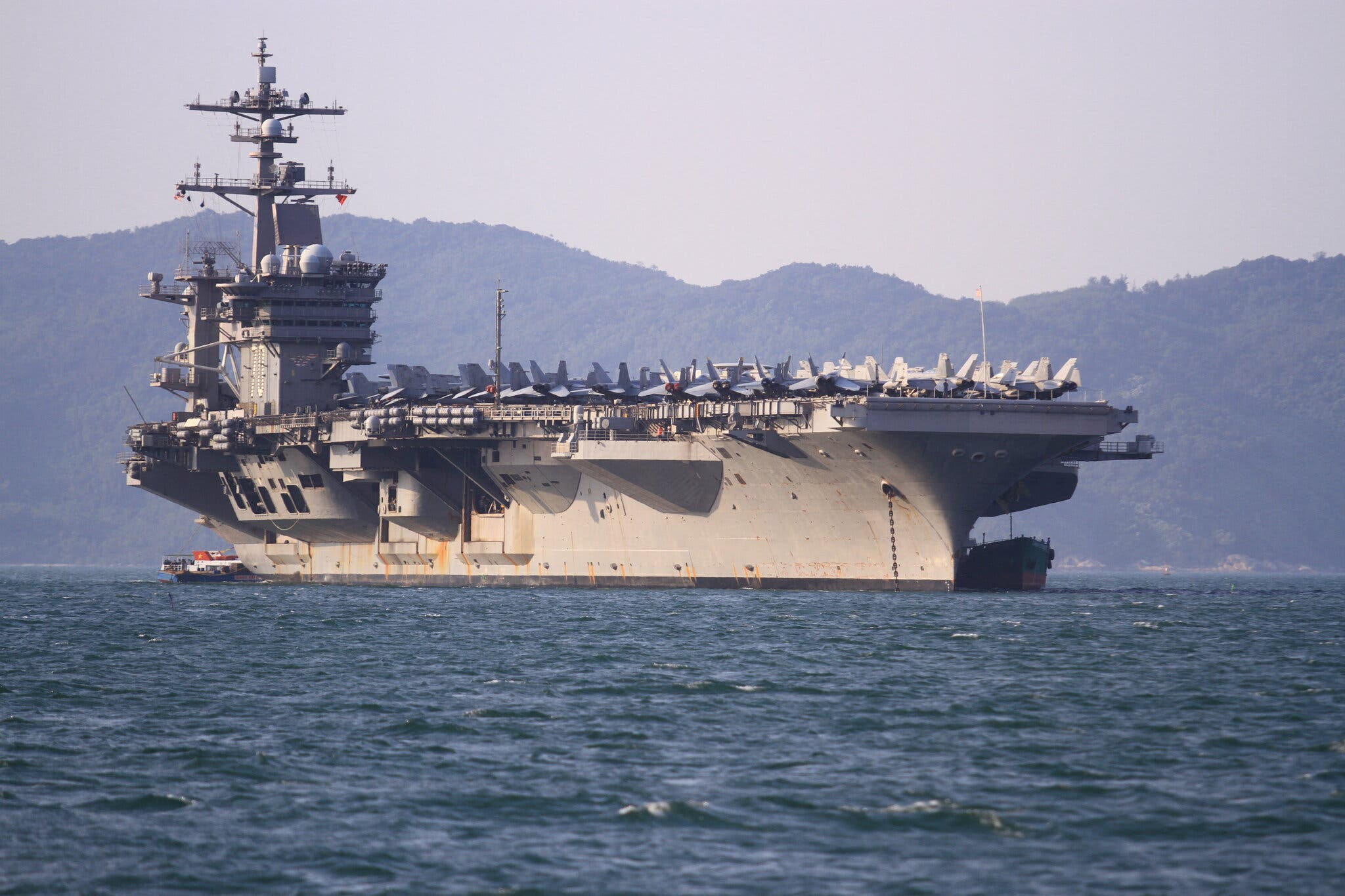
The aircraft carrier Carl Vinson was repositioned from the Pacific to the Arabian Sea for operations against the Houthi rebels in Yemen, but also to potentially support an Israeli strike on Iran.Credit…Linh Pham/Agence France-Presse — Getty Images
With the United States intensifying its war against the Iran-backed Houthi militants in Yemen, General Kurilla, with the blessing of the White House, began moving military equipment to the Middle East. A second aircraft carrier, Carl Vinson, is now in the Arabian Sea, joining the carrier Harry S. Truman in the Red Sea.
The United States also moved two Patriot missile batteries and a Terminal High Altitude Area Defense system, known as a THAAD, to the Middle East.
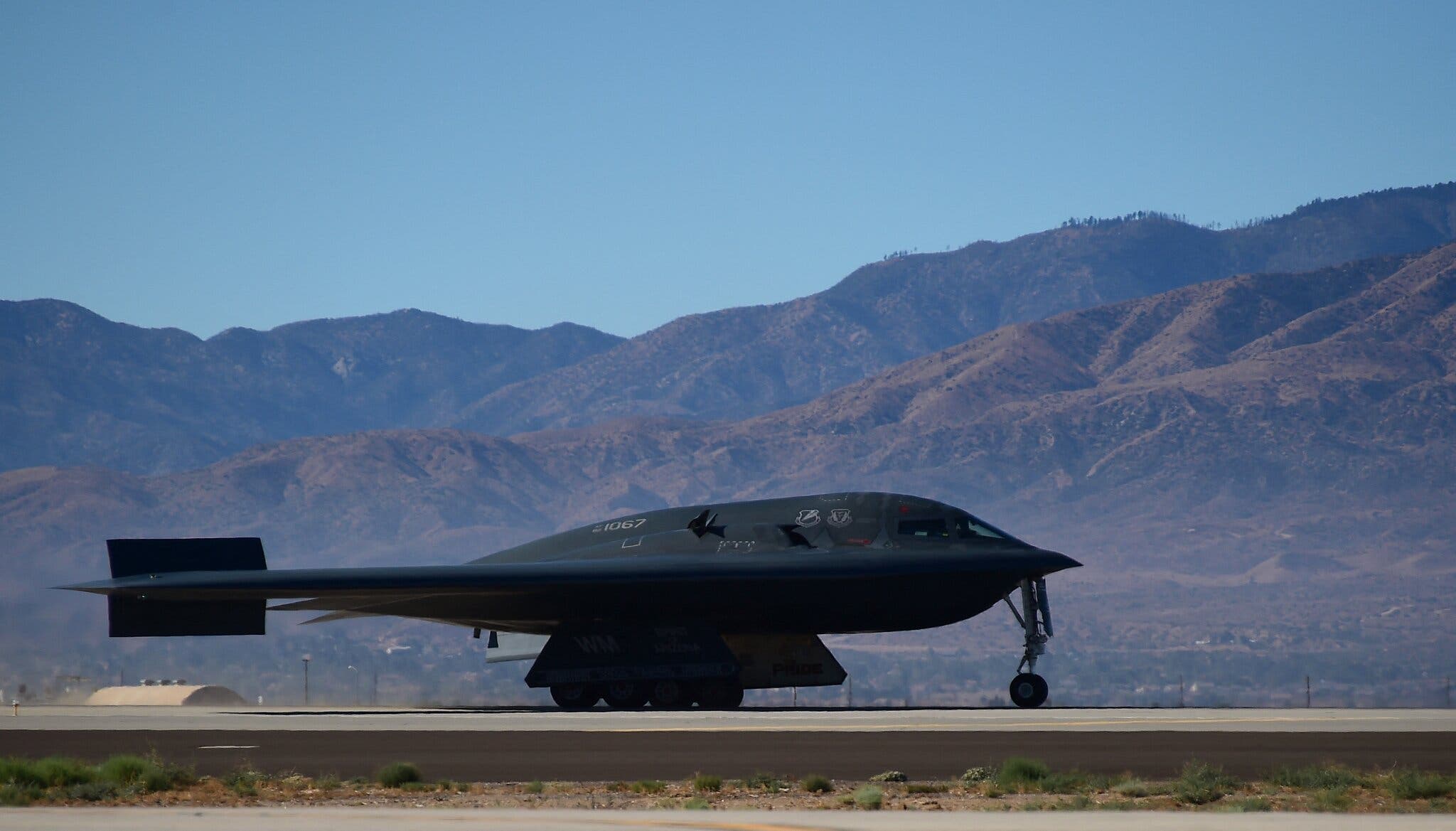
Around a half-dozen B-2 bombers capable of carrying 30,000-pound bombs essential to destroying Iran’s underground nuclear program were dispatched to Diego Garcia, an island base in the Indian Ocean.
Moving additional fighter aircraft to the region, potentially to a base in Israel, was also considered.
All of the equipment could be used for strikes against the Houthis — whom the United States has been attacking since March 15 in an effort to halt their strikes against shipping vessels in the Red Sea. But U.S. officials said privately that the weaponry was also part of the planning for potentially supporting Israel in a conflict with Iran.
Even if the United States decided not to authorize the aircraft to take part in a strike on Iran, Israel would know that the American fighters were available to defend against attacks by an Iranian ally.
There were signs that Mr. Trump was open to U.S. support for Israeli military action against Iran. The United States has long accused Iran of giving the Houthis weapons and intelligence, and of exercising at least a degree of control over the group. On March 17, as Mr. Trump warned the Houthis in Yemen to stop their attacks, he also called out Iran, saying that it was in control of the Houthis.
The use of American B-2 stealth bombers, capable of carrying 30,000-pound bunker-busting bombs, would make any strike on Iran easier. Credit…Frederic J. Brown/Agence France-Presse — Getty Images
“Every shot fired by the Houthis will be looked upon, from this point forward, as being a shot fired from the weapons and leadership of IRAN,” Mr. Trump wrote in a social media post, adding, “IRAN will be held responsible, and suffer the consequences, and those consequences will be dire!”
There were many reasons that Israeli officials expected Mr. Trump to take an aggressive line on Iran. In 2020, he ordered the killing of Gen. Qassim Suleimani, the commander of Iran’s most elite military unit. And Iran sought to hire hit men to assassinate Mr. Trump during last year’s presidential campaign, according to a Justice Department indictment.
But inside the Trump administration, some officials were becoming skeptical of the Israeli plan.
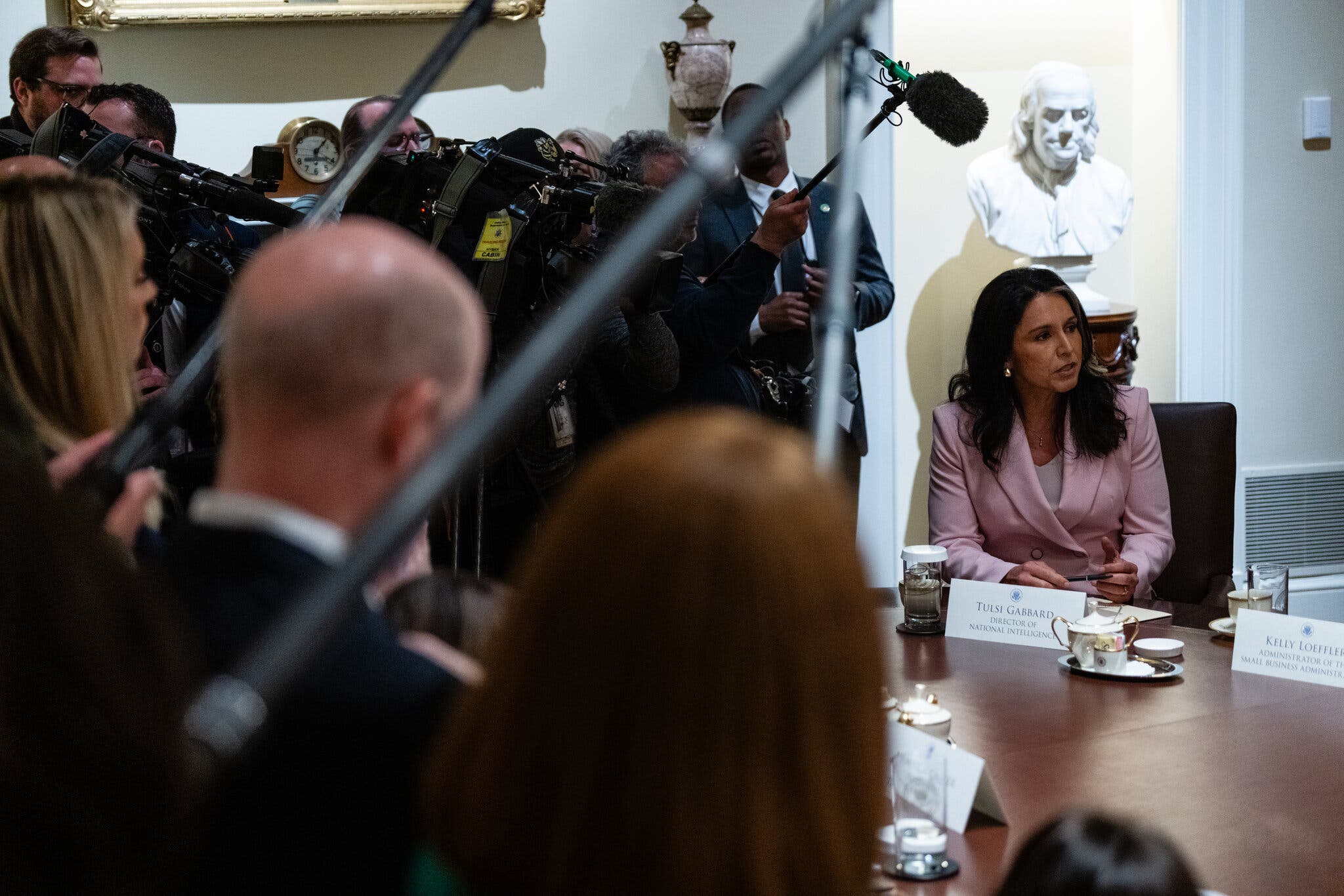
In a meeting this month — one of several discussions about the Israeli plan — Tulsi Gabbard, the director of national intelligence, presented a new intelligence assessment that said the buildup of American weaponry could potentially spark a wider conflict with Iran that the United States did not want.
A range of officials echoed Ms. Gabbard’s concerns in the various meetings. Susie Wiles, the White House chief of staff; Defense Secretary Pete Hegseth; and Vice President JD Vance all voiced doubts about the attack.
Even Mr. Waltz, frequently one of the most hawkish voices on Iran, was skeptical that Israel’s plan could succeed without substantial American assistance.
Tulsi Gabbard, the director of national intelligence, during a cabinet meeting last week.Credit…Eric Lee/The New York Times
The recent meetings came shortly after the Iranians said that they were open to indirect talks — communications through an intermediary. In March, Mr. Trump had sent a letter offering direct talks with Iran, an overture that Ayatollah Ali Khamenei, the supreme leader, had appeared to reject. But on March 28, a senior Iranian official sent a letter back signaling openness to indirect talks.
There is still significant debate within Mr. Trump’s team about what kind of agreement with Iran would be acceptable. The Trump administration has sent mixed signals about what kind of deal it wants, and what the consequences for Iran would be if it failed to agree.
In one discussion, Mr. Vance, with support from others, argued that Mr. Trump had a unique opportunity to make a deal.
If the talks failed, Mr. Trump could then support an Israeli attack, Mr. Vance said, according to administration officials.
During a visit to Israel earlier this month, General Kurilla told officials there that the White House wanted to put the plan to attack the nuclear facility on hold.
Mr. Netanyahu called Mr. Trump on April 3. According to Israeli officials, Mr. Trump told Mr. Netanyahu that he did not want to discuss Iran plans on the phone. But he invited Mr. Netanyahu to come to the White House.
Mr. Netanyahu arrived in Washington on April 7. While the trip was presented as an opportunity for him to argue against Mr. Trump’s tariffs, the most important discussion for the Israelis was their planned strike on Iran.
But while Mr. Netanyahu was still at the White House, Mr. Trump publicly announced the talks with Iran.
President Trump announced talks with Iran during Prime Minister Benjamin Netanyahu’s recent visit to the United States.Credit…Eric Lee/The New York Times
In private discussions, Mr. Trump made clear to Mr. Netanyahu that he would not provide American support for an Israeli attack in May while the negotiations were playing out, according to officials briefed on the discussions.
The next day, Mr. Trump suggested that an Israeli military strike against Iran remained an option. “If it requires military, we’re going to have military,” Mr. Trump said. “Israel will, obviously, be the leader of that.”
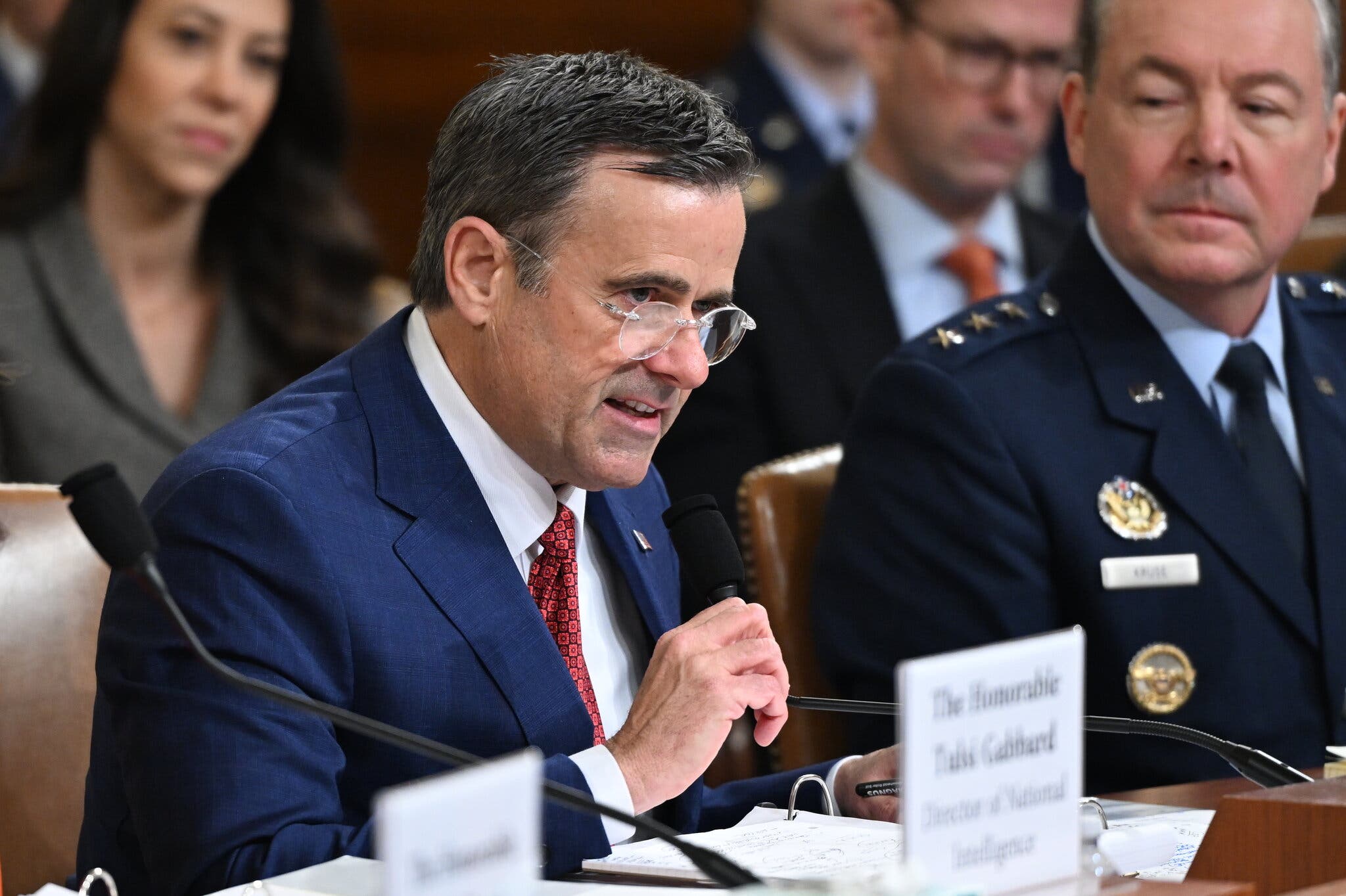
After Mr. Netanyahu’s visit, Mr. Trump assigned John Ratcliffe, the C.I.A. director, to travel to Jerusalem. Last Wednesday, Mr. Ratcliffe met with Mr. Netanyahu and David Barnea, the head of the Mossad spy agency, to discuss various options for dealing with Iran.
In addition to talks and strikes, other options were discussed, including covert Israeli operations conducted with U.S. support and more aggressive sanctions enforcement, according to a person briefed on Mr. Ratcliffe’s visit.
Brian Hughes, a National Security Council spokesman, said the administration’s “entire national security leadership team” was committed to Mr. Trump’s Iran policy and efforts “to ensure peace and stability in the Middle East.”
“President Trump has been clear: Iran cannot have a nuclear weapon, and all options remain on the table,” Mr. Hughes said. “The president has authorized direct and indirect discussions with Iran to make this point clear. But he’s also made clear this cannot go on indefinitely.”
John Ratcliffe, the C.I.A. director, traveled to Israel to meet with Prime Minister Benjamin Netanyahu and the head of Mossad, the Israeli intelligence agency.Credit…Kenny Holston/The New York Times
The White House and the C.I.A. did not respond to requests for comment. The Office of the Director of National Intelligence referred questions to the National Security Council. The Defense Department declined to comment. Mr. Netanyahu’s office and the Israel Defense Forces also declined to comment.
In pressing Mr. Trump to join in an attack, Mr. Netanyahu was replaying a debate he has had with American presidents over nearly two decades.
Blocked by his American counterparts, Mr. Netanyahu has instead focused on covert sabotage operations against specific facilities and assassinations of Iranian nuclear scientists. While those efforts may have slowed the program, it is now closer than it has ever been to being able to produce six or more nuclear weapons in a matter of months or a year.
American officials have long said that Israel, acting alone, could not do significant enough damage to Iranian nuclear sites with only a bombing campaign. Israel has long sought America’s largest conventional bomb — a 30,000-pound bunker buster, which could do significant damage to key Iranian nuclear sites beneath mountains.
Israel considered various options for the May strike, many of which it discussed with American officials.
Mr. Netanyahu initially pushed for an option that would have combined airstrikes with commando raids. The plan would have been a far more ambitious version of an operation Israel carried out last September, when Israeli forces flew by helicopter into Syria to destroy an underground bunker used to build missiles for Hezbollah.
In that operation, Israel used airstrikes to take out guard posts and air defense sites. Commandos then rappelled to the ground. The teams of fighters, armed with explosives and small arms, infiltrated the underground facility and set explosives to destroy key equipment for making the weaponry.
But American officials were concerned that only some of Iran’s key facilities could be taken out by commandos. Iran’s most highly enriched uranium, close to bomb grade, is hidden around the country at multiple sites.
One of Israel’s plans would have combined airstrikes with raids by Israeli commandos to destroy underground facilities, potentially including the heavily guarded Natanz complex.Credit…Raheb Homavandi/Reuters
To be successful, Israeli officials wanted American planes to conduct airstrikes, protecting the commando teams on the ground.
But even if U.S. assistance was forthcoming, Israeli military commanders said that such an operation would take months to plan. That presented problems. With General Kurilla’s duty tour expected to conclude in the next few months, Israeli and American officials wanted to develop a plan that could be carried out while he was still in command.
And Mr. Netanyahu wanted to move fast.
After shelving the commando idea, Israeli and American officials began discussing a plan for an extensive bombing campaign that would have started in early May and lasted more than a week. An Israeli strike last year had already destroyed Iran’s Russian-made S-300 air defense systems. The bombing campaign would have had to begin with striking remaining air defense systems, allowing Israeli fighters to have a clearer path to hitting the nuclear sites.
Any Israeli attack on nuclear sites would prompt a new Iranian missile barrage against Israel that would require American assistance to rebuff.
Senior Iranian officials, from the president to the head of the armed forces and foreign minister, have said that Iran would defend itself if attacked by Israel or the United States.
Brig. Gen. Mohammad Bagheri, the head of Iran’s Armed Forces, said in a speech on April 6 that Iran did not want war and wanted to resolve the standoff with the United States through diplomacy. But he warned: “Our response to any attack on the Islamic Republic’s sovereignty will be forceful and consequential.”
Cookie Consent
We use cookies to improve your experience on our site. By using our site, you consent to cookies.
Contains information related to marketing campaigns of the user. These are shared with Google AdWords / Google Ads when the Google Ads and Google Analytics accounts are linked together.
90 days
__utma
ID used to identify users and sessions
2 years after last activity
__utmt
Used to monitor number of Google Analytics server requests
10 minutes
__utmb
Used to distinguish new sessions and visits. This cookie is set when the GA.js javascript library is loaded and there is no existing __utmb cookie. The cookie is updated every time data is sent to the Google Analytics server.
30 minutes after last activity
__utmc
Used only with old Urchin versions of Google Analytics and not with GA.js. Was used to distinguish between new sessions and visits at the end of a session.
End of session (browser)
__utmz
Contains information about the traffic source or campaign that directed user to the website. The cookie is set when the GA.js javascript is loaded and updated when data is sent to the Google Anaytics server
6 months after last activity
__utmv
Contains custom information set by the web developer via the _setCustomVar method in Google Analytics. This cookie is updated every time new data is sent to the Google Analytics server.
2 years after last activity
__utmx
Used to determine whether a user is included in an A / B or Multivariate test.
18 months
_ga
ID used to identify users
2 years
_gali
Used by Google Analytics to determine which links on a page are being clicked
30 seconds
_ga_
ID used to identify users
2 years
_gid
ID used to identify users for 24 hours after last activity
24 hours
_gat
Used to monitor number of Google Analytics server requests when using Google Tag Manager