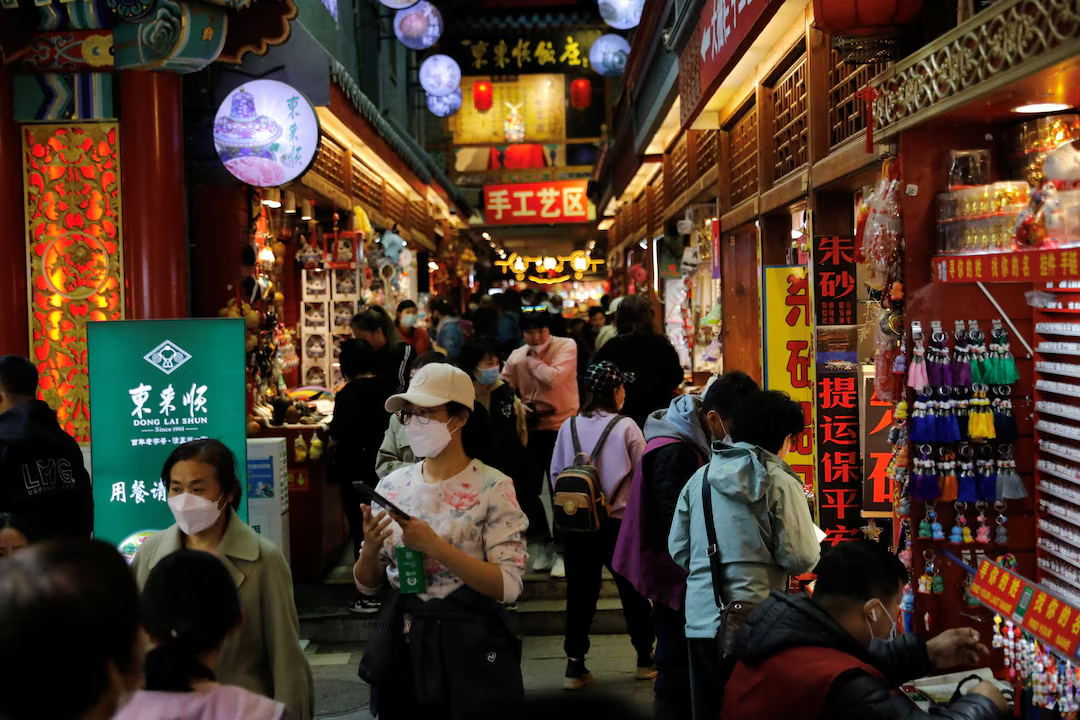
As the United States and China barreled headfirst into full-fledged trade war this week, one of Beijing’s most fashionable shopping districts was still bustling. People browsed a high-end perfumery, lounged outside coffee shops and waited in a wraparound line for a trendy bakery.
That is just the type of scene the Chinese government wants to see as it steels for what could be a total breakdown of trade with the United States. As President Trump maintains tariffs of at least 125 percent on its goods, China has vowed not to back down. Besides hitting back with its own tariffs — 84 percent on all imports from the United States — the government has promised to make up for the blow to exports, on which China’s economy currently relies, by getting its people to spend more.
“In the face of high tariffs continuing to shrink the space for trade with the United States,” read a commentary on Sunday in People’s Daily, the Chinese Communist Party mouthpiece, China will “make consumption the main driving force and ballast stone of economic growth, and deliver on the advantages of a super-large market.”
But that is easier said than done.
Domestic consumption in China was anemic even before the tariffs. The post-pandemic economic recovery has been lackluster, factories have shuttered and youth unemployment is high. Home prices, the bedrock of many middle-class Chinese families’ wealth, have plummeted.
Even the busy scene at the Beijing shopping area, Taikoo Li, was deceptive. When Chinese people do go out, they increasingly tend to look for bargains or simply browse.
Qu Nan, the 38-year-old founder of a construction company, was sitting at a Starbucks in Taikoo Li. But he wasn’t drinking anything, just meeting a friend.

Before the pandemic, Mr. Qu would casually spend $25 to $40 for a meal when eating out. But his business had fallen by 20 percent since then, and now he was willing to spend that much only for high-quality food.
“For that price, I might as well cook for myself,” he said. “People’s spending habits have changed. Everyone is making targeted, cost-effective choices.”
The trade war could make people even warier of spending, just as it becomes a higher priority for the government. If exports slow dramatically, it could hurt everyone from garment makers in southern China to kitchen appliance makers on the eastern seaboard. That, in turn, could lead to lower wages or higher unemployment.
“The economy is all integrated, and producers are also consumers. It’s all the same people,” said Zhou Mi, a researcher at an institute affiliated with China’s Ministry of Commerce.
Before the trade tensions began escalating, there had been signs that Chinese people were starting to spend more.
Government incentives to trade in old cars or electronics for new ones lifted sales. A quarterly survey of Chinese consumers released by Deutsche Bank in March found that 54 percent of respondents felt better off financially than a year before, and that 52 percent — the most in a year — were willing to increase their spending.
During a long holiday weekend for China’s Tomb Sweeping Festival this month, travelers crowded into tourist sites and restaurants. They made 126 million domestic trips and spent about $8 billion, according to official data. Both figures represented increases of more than 6 percent from the previous year, and they were above prepandemic levels.
But then Mr. Trump hit China with his staggering new tariffs. China responded with matching tariffs of its own.

In some ways, Americans are more likely to be directly affected by price increases from the tariff war, because imported goods make up the texture of daily life in the United States. China’s U.S. imports are mostly intermediate products, like soybeans and farm equipment, not consumer goods. And China has worked to diversify its supply chains since Mr. Trump imposed tariffs in his first term. Brazil, not the United States, is now China’s top soybean supplier.
Many high-profile American brands in China, like Nike, won’t have to dramatically raise prices, because many of their products are made outside the United States. Some American electronics or cars, like Chevrolets, would see prices jump, but American automakers have been losing ground in China anyway.

Ye Yi, a 42-year-old wine importer in Beijing, would be hurt by the tariffs, in theory. He sells wine from Napa Valley for about $134 a bottle.
But he said he wasn’t worried about China’s new levies, because nobody was buying such expensive wines anyway. They were once popular with businesspeople throwing banquets, but as customers became more cost-conscious they opted for cheaper wines from Australia or Chile.
Mr. Ye said his business had dropped by 70 to 80 percent since early 2023. He does not plan to order more American wine and is looking for ways to get out of the industry altogether, he said.
“We’re riding a donkey while looking for a horse,” Mr. Ye said, using a Chinese idiom about making do.
Indeed, the bigger problem for Chinese consumption is not rising prices, but the fact that people aren’t spending much to begin with.
Many Chinese companies have been entangled in damaging price wars as consumers demand ever-lower prices. Some of the fastest-growing brands in recent years have been ultracheap ones. Qunar, a Chinese travel company, partly attributed the uptick in travel during the Tomb Sweeping Festival to cheaper hotel rooms.
Even if the tariffs hit Chinese manufacturers hard by reducing demand in the United States, or making American intermediate goods more expensive, they may try to absorb the costs themselves, to stay competitive.
Any recent small gains in consumer confidence may already be vanishing. Chinese stocks have fallen sharply this week, though government efforts to stabilize the markets have helped. In manufacturing hubs like Guangzhou, exporters have seen orders canceled.

Many economists agree that in the long term, getting consumers to spend more will require major investments in China’s limited social safety net. Medical costs for serious illnesses can be devastating for families. People from the countryside, in particular, have almost no pensions, and they have trouble accessing education or health care in cities.
“When people feel safe about their retirement life and feel safe about their financials after some major life events like illness, then I think they’re definitely going to be more willing to spend,” said Xu Tianchen, a China analyst at the Economist Intelligence Unit.
Historically, Chinese leaders have been wary of expanding the safety net, citing, among other things, concern about encouraging laziness.
But Mr. Xu said he was optimistic that Beijing was now serious about reforms, to support consumption. The government said last month that it would work to increase wages, pensions and medical benefits.
“Because there’s no way back for U.S.-China trade, I would say, and especially on the China side, they have to be realistic about finding the next engine for the Chinese economy,” Mr. Xu said.

Such substantive changes are likely to take years. In the meantime, consumers will probably remain skittish about the kind of spending that China needs.
In Taikoo Li, the shopping district, Zhao Yong, a 42-year-old photographer, said he was hopeful that the government would issue spending vouchers and roll out other policies to blunt the effects of the trade war.
But he was putting his own money into gold — an increasingly popular option for nervous Chinese investors.
“Otherwise, what can you buy? You can’t buy a house. You can’t buy stocks. You’d have to be foolish to start your own business,” Mr. Zhao said. “It’s only because our outlook on the general environment is pessimistic that we choose this.”