TORONTO—ChatGPT-maker OpenAI said Friday it considered last year alerting Canadian police about the activities of a person who months later committed one of the worst school shootings in the country’s history.
OpenAI said last June the company identified the account of Jesse Van Rootselaar via abuse detection efforts for “furtherance of violent activities.”
The San Francisco tech company said it considered whether to refer the account the Royal Canadian Mounted Police but determined at the time that the account activity did not meet a threshold for referral to law enforcement. OpenAI banned the account in June 2025 for violating its usage policy.
The 18-year-old killed eight people in a remote part of British Columbia last week and died from a self-inflicted gun shot wound.
OpenAI said the threshold for referring a user to law enforcement is whether the case involves an imminent and credible risk of serious physical harm to others. The company said it did not identify credible or imminent planning. The Wall Street Journal first reported OpenAI’s revelation.
OpenAI said that, after learning of the school shooting, employees reached out to the RCMP with information on the individual and their use of ChatGPT.
“Our thoughts are with everyone affected by the Tumbler Ridge tragedy. We proactively reached out to the Royal Canadian Mounted Police with information on the individual and their use of ChatGPT, and we’ll continue to support their investigation,” an OpenAI spokesperson said.
The RCMP said Van Rootselaar first killed her mother and stepbrother at the family home before attacking the nearby school. Van Rootselaar had a history of mental health contacts with police.
The motive for the shooting remains unclear.
The town of 2,700 people in the Canadian Rockies is more than 1,000 kilometers northeast of Vancouver, near the provincial border with Alberta. Police said the victims included a 39-year-old teaching assistant and five students, ages 12 to 13.
The attack was Canada’s deadliest rampage since 2020, when a gunman in Nova Scotia killed 13 people and set fires that left another nine dead.
Jesse Van Rootselaar in a photo released by the Royal Canadian Mounted Police. (RCMP)
Police in Canada are still investigating the motives behind the actions of 18-year-old Jesse Van Rootelaar, the suspect in a recent violent incident, and how she managed to carry it out.
In Tumbler Ridge, a mining community with about 2,700 residents, details from police reports, court documents, and family statements are revealing a troubled upbringing for the teenager.
Jesse Strang was the birth name given by her mother, Jennifer Strang. Her biological father was Van Rootelaar, a man she hardly knew following her parents’ difficult separation. Although her father resided in the same town, they had minimal interaction.
Van Rootelaar left school around four years ago, according to officials.
In her adolescence, she became familiar to local law enforcement. She frequently visited the mental-health unit at the home she shared with her mother and younger siblings for assessments under the province’s mental health laws. However, she consistently returned home. At times, firearms stored in the house were confiscated by police and later returned upon petition from a resident.
Van Rootelaar is accused of using four weapons in Tuesday’s fatal attack, which claimed eight lives before she succumbed to a self-inflicted gunshot, authorities reported. Two of the weapons, thought to be the primary ones used, had never been seized by police previously and were unregistered. Locating their source and how Van Rootelaar acquired them remains a key focus for investigators.
A dedicated team is sifting through her online presence and digital history for insights into the reasons and planning behind the mass shooting, as well as examining her previous engagements with police and mental health experts, stated Royal Canadian Mounted Police Deputy Commissioner Dwayne McDonald.
The teen had consulted a gender transition specialist and posted a mirror selfie of her initial makeup attempt, expressing worries about her 6-foot stature’s proportions.
“Why can’t I be petit an smol?” she posted on Reddit.
Company reviewed alarming user conversations but ultimately did not contact law enforcement
Later that year, she shared that she “went crazy and burnt my house down” after a second attempt with psychedelic mushrooms, noting the dosage led to “dangerous psychosis.”
She hoped to discover the proper amount for a “positive experience in my life,” mentioning that electroconvulsive therapy and prescribed drugs hadn’t alleviated her mental health issues.
Her biological father, Justin Van Rootelaar, suggested a turbulent early life for the teen in a statement affirming their distant relationship, which he attributed to her mother.
“While that distance is the reality of our relationship, it does not lessen the heartbreak I feel for the pain that has been caused to innocent people and to the town we call home,” he told Canadian media on Friday.
As a child, Van Rootelaar’s life involved multiple relocations, court records indicate, as her mother frequently moved across the country: from Newfoundland on Canada’s eastern Atlantic coast, to Grand Cache, a small mountain town in western Alberta, and Powell River, a coastal area in southwestern British Columbia.
Around age 7 or 8, a then-pregnant Strang transported her across the country from British Columbia to Chamberlain, Newfoundland, against the father’s wishes. A judge labeled this as “reprehensible conduct” in court documents.
At that time, Van Rootelaar and her father had no relationship for “many years,” but they were starting to communicate via phone, per court records.
Some of Van Rootelaar’s online activity has surfaced. She developed a videogame simulating a mass shooting in a shopping mall on Roblox, the company confirmed. The simulation let a Roblox avatar select weapons and shoot other characters in a mall. It was viewable only by seven users via a separate developer app called Roblox Studio and was never released to the public. The company didn’t specify the creation date.
“We have removed the user account connected to this horrifying incident as well as any content associated with the suspect,” a Roblox spokesperson stated. “We are committed to fully supporting law enforcement in their investigation.”
Archived social media shows Van Rootelaar posting images of herself at a gun range, claiming to have made a bullet cartridge with a 3-D printer, and participating in online talks about YouTube videos by gun enthusiasts.
The trans woman also voiced concerns about transitioning and her interests in anime cartoons and illicit drugs, using “jesseboy347” as a social-media handle, according to a post on her mother’s Facebook page.
In 2023 Reddit posts, at age 15, she wrote in the r/trans forum that transitioning felt “super intimidating,” but she posted there.
The father, who hadn’t initially exercised all his parental rights, sought joint guardianship and requested he be consulted on parental decisions. The sparse relationship between father and child resulted from the mother’s “nomadic lifestyle,” British Columbia Supreme Court Judge Anthony Saunders noted.
Before Strang departed with the child, she texted her ex-partner: “We are moving to Newfoundland,” and “We told your lawyer that last week.” But she hadn’t informed the father exactly where or when she planned to relocate with their child, court documents reveal.
It’s uncertain when the mother returned the children.
Over the next decade, Van Rootelaar began interacting with local police due to mental health issues, and those encounters are now under review in the probe into Tuesday’s events, when police say she fatally shot her 39-year-old mother and 11-year-old half-brother at the family home. She then proceeded to Tumbler Ridge Secondary School, fatally shooting six people there—a teacher and five students—and critically injuring two others, police said. She ended her life as officers arrived at the school. Asked if she had been bullied at school, police said they didn’t know but noted she wasn’t currently enrolled as a student.
Amid the complex forensic evidence at both sites, one evident detail has surfaced, said Deputy Commissioner McDonald. Van Rootelaar didn’t seem to have a particular target in mind at the school and shot randomly, he said.
“This suspect was, for lack of a better term, hunting. They were prepared and engaging anybody and everybody they could come in contact with,” McDonald said.
MONTREAL/TORONTO — Air Canada and its 10,000 flight attendants, represented by the Canadian Union of Public Employees (CUPE), reached a tentative agreement early Tuesday, August 19, 2025, ending a disruptive four-day strike that canceled approximately 500,000 passengers’ flights during the peak summer travel season. The breakthrough, announced after intense overnight negotiations, allows Canada’s largest carrier to begin resuming operations, though the airline warns that a full return to normal service could take seven to ten days.
“The strike has ended. We have a tentative agreement we will bring forward to you,” CUPE’s Air Canada Component stated, confirming that members will comply with the resumption of operations. Air Canada echoed the announcement, noting that mediation began Monday at 7 p.m. ET and concluded just after 4 a.m. ET on Tuesday, with the condition that flight attendants return to work immediately. “This allows the airline to resume the operations of Air Canada and Air Canada Rouge, which have been grounded since Aug. 16,” the airline said in a statement.
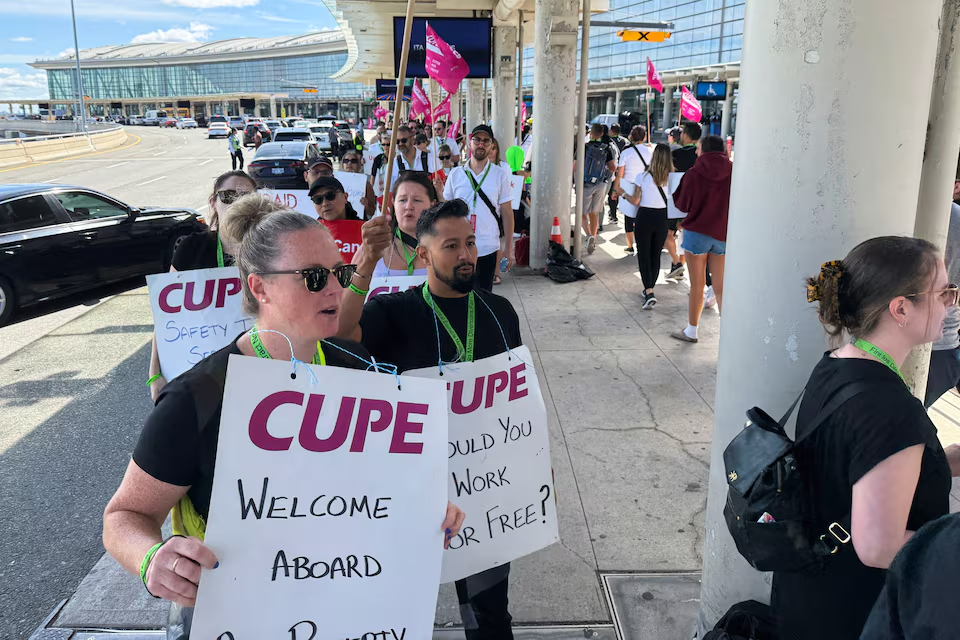
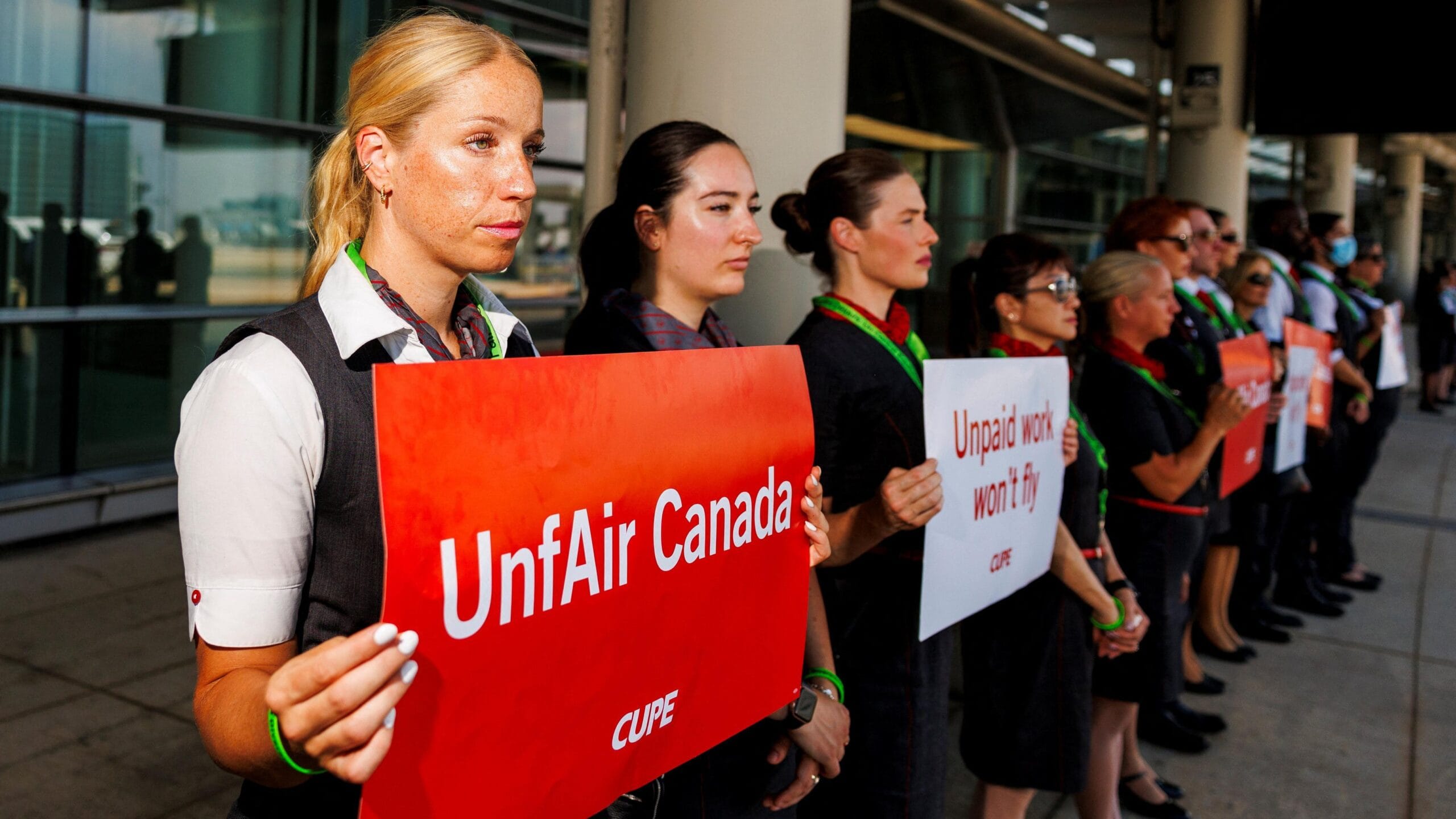
The strike, which began on Saturday, August 16, followed months of stalled talks over wages and unpaid ground work, such as boarding and safety checks. CUPE rejected Air Canada’s initial offer of a 38% compensation increase, arguing it amounted to only a 17.2% wage hike over four years, insufficient given inflation and industry standards. The union also defied a Canada Industrial Relations Board (CIRB) order to return to work on Sunday, prompting the board to declare the strike unlawful. CUPE challenged the order in Federal Court, with national president Mark Hancock stating on Monday, “If it means folks like me going to jail, then so be it. We’re looking for a solution here.”
The tentative agreement’s details remain undisclosed pending ratification by union members, but it follows significant pressure from federal Jobs Minister Patty Hajdu, who urged both sides to negotiate and announced a probe into allegations of unpaid work in the airline sector. “The claims are deeply disturbing,” Hajdu said, referencing flight attendants’ demands for compensation for ground duties.
Passenger Disruptions and Recovery Challenges
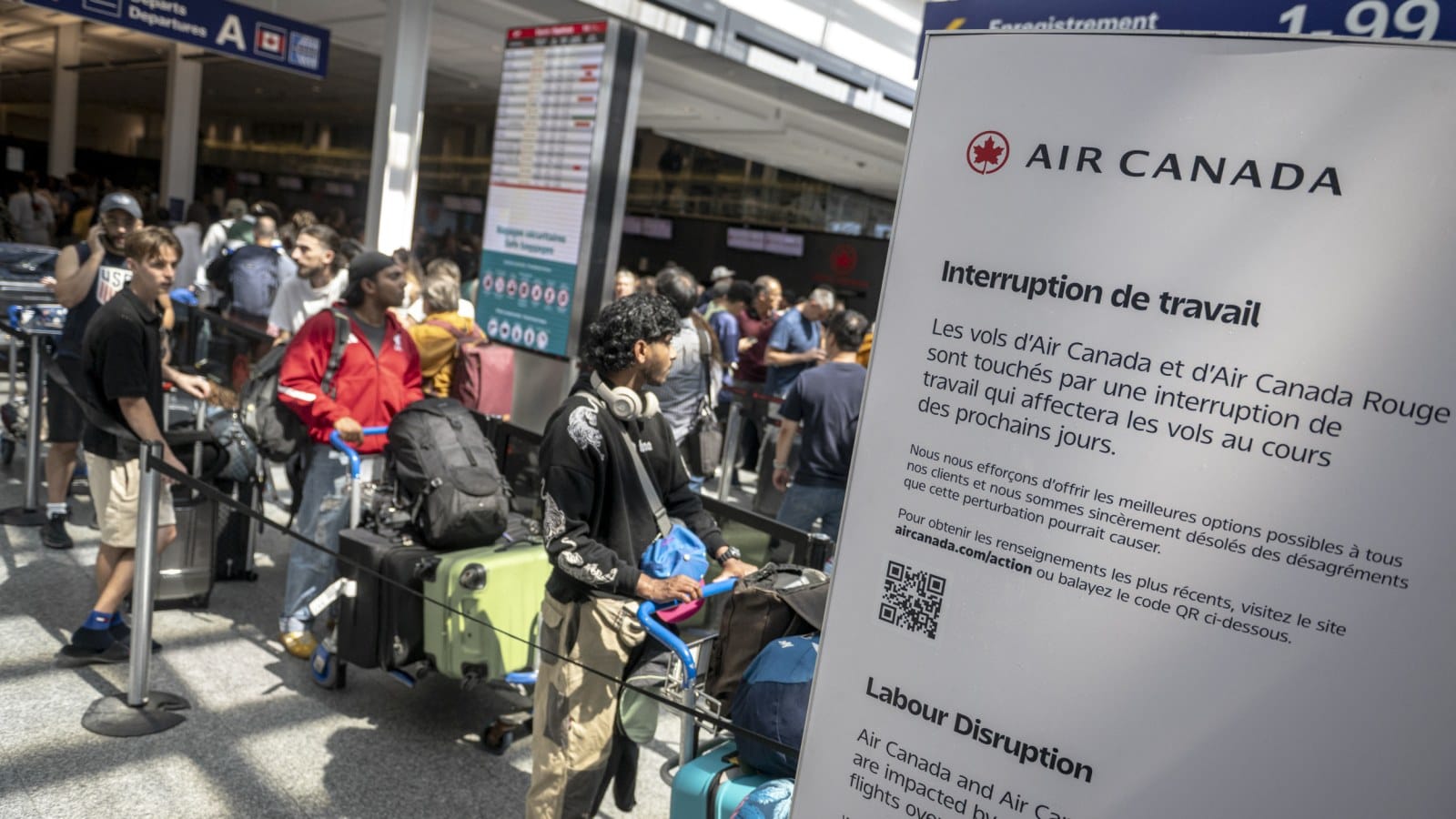
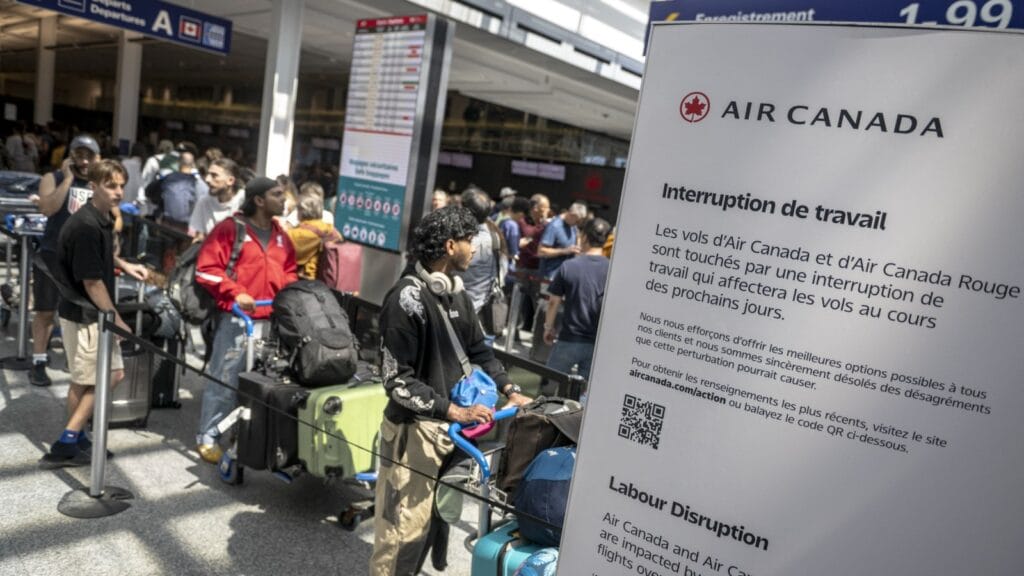
The strike left passengers stranded across Canada and beyond, with Air Canada operating around 700 flights daily. Travelers faced canceled flights, limited rebooking options, and significant out-of-pocket expenses. The airline advised that only passengers with confirmed bookings on operating flights should head to airports, as aircraft and crew remain out of position. “Some flights will be cancelled over the next seven to ten days until the schedule is stabilized,” Air Canada warned, offering refunds, travel credits, or rebooking on other airlines, though capacity is constrained due to the busy summer season.
The agreement comes as a relief to passengers like John and Lois Alderman, who faced a potential week-long delay in Toronto with dwindling insulin supplies for John, a diabetic. Others, like Beverley and Martin Newstead, also U.K.-bound, expressed frustration over extended stays and mounting costs. In Montreal, Luca Pozzoli considered driving to Boston to catch a flight to Italy, while Sandra Major, a Bahamian grandmother, received no immediate rebooking options after her flight was canceled.
Broader Implications for Labor
The strike’s defiance of the CIRB order drew support from other labor groups, with the Canadian Labour Congress and Air Canada’s pilot union rallying behind CUPE. The resolution marks a significant moment for Canada’s labor movement, as CUPE’s push for fair compensation and paid ground work could influence future negotiations in the aviation sector. The federal probe into unpaid work, prompted by the strike, may further reshape industry practices.
Prime Minister Mark Carney, speaking on Monday, expressed disappointment over the prolonged dispute but emphasized the importance of fair compensation for flight attendants. “Ottawa recognizes the critical role that flight attendants play in keeping Canadians and their families safe as they travel,” he said, urging a swift resolution.
As Air Canada ramps up operations, with the first flights scheduled for Tuesday evening, passengers and the airline face a challenging recovery period. The tentative deal signals a step toward normalcy, but the union’s fight for better working conditions and the government’s scrutiny of airline labor practices suggest lasting impacts from this high-profile standoff.
MONTREAL/TORONTO — Air Canada AC.TO -3.85% ▼‘s flight attendants, represented by the Canadian Union of Public Employees (CUPE), extended their strike into its fourth day on Tuesday, August 19, 2025, disrupting travel for hundreds of thousands of passengers during the peak summer season. While talks between the union and the airline resumed late Monday, a standoff persists after CUPE defied a federal labor board order to return to work, escalating tensions with both Air Canada and the Canadian government.
The strike, which began on Saturday, August 16, has grounded approximately 700 daily flights, affecting around 130,000 passengers daily, according to Air Canada, Canada’s largest carrier and a member of the global Star Alliance. The Canadian Industrial Relations Board (CIRB) declared the strike unlawful and ordered flight attendants back to work by 2 p.m. ET on Sunday, but CUPE’s leadership, led by president Mark Hancock, refused to comply, with Hancock stating he would “risk jail time” rather than force cabin crews back. The union insists the strike will continue until Air Canada negotiates on key demands, including higher wages and compensation for unpaid ground work, such as boarding passengers.
Late Monday, CUPE announced on Facebook that it had met with Air Canada and federal mediator William Kaplan in Toronto, marking the first talks since the strike began. However, the union emphasized that the strike remains active, and a source familiar with the discussions told Reuters that mediation hinges on flight attendants returning to work—a condition CUPE has rejected. The resulting three-way standoff between the airline, workers, and the government has drawn attention from other labor groups, who view the dispute as a pivotal moment for workers’ rights in Canada.
Government Response and Unpaid Work Probe
Jobs Minister Patty Hajdu has intensified pressure on Air Canada, urging both sides to accept government mediation while announcing a probe into allegations of unpaid work in the airline sector. Flight attendants have long argued that their contracts should include pay for ground duties, such as boarding and safety checks, which currently go uncompensated. “I’ve ordered a probe into the allegation of unpaid work in the airline sector,” Hajdu said, expressing surprise at the practice in posts on X. The investigation, a key demand of CUPE, could reshape labor standards in Canada’s aviation industry.
Hajdu also invoked Section 107 of the Canada Labour Code on Saturday to refer the dispute to the CIRB for binding arbitration, a move CUPE called “unconstitutional” and accused of “caving to corporate pressure.” The government’s options to end the strike include seeking court enforcement of the CIRB’s back-to-work order or passing legislation, though the latter would require support from opposition parties in a minority government and approval from both houses of parliament, currently on recess until September 15.
Union Demands and Airline Offer
The core issues fueling the strike are wages and unpaid ground work. CUPE has criticized Air Canada’s offer of a 38% increase in total compensation over four years, claiming it translates to only a 17.2% wage hike, which they argue is “below inflation, below market value, below minimum wage,” according to a union statement. Air Canada’s CEO, in a Reuters interview on Monday, defended the offer as positioning flight attendants as “the best compensated in Canada” but acknowledged a “big gap” with the union’s demands, offering no immediate plan to bridge it.
The dispute follows months of stalled negotiations, with 99.7% of CUPE’s 10,000 flight attendants voting for strike action earlier this month. The union has highlighted the financial strain on workers, with some relying on food banks due to wages lagging inflation since their last contract a decade ago, as noted by CUPE Strike Committee Chair Shanyn Elliott in a prior Reuters interview.
Passenger Impact and Labor Solidarity
The strike has left passengers stranded, with many expressing frustration over limited support from Air Canada. James Numfor, 38, from Regina, Saskatchewan, told Reuters he and his family have been sleeping in Toronto’s Pearson International Airport for two nights after returning from Cameroon. “We find any place comfortable with the kids, they just lay down,” Numfor said, adding that Air Canada provided only one night of hotel accommodation. Retiree Klaus Hickman, who missed a Toronto flight and rebooked with another airline, sympathized with the workers but worried about making a connecting flight to Germany, citing health concerns.
Other labor groups have rallied behind CUPE. Bea Bruske, president of the Canadian Labour Congress, representing 3 million workers, told Reuters that unions are prepared to escalate support, including covering CUPE’s legal costs. Air Canada’s pilot union, the Air Line Pilots’ Association, encouraged its members to join picket lines during off-hours, stating, “This is an important moment for organized labor across Canada.”
As talks resume, the outcome remains uncertain. The strike’s defiance of the CIRB order marks a rare challenge to federal authority, drawing parallels to recent U.S. labor gains by flight attendants at American Airlines and Alaska Airlines. With passengers stranded and labor tensions rising, the resolution of this dispute could set a precedent for Canada’s aviation industry and beyond.
TORONTO/MONTREAL — Thousands of passengers faced another day of travel chaos on Monday, August 18, 2025, as Air Canada AC.TO -3.85% ▼‘s 10,000 flight attendants continued their strike, defying a Canada Industrial Relations Board (CIRB) order to return to work. The ongoing labor dispute, now in its third day, has led to the cancellation of approximately 500,000 passengers’ flights, leaving travelers stranded across Canada and beyond during the peak summer travel season.
Among those affected are John and Lois Alderman, a British couple stranded in Toronto with their two teenage children. “I’m a diabetic and I’m going to run out of insulin in about four days,” John told reporters at Pearson International Airport. “That’s going to cause a problem.” The family, facing a four-to-five-day wait for a flight back to Manchester, U.K., feels like “prisoners in the hotel,” hesitant to explore the city due to the risk of missing a last-minute flight notification. The Aldermans are paying $700 per night for accommodations, with alternative flights on competitor airlines costing upwards of $8,000 for the family of four.
Similarly, Beverley and Martin Newstead, also U.K. residents, saw their Toronto flight canceled and are now grappling with an indefinite extension of their vacation. “It’s not ideal,” Martin said. “It is nice in Canada, but we’ve been here for two weeks and a bit and are running out of clothes to wear.” In Montreal, Luca Pozzoli, attempting to reach Milan, Italy, found his flight canceled and is now considering driving to Boston to catch a flight. “Everything is fully booked,” he said, highlighting the scarcity of alternatives.
The disruptions have sparked frustration, with passengers like Sandra Major, a Bahamian grandmother visiting Canada, receiving little support. After her 2:45 p.m. flight was canceled, Major told The Canadian Press, “I came down here for some assistance to see if they could transfer me on another flight, and they said they can’t help because they’re all shut down.” The lack of immediate options has left travelers feeling abandoned, with Air Canada offering rebookings on competitor airlines but no compensation for hotels, meals, or transportation.
Union Defies CIRB, Talks Stalled
The strike, initiated by the Canadian Union of Public Employees (CUPE) on Saturday, August 16, centers on demands for higher wages and compensation for unpaid ground work, such as boarding and safety checks. The CIRB declared the strike unlawful on Monday, with vice chairperson Jennifer Webster ordering, “The members of the union’s bargaining unit are directed to resume the performance of their duties immediately and to refrain from engaging in unlawful strike activities.” The order followed federal Jobs Minister Patty Hajdu’s invocation of Section 107 of the Canada Labour Code, directing the dispute to binding arbitration.
CUPE, however, has defied the CIRB’s order and challenged it in Federal Court, arguing it violates workers’ constitutional rights. Union president Mark Hancock stated, “If Air Canada thinks planes will be flying this afternoon, they’re sorely mistaken,” signaling an intent to continue the strike until negotiations address their demands. Air Canada, which planned to resume flights on Sunday, was forced to delay operations, exacerbating the travel disruptions.
Prime Minister Mark Carney expressed disappointment over the failure of Air Canada and CUPE to reach an agreement after eight months of negotiations. “It’s critical that both sides quickly resolve the situation causing chaos for travellers,” Carney said, acknowledging the “critical role that flight attendants play in keeping Canadians and their families safe as they travel” and emphasizing the need for equitable compensation.
Passenger Sympathy Amid Frustration
Despite the chaos, some passengers voiced support for the striking flight attendants. Lisa Smith, stranded in Montreal with her sister Nicole Power, told The Canadian Press, “I think that’s important. If you’re here to do your job and you’ve already started to do your job, then you should get paid for it.” The sisters, who were visiting San Francisco, were initially assured their return to Newfoundland would proceed but learned on Sunday that their flight was canceled. Rebooked on a competitor airline, they face a wait until Wednesday, with no compensation for accommodations or meals.
Air Canada, a key member of the Star Alliance, typically serves 130,000 passengers daily. The prolonged strike has drawn attention from other labor groups, with the Canadian Labour Congress and Air Canada’s pilot union expressing solidarity. The dispute’s resolution remains uncertain as CUPE challenges the CIRB order and negotiations remain stalled, leaving travelers like the Aldermans, Newsteads, and Major to navigate mounting costs and uncertainty.