Category: Politics

  • Arrest warrant issued in Bangladesh for UK MP Tulip Siddiq

    Arrest warrant issued in Bangladesh for UK MP Tulip Siddiq

    An arrest warrant for the former City minister Tulip Siddiq has been issued in Bangladesh with a new allegation accusing her of illegally receiving a plot of land from her aunt, the ousted former prime minister Sheikh Hasina.

    Bangladeshi media reported the warrant was issued by a judge for 53 people connected to Hasina, including Siddiq. There is no formal extradition treaty between the UK and Bangladesh.

    Siddiq’s representative said there was “no basis at all for any charges to be made against her, and there is absolutely no truth in any allegation that she received a plot of land in Dhaka through illegal means”.

    The MP for Hampstead and Highgate has denied allegations of corruptionlinked to her aunt’s collapsed regime and accused the Bangladeshi authorities of a “targeted and baseless” campaign against her.

    Siddiq resigned in January as economic secretary to the Treasury, citing the risk of becoming a distraction and saying the government was being harmed by the furore over her use of properties given to herself and her family by allies of the regime of Hasina.

    She was not deemed by Keir Starmer’s ethics adviser to have broken any rules over her use of the homes and he found no evidence to suggest that any of Siddiq’s assets were derived from anything other than legitimate means.

    But Laurie Magnus did find a lack of records and said lapse of time meant he had “not been able to obtain comprehensive comfort in relation to all the UK property-related matters”.

    A Conservative party spokesperson said: “If it is the case that Keir Starmer’s choice for anti-corruption minister is the subject of an international arrest warrant for corruption, she should immediately stand down as Labour MP.

    “It is shocking that Keir Starmer believes ‘the door remains open’ for Ms Siddiq returning to a government position. Keir Starmer must put his close friendship and association with Ms Siddiq aside and take the action he should have months ago.”

    Bangladesh’s anti-corruption commission (ACC) has alleged that Siddiq, 42, received a 670 sq metre plot in the diplomatic zone of the capital, Dhaka, through ties to the former rulers, according to the Sunday Telegraph.

    The allegation is that Siddiq persuaded her aunt to allocate three plots of land in the exclusive enclave for her family members, including her mother, Sheikh Rehana, her brother Radwan and her younger sister Azmina. The family are all based in Britain.

    The ACC chair, Mohammad Abdul Momen, previously told the BBC the investigations in Bangladesh were “based on documentary evidence of corruption” and Siddiq should return to fight her case in Bangladesh.

    In a statement made through her lawyers, Siddiq’s representatives said: “The ACC has made various allegations against Ms Siddiq through the media in the last few months. The allegations are completely false and have been dealt with in writing by Ms Siddiq’s lawyers.

    “The ACC has not responded to Ms Siddiq or put any allegations to her directly or through her lawyers. Ms Siddiq knows nothing about a hearing in Dhaka relating to her and she has no knowledge of any arrest warrant that is said to have been issued.

    “To be clear, there is no basis at all for any charges to be made against her, and there is absolutely no truth in any allegation that she received a plot of land in Dhaka through illegal means.

    “She has never had a plot of land in Bangladesh and she has never influenced any allocation of plots of land to her family members or anyone else.

    “No evidence has been provided by the ACC to support this or any other allegation made against Ms Siddiq and it is clear to us that the charges are politically motivated.”

  • A new trial begins for Sarah Palin’s defamation case against The New York Times.

    A new trial begins for Sarah Palin’s defamation case against The New York Times.

    A retrial is set to begin Monday for Sarah Palin’s libel lawsuit claiming The New York Times libeled her in an editorial eight years ago.

    The onetime Republican vice presidential candidate and ex-governor of Alaska gets another chance to prove to a federal jury that the newspaper defamed her with the 2017 editorial falsely linking her campaign rhetoric to a mass shooting. Palin said it damaged her reputation and career. 

    The Times has acknowledged the editorial was inaccurate but said it quickly corrected an “honest mistake.” 

    The trial, expected to last a week, comes after the 2nd U.S. Circuit Court of Appeals restored the case last year. Jury selection is scheduled to begin Monday morning.

    In February 2022, Judge Jed S. Rakoff in Manhattan rejected Palin’s claims in a ruling issued while a jury deliberated. The judge then let jurors deliver their verdict, which went against Palin.

    In restoring the lawsuit, the 2nd Circuit said Rakoff’s dismissal ruling improperly intruded on the jury’s work. It also cited flaws in the trial, saying there was erroneous exclusion of evidence, an inaccurate jury instruction and an erroneous response to a question from the jury.

    The retrial occurs as President Donald Trump and others in agreement with his views of news coverage have been aggressive toward media outlets when they believe there has been unjust treatment.

    Trump sued CBS News for $20 billion over the editing of a “60 Minutes” interview with his 2024 opponent, former Vice President Kamala Harris, and also sued the Des Moines Register over an Iowa election poll that turned out to be inaccurate. ABC News settled a lawsuit with Trump over its incorrect claim the president had been found civilly liable for raping writer E. Jean Carroll.

    Kenneth G. Turkel, a lawyer for Palin, did not return a request for comment.

    Charlie Stadtlander, a spokesperson for the Times, said Palin’s claim stemmed from “a passing reference to an event in an editorial that was not about Sarah Palin.”

    “That reference was an unintended error, and quickly corrected. We’re confident we will prevail and intend to vigorously defend the case,” Stadtlander said in a statement.

  • Trump introduces tariff exemptions for electronics, including smartphones and computers.

    Trump introduces tariff exemptions for electronics, including smartphones and computers.

    After more than a week of ratcheting up tariffs on products imported from China, the Trump administration issued a rule late Friday that spared smartphones, computers, semiconductors and other electronics from some of the fees, in a significant break for tech companies like Apple and Dell and the prices of iPhones and other consumer electronics.

    message posted late Friday by U.S. Customs and Border Protection included a long list of products that would not face the reciprocal tariffs President Trump imposed in recent days on Chinese goods as part of a worsening trade war. The exclusions would also apply to modems, routers, flash drives and other technology goods, which are largely not made in the United States.

    The exemptions are not a full reprieve. Other tariffs will still apply to electronics and smartphones. The Trump administration had applied a tariff of 20 percent on Chinese goods earlier this year for what the administration said was the country’s role in the fentanyl trade. And the administration could still end up increasing tariffs for semiconductors, a vital component of smartphones and other electronics.

    The moves were the first major exemptions for Chinese goods, which would have wide-ranging implications for the U.S. economy if they persist. Tech giants such as Apple and Nvidia would largely sidestep punitive taxes that could slash their profits. Consumers — some of whom rushed to buy iPhones this past week — would avoid major potential price increases on smartphones, computers and other gadgets. And the exemptions could dampen additional inflation and calm the turmoil that many economists feared might lead to a recession.

    The tariff relief was also the latest flip-flop in Mr. Trump’s effort to rewrite global trade in a bid to boost U.S. manufacturing. The factories that churn out iPhones, laptops and other electronics are deeply entrenched in Asia — especially in China — and are unlikely to move without a galvanizing force like the steep taxes that the Trump administration had proposed.

    “It’s difficult to know if there’s a realization within the administration that reworking the American economy is a gargantuan effort,” said Matthew Slaughter, the dean of the Tuck School of Business at Dartmouth. 

    The electronics exemptions apply to all countries, not just China. 

    Still, any relief for the electronics industry may be short-lived, since the Trump administration is preparing another national security-related trade investigation into semiconductors. That will also apply to some downstream products like electronics, since many semiconductors come into the United States inside other devices, a person familiar with the matter said. These investigations have previously resulted in additional tariffs.

    Karoline Leavitt, the White House spokeswoman, said in a statement on Saturday that Mr. Trump was still committed to seeing more of these products and components made domestically. “President Trump has made it clear America cannot rely on China to manufacture critical technologies” and that at his direction, tech companies “are hustling to onshore their manufacturing in the United States as soon as possible,” she said.

    A senior administration official, speaking on background because they were not authorized to speak publicly, said that Friday’s exemptions were aimed at maintaining America’s supply of semiconductors, a foundational technology used in smartphones, cars, toasters and dozens of other products. Many cutting-edge semiconductors are manufactured overseas, such as in Taiwan.

    Paul Ashworth, the chief North America economist for Capital Economics, said the move “represents a partial de-escalation of President Trump’s trade war with China.”

    He said the 20 product types that were exempted on Friday account for nearly a quarter of U.S. imports from China. Other countries in Asia would be even bigger winners, he said. Should the tariffs on those countries kick in again, the exemption would cover 64 percent of U.S. imports from Taiwan, 44 percent of imports from Malaysia and nearly a third of imports from both Vietnam and Thailand, he said.

    The changes punctuated a wild week in which Mr. Trump backtracked from many tariffs he introduced on April 2, which he had called “liberation day.” His so-called reciprocal tariffs had introduced taxes that would reach up to 40 percent on products imported from some nations. After the stock and bond markets plunged, Mr. Trump reversed course and said he would pause levies for 90 days.

    China was the one exception to Mr. Trump’s relief because Beijing chose to retaliate against U.S. tariffs with levies of its own. Instead of pausing tariffs on Chinese imports, Mr. Trump increased them to 145 percent and showed no willingness to spare any companies from those fees. In return, China on Friday said it was raising its tariffs on American goods to 125 percent.

    That sent shares of many technology companies into free fall. Over four days of trading, the valuation of Apple, which makes about 80 percent of its iPhones in China, fell by $773 billion.

    For now, Mr. Trump’s moderation is a major relief for a tech industry that has spent months cozying up to the president. Meta, Amazon and several tech leaders donated millions to President Trump’s inauguration, stood behind him as he was sworn into office in January and promised to invest billions of dollars in the United States to support him.

    Tim Cook, Apple’s chief executive, has been at the forefront of the industry’s courtship of Mr. Trump. He donated $1 million to Mr. Trump’s inauguration and later visited the White House to pledge that Apple would spend $500 billion in the United States over the next four years.

    The strategy repeated Mr. Cook’s tactics during Mr. Trump’s first term. To head off requests that Apple begin manufacturing its products in the United States rather than China, Mr. Cook cultivated a personal relationship with the president that helped Apple win exemptions on tariffs for its iPhones, smartwatches and laptops.

    It had been unclear if Mr. Cook could obtain a similar break this time, and the tariffs Mr. Trump proposed were more severe. As the Trump administration increased its taxes on Chinese goods, Wall Street analysts said Apple might have to increase the price of its iPhones from $1,000 to more than $1,600.

    The threat of higher iPhone prices caused some Americans to rush to Apple stores to buy new phones. Others raced to buy computers and tablets that were made in China.

    Apple did not immediately respond to a request for comment.

    Apple’s iPhone quickly became a symbol of the tit-for-tat over tariffs with China. On Sunday, Commerce Secretary Howard Lutnick appeared on CBS’s “Face the Nation” and said the tariffs would result in an “army of millions and millions of people screwing in little, little screws to make iPhones” in the United States. Ms. Leavitt said later in the week that Mr. Trump believed that the United States had the resources to make iPhones for Apple.

    “Apple has invested $500 billion here in the United States,” she said. “So if Apple didn’t think the United States could do it, they probably wouldn’t have put up that big chunk of change.”

    Apple has faced questions about moving some iPhone manufacturing to the United States for more than a decade. In 2011, President Obama asked Steve Jobs, Apple’s co-founder, what it would take to make the company’s best-selling product in the United States rather than China. In 2016, Mr. Trump also pressured Apple to change its position.

    Mr. Cook has remained steadfast in his commitment to China and has said the United States doesn’t have enough skilled manufacturing workers to compete with China.

    “In the U.S., you could have a meeting of tooling engineers, and I’m not sure we could fill the room,” he said at a conference in late 2017. “In China, you could fill multiple football fields.”

    Additional tariffs on semiconductors and other electronics could come in the next few weeks or months. The administration has signaled it is considering such tariffs under a legal statute known as Section 232, alongside other tariffs on imported pharmaceuticals.

    The president has already used the statute to put a 25 percent tariff on imported steel, aluminum and automobiles, and is weighing similar steps for imported lumber and copper. All of those sectors were given exemptions from the so-called reciprocal tariffs that the president announced on April 2.

    Speaking to reporters the next day, the president said that other tariffs on chips would be “starting very soon,” adding that the administration was also looking at tariffs on pharmaceuticals. “We’ll be announcing that sometime in the near future,” he said. “It’s under review right now.”

    The other tariffs that the Trump administration has applied through Section 232 investigations have been set at 25 percent — much lower than the 145 percent tariff currently in place for many products from China.

  • DOGE still has a long way to go to reach its goal, and it’s not being honest about how much it has actually done.

    DOGE still has a long way to go to reach its goal, and it’s not being honest about how much it has actually done.

    Last week, Elon Musk indicated for the first time that his Department of Government Efficiency was falling short of its goal.

    He previously said his powerful budget-cutting team could reduce the next fiscal year’s federal budget by $1 trillion, and do it by Sept. 30, the end of the current fiscal year. Instead, in a cabinet meeting on Thursday, Mr. Musk said that he anticipated the group would save about $150 billion, 85 percent less than its objective.

    Even that figure may be too high, according to a New York Times analysis of DOGE’s claims.

    That’s because, when Mr. Musk’s group tallies up its savings so far, it inflates its progress by including billion-dollar errors, by counting spending that will not happen in the next fiscal year — and by making guesses about spending that might not happen at all.

    One of the group’s largest claims, in fact, involves canceling a contract that did not exist. Although the government says it had merely asked for proposals in that case, and had not settled on a vendor or a price, Mr. Musk’s group ignored that uncertainty and assigned itself a large and very specific amount of credit for canceling it.

    It said it had saved exactly $318,310,328.30.

    Mr. Musk’s group has now triggered mass firings across the government, and sharp cutbacks in humanitarian aid around the world. Mr. Musk has justified those disruptions with two promises: that the group would be transparent, and that it would achieve budget cuts that others called impossible.

    Now, watching the group pare back its aims and puff up its progress, some of its allies have grown doubtful about both.

    “They’re just spinning their wheels, citing in many cases overstated or fake savings,” said Romina Boccia, the director of budget and entitlement policy at the libertarian Cato Institute. “What’s most frustrating is that we agree with their goals. But we’re watching them flail at achieving them.”

    Mr. Musk’s group did not respond to questions about its claims sent via X, his social-media platform. Mr. Musk previously acknowledged the group might make errors but said they would be corrected.

    The White House press office defended the team, saying it had compiled “massive accomplishments,” but declined to address specific instances where the group seemed to have inflated its progress.

    Mr. Musk actually promised an even larger reduction last year. When he was Mr. Trump’s most prominent supporter on the campaign trail, he said he could cut $2 trillion from a federal budget of about $7 trillion. After Mr. Trump was elected and Mr. Musk’s group began its work, Mr. Musk lowered that goal to $1 trillion.

    Even after Mr. Musk’s comments in Thursday’s cabinet meeting, a White House official indicated that this target had not changed.

    Budget analysts had been deeply skeptical of these claims, saying it would be difficult to cut that much without disrupting government services even further, or drastically altering popular benefit programs like Medicare and Social Security.

    Mr. Musk’s group has provided an online ledger of its budget cuts, which it calls the “Wall of Receipts.” The site was last updated on Tuesday, to show an “estimated savings” of $150 billion.

    The ledger is riddled with omissions and flaws.

    While Mr. Musk said on Thursday that his group would save $150 billion in fiscal 2026 alone, the website does not say explicitly when its savings would be realized. The site also gives no identifying details about $92 billion of its claimed savings, which is more than 60 percent of the total.

    The rest of the savings are itemized, attributed to cancellations of specific federal grants, contracts or office leases. But these detailed listings have been plagued with data errors, which have inflated the group’s savings by billions.

    DOGE Savings Chart
    DOGE’s $150 Billion in Claimed Savings Is Short on Detail
    On its website, the Department of Government Efficiency claims to have saved $150 billion in federal spending. As of early April, however, it has provided receipt-level breakdowns for less than 40 percent of that amount.
    Source: DOGE · By The New York Budgets

    Mr. Musk’s group has deleted some of its original errors, like entries that triple-counted the same savings, a claim that confused “billion” with “million,” and items that claimed credit for canceling contracts that ended when George W. Bush was president.

    Still, some expensive mistakes remain.

    The second-largest savings that the group lists on its site comes from a canceled I.R.S. contract that DOGE says saved $1.9 billion. But the contract it cites was actually canceled when Joseph R. Biden Jr. was president. The third-largest savings that the group claims comes from a canceled grant to a vaccine nonprofit. Mr. Musk’s group says that saved $1.75 billion. But the nonprofit said it had actually been paid in full, so the savings was $0.

    In other cases, the itemized claims include “savings” that would not happen in fiscal 2026 — or might not happen at all.

    They start with the largest single savings on the group’s website. Mr. Musk’s team says it saved $2.9 billion by canceling a contract for a huge shelter in West Texas to house migrant children who crossed the border alone.

    That figure is pumped up by assuming things that might never happen, according to a New York Times analysis of federal contracting data and interviews with people familiar with that contract who spoke on condition of anonymity because they were not permitted to discuss it with members of the media.

    One assumption was that the government was going to renew the contract every year for three more years. Another was that the shelter was going to hold hundreds of children every day from 2023 to 2028, triggering a higher payment rate.

    Both of those assumptions seem less than guaranteed, given that the number of unaccompanied child migrants began falling last year. Around the country, shelters like this had emptied out even before Mr. Trump took office.

    The Texas shelter had been empty since March 2024. The government paid a lower rate of $18 million per month to keep it on standby, compared to $55 million per month if the facility had been full, people familiar with the contract said.

    By canceling the contract, the government did save the cost of keeping the facility ready until it expired later this year. But only a fraction of that money — about $27 million — would count as savings in fiscal 2026. That was about 1 percent of the savings that Mr. Musk’s group had claimed.

    Nat Malkus, a senior fellow at the conservative American Enterprise Institute, said this approach — casting uncertain events as certain — was common in the data published by Mr. Musk’s group.

    “It’s like if your kid drops out of college, and you tell your wife, ‘Whoa, we saved money on medical school!’ Well, that doesn’t make any sense, but that’s the same idea,” Mr. Malkus said. “How do you call it savings?”

    In another example, Mr. Musk’s group said it had saved $285 million by canceling a contract with a South Dakota company, Project Solutions Inc., to perform safety inspections in federally subsidized apartment buildings.

    But that presumed the government would spend money it had not promised to spend.

    Robin Miller, a Project Solutions manager, said that the higher figure was calculated using a “ceiling value” — the maximum amount that the government could pay. In reality, she said, the government had agreed to pay only $29 million, of which $1.8 million had been disbursed, and another $3 million was owed for completed work.

    Ms. Miller said her company supported Mr. Musk’s mission, but his group had its facts wrong in this case.

    “If it’s not going to be used, it wasn’t truly money saved,” she said. In any event, she said, there would not have been much savings in the period Mr. Musk was focused on: The contract would end on Oct. 3, 2025, just three days into the next fiscal year.

    Mr. Musk’s group also claimed credit for canceling a contract that was not a contract at all.

    It involved a request for proposal that the Office of Personnel Management had published, seeking bids for help with human-resources work.

    When announcing these requests, government agencies describe the work they want done. Contractors submit proposals, with both a plan and a price. The government can choose one vendor, or several. Even after that, it often negotiates with them to push the price below their original bids.

    Details about this particular request were scarce: Mr. Musk’s group provided a tracking number for the request, 47QFEA24K0008. But The New York Times was not able to find that number in databases of previous government solicitations. The Office of Personnel Management declined to release the request, or say what it had planned to spend on the contract, nor would the office say when it planned to choose a contractor.

    Despite that uncertainty, Mr. Musk’s calculated the savings involved in that cancellation down to the cent. (It later rounded the claim to an even dollar: $318,310,328.)

    “Garbage,” said Steven L. Schooner, a professor who studies federal contracting at George Washington University.

    He said it was far too early to know for sure what the government was going to spend — especially in the year that Mr. Musk had targeted. What if the bidders competed to drive the price lower? What if a losing bidder protested, and then the whole thing got canceled?

    “You don’t know what’s going to happen,” Mr. Schooner said. “It’s silly.”

  • U.S., China barrel toward the bottom in escalating trade war

    U.S., China barrel toward the bottom in escalating trade war

    The world’s two largest powers are closer to a full economic break than ever, as President Donald Trump and Chinese leader Xi Jinping refuse to back down in a trade war that has become a high-stakes game of chicken — raising the specter of mass economic fallout and heightened risk of conflict between Washington and Beijing.

    A week after Trump’s “Liberation Day” tariffs roiled global markets, his administration has put China in its crosshairs, shifting his global trade war from a crusade against what he called foreign freeloading to a winner-takes-all confrontation with Beijing.

    China on Friday countered Washington’s levies by raising tariffs on all U.S. goods to 125 percent, while it dismissed U.S. measures as “economically meaningless” and Xi urged European nations to join Beijing in resisting Trump’s “unilateral bullying.” A day earlier, Trump confirmed he had hiked tariffs on Chinese imports to 145 percent — the fourth such escalation since taking office two months ago. The Trump administration said late Friday that it would exempt many consumer electronics, like the popular iPhone, from tariffs even as it didn’t back down from the broad levies.

    But analysts and people close to officials in China’s leadership circles say beneath the growing market panic over the tariffs lies a deeper concern: Trump’s erratic early moves — and the absence of any meaningful back-channel between Washington and Beijing since January — mean there are few tools available to steer the relationship back on course.

    “Everyone is so fixated on tariffs, but we are at a level where this is past tariffs; we have backed into decoupling,” said Jude Blanchette, who runs the China Research Center at the Rand Corporation.

    “Beijing was tolerant of tariff increases and other increases so long as they thought they had a chance to sit down with Trump and stabilize the relationship. This is so completely off the table now,” he said.

    The flow of trade and investment between the world’s two largest economies has long been a stabilizing force in a fraught diplomatic relationship between superpowers. The severing of these economic ties, what has become known as “decoupling,” could remove a key guardrail, fundamentally reordering the global economy and increasing the chance of an actual shooting war, analysts warn.

    Trump and his appointees are rallying behind the idea that the sudden reversal on implementing most tariffs was a strategic move to outmaneuver Beijing and are now betting that China will back down.

    Speaking at an American Bankers Association conference in Washington on Wednesday, Treasury Secretary Scott Bessent said he expects a wave of new deals with U.S. allies and a coordinated approach to confronting China.

    “They can raise their tariffs. But, so what?” he said in a separate interview with Fox Business on Wednesday. “No one wins in a war, but its proportionality, and the proportionality for the Chinese is going to be much worse,” he said.

    But Chinese officials have signaled that Beijing is bracing for a protracted economic battle with the United States — determined not to show weakness at home and still smarting from the belief that it gained little from the intense dealmaking of Trump’s first term.

    In Beijing, two people familiar with internal discussions said a core group of senior officials have been tasked with rolling out a set of preplanned measures to match any U.S. economic salvos — including some actions drafted weeks before Trump took office on Jan. 20. They include tariffs on specific U.S. industries and restrictions on U.S. firms.

    ‘Bullying and hostility’

    Lines of communication between the two superpowers came to a screeching halt Monday when Donald Trump posted on Truth Social: “All talks with China concerning their requested meetings with us will be terminated!”

    Beijing responded with a sharp warning that it would not bow to “pressure, threats and blackmail.”

    “Trump basically is open to some kind of deal, but he now seems to have dug himself into a hole where he’s not willing to talk to China unless China kind of grovels before him, and China is certainly not going to do that. And that means that the most likely direction things go now is just escalation,” said Jake Werner, director of the East Asia Program at the Quincy Institute.

    While Beijing had braced for a possible tariff escalation, Chinese diplomats were caught off guard by the speed and scale of the past week’s moves, according to people familiar with internal discussions in Beijing and who, like others interviewed, spoke on the condition of anonymity to describe sensitive diplomacy.

    Part of the shock stemmed from the aggressiveness of Trump’s opening moves, despite making little effort to engage Chinese officials during his first two months in office.

    The Trump administration’s use of fentanyl to justify its first round of tariffs particularly frustrated Chinese officials. Beijing had already taken modest but meaningful steps to address its role as the top global supplier of fentanyl ingredients — scheduling over 50 new precursors in coordination with Biden administration working groups and making hundreds of domestic arrests.

    Unlike their Canadian and Mexican counterparts, who vociferously pushed back on Trump’s threats, Chinese officials shunned public gestures in reaction to the tariffs and instead tried to establish a back channel to bypass what they saw as political theater.

    In February, former Chinese ambassador to the United States Cui Tiankai quietly led the first of multiple delegations to Washington, meeting with think tank representatives and exploring how Beijing might engage the new administration. During Trump’s first term, a similar back channel between Cui and Jared Kushner, the president’s son-in-law, served as a key conduit to lay the groundwork for meetings between the two leaders.

    People familiar with Cui’s mission said he brought proposals approved by the highest levels of the Communist Party outlining potential concessions Beijing was prepared to make in negotiations.

    However, those efforts — including a return visit by Cui last week — have yet to yield meaningful inroads with the new administration, despite public signals from both Trump and China’s Foreign Ministry that they’re open to dialogue.

    “It feels pointless,” said one of the people in Beijing, noting the difference from the first Trump administration. Now it’s “just bullying and hostility.”

    “This is certainly going to be quite different from what the Chinese side is used to,” said Yao Yang, an economist at China’s Peking University. “It’s very difficult to even contact the American government. The whole American government listens to just one guy.”

    ‘Willing to fight’

    The past week has demonstrated how far the relationship has soured since Trump’s first trade war with China in 2018, and which deepened during the Biden administration.

    “I was really shocked,” said Xin Qiang, deputy director of the Center for American Studies at Fudan University in Shanghai. “I didn’t expect the situation to deteriorate to this extent in just a few days.”

    Analysts say the president now faces a ticking clock: managing the escalating standoff with Beijing while scrambling to secure deals with allies hit with tariffs — all in a race to build a united front that could block China from circumventing the hefty trade measures.

    “The next 90 days are crucial. … If President Trump can ink deals with these 75 countries and get their buy-in to block China’s transshipping efforts, then America has the chance to build a trade coalition that doesn’t include Beijing. It’s an enormous opportunity,” said Michael Sobolik, senior fellow at Hudson Institute.

    Transshipping — the practice of rerouting goods through a third country to dodge high tariffs — was a strategy some Chinese companies adopted following the 2018 trade war, using countries like Vietnam as intermediaries.

    As the world’s largest exporter, China posted a global trade surplus of around $1 trillion last year and remains heavily reliant on external demand. But financial analysts say it’s now unlikely to hit its annual GDP growth target of 5 percent.

    On Thursday, Goldman Sachs cut its China GDP forecast to 4 percent. Trump has also warned of “transition problems” in the U.S. economy as part of his tariff program, urging Americans to “hang on” as market shock waves continue and the likelihood of a recession grows.

    Analysts also say the longer the trade war drags on, the more likely it is that retaliation spreads to other areas of rivalry between the two countries — in particular, Washington’s relationship with Taiwan, the democratic island that Beijing claims as its own and has threatened to take by force.

    Yun Sun, director of the China program at the Stimson Center, compared the current moment to Trump’s first term, when U.S.-China ties went into free fall after the 2020 “phase one” trade deal largely collapsed and China did not meet its purchase commitments. Washington and Beijing butted heads over China’s aggression in the South China Sea and U.S. support of Taiwan.

    “There is a pattern of starting with tariffs, forcing China to concede. And when China refuses to do so, it very quickly spills over into other domains because Trump believes in the maximum pressure campaign,” Yun said.

    “The danger is that when two confident leaders decide to engage in a game of chicken it makes the escalation so much more difficult because … they both believe that they will win,” Yun said.

    Trump’s public messaging to Xi has been mixed. The two leaders spoke in the days leading up to Trump’s inauguration, with the U.S. president calling Xi “a smart guy.” In March, hopes for a meeting appeared to gain some traction when Sen. Steve Daines (R-Montana) visited Beijing and suggested he was laying the groundwork for a leader-level summit. But prospects for an immediate meeting now appear dashed.

    “China took measures, and then Trump raised tariffs again, but there is still room for negotiation,” said Zhu Feng, professor and dean of the School of International Studies at Nanjing University.

    Chinese officials — both in public and private — are letting it be known that Beijing’s door is still open to accommodation with the Trump administration. Yun, who described recent meetings with Chinese interlocutors, said: “The message is pretty much that we want to talk, but we’re also willing to fight.”

  • Ukrainian officials are saying that Russian missiles hit Sumy, and sadly, at least 32 people died.

    Ukrainian officials are saying that Russian missiles hit Sumy, and sadly, at least 32 people died.

    Russian ballistic missiles killed at least 32 people, including two children, on Sunday in the northeastern Ukrainian city of Sumy, officials said — the latest in a string of attacks on urban centers that have caused heavy civilian casualties despite the Trump’s administration push for a cease-fire.

    Two missiles hit the city center about 10:15 a.m., according to the regional prosecutor’s office. Ukraine’s interior minister, Ihor Klymenko, said the ballistic missiles struck when the streets were crowded with civilians out enjoying Palm Sunday, a Christian celebration popular in Ukraine. At least 83 people were injured, Mr. Klymenko added.

    “People were harmed right in the middle of the street — in cars, on public transport, in their homes,” Mr. Klymenko said on social media.

    President Volodymyr Zelensky of Ukraine posted a video on social media that he said showed the aftermath of the attack in Sumy, only 18 miles from the Russian border. The video showed cars smashed and burned, as well as bloodied bodies laying motionless on the streets. Firefighters and civilians tended to the wounded as screams echoed in the background.

    “A strong reaction from the world is needed. From the United States, from Europe, from everyone in the world who wants this war and the killings to end,” Mr. Zelensky said in a message posted on Telegram. “Russia seeks exactly this kind of terror and is dragging out the war.”

    The strikes came just over a week after a Russian missile hit near a playground in the central city of Kryvyi Rih, killing 19 people, including nine children. In that attack and in the one on Sunday, according to Ukrainian officials, Russia used ballistic missiles, which travel at high speeds, making them very difficult to shoot down.

    The two strikes were some of the deadliest in Ukraine this year and come amid an overall increase in civilian deaths since cease-fire talks began in March. The United Nations said last week that 164 civilians were killed in Ukraine last month, a 50 percent increase from February and 70 percent more than the same period a year earlier.

    There was no immediate comment from Russia’s military about Sunday’s strikes on Sumy, which was home to about 250,000 people before the war and has become a refuge for Ukrainian civilians fleeing villages and towns along the Russian border to escape bombardment and potential assaults.

    The city and surrounding region have regularly come under Russian attack over the past year, particularly since Ukraine used the area as a base for a cross-border offensive into Russia’s neighboring Kursk region. Moscow’s forces pushed most Ukrainian troops out of Kursk this year, but Kyiv has warned that Russia is preparing to push into the Sumy region and open a new front in the war.

    Ukrainian officials say the recent attacks that have killed large numbers of civilians show that Russia is not actually interested in a cease-fire, despite the efforts by the Trump administration to broker one.

    Both Russia and Ukraine have pledged to halt attacks on energy infrastructure, only to accuse each other of violations. Kyiv and Moscow have also agreed to a cease-fire on the Black Sea, but a deal has yet to come into effect. Russia has also rejected a full, unconditional 30-day cease-fire that Ukraine had accepted at the urging of the United States.

    Ukraine’s foreign minister, Andrii Sybiha, said on Saturday that since cease-fire talks began last month in Saudi Arabia, Russia “only escalated its attacks on Ukrainian civilian objects and increased missile terror, including strikes on energy facilities.”

    “This is Russia’s response to all peace proposals,” Mr. Sybiha told the state news agency Ukrinform. “They delay, manipulate, and play with their partners to continue aggression.”

  • Even the safest money investments are now uncertain because of Trump’s decisions.

    Even the safest money investments are now uncertain because of Trump’s decisions.

    There are not many certainties in the world of money, but this traditionally has been one of them: When life turns scary, people take refuge in American government bonds.

    Investors buy U.S. Treasuries on the assumption that, come what may — financial panic, war, natural disaster — the federal government will endure and stand by its debts, making its bonds the closest thing to a covenant with the heavens.

    Yet turmoil in bond markets last week revealed the extent to which President Trump has shaken faith in that basic proposition, challenging the previously unimpeachable solidity of U.S. government debt. His trade war — now focused intently on China — has raised the prospect of a worldwide economic downturn while damaging American credibility as a responsible steward of peace and prosperity.

    “The whole world has decided that the U.S. government has no idea what it’s doing,” said Mark Blyth, a political economist at Brown University and co-author of the forthcoming book “Inflation: A Guide for Users and Losers.”

    An erosion of faith in the governance of the world’s largest economy appears at least in part responsible for the sharp sell-off in the bond market in recent days. When large numbers of investors sell bonds at once, that forces the government to offer higher interest rates to entice others to buy its debt. And that tends to push up interest rates throughout the economy, increasing payments for mortgages, car loans and credit card balances.

    Last week, the yield on the closely watched 10-year Treasury bond soared to roughly 4.5 percent from just below 4 percent — the most pronounced spike in nearly a quarter century. At the same time, the value of the American dollar has been falling, even as tariffs would normally be expected to push it up.

    Other elements also go into the explanation for the bond sell-off. Hedge funds and other financial players have sold holdings as they exit a complex trade that seeks to profit from the gap between existing prices for bonds and bets on their future values. Speculators have been unloading bonds in response to losses from plunging stock markets, seeking to amass cash to stave off insolvency.

    Some fear that China’s central bank, which commands $3 trillion in foreign exchange reserves, including $761 billion in U.S. Treasury debt, could be selling as a form of retaliation for American tariffs.

    Given the many factors playing out at once, the sharp increase in yields for government bonds registers as something similar to when medical patients learn that their red blood cell count is down: There may be many reasons for the drop, but none of them are good.

    One reason appears to be an effective downgrading of the American place in global finance, from a safe haven to a source of volatility and danger.

    As Mr. Blyth put it, Treasury bills have devolved from so-called information invariant assets — rock-solid investments regardless of the news — to “risk assets” that are vulnerable to getting sold when fear seizes the market.

    The Trump administration has championed tariffs in the name of bringing manufacturing jobs back to the United States, asserting that a short-term period of turbulence will be followed by long-term gains. But as most economists describe it, global trade is being sabotaged without a coherent strategy. And the chaotic way in which tariffs have been administered — frequently announced and then suspended — has undercut confidence in the American system.

    For years, economists have worried about an abrupt drop in the willingness of foreigners to buy and hold United States government debt, yielding a sharp and destabilizing increase in American interest rates. By many indications, that moment may be unfolding.

    “People feel nervous about lending us money,” said Justin Wolfers, an economist at the University of Michigan. “They are saying, ‘We’ve lost our faith in America and the American economy.’”

    For Americans, that reassessment threatens to revoke a unique form of privilege. Because the United States has long served as the global economy’s safe harbor, the government has reliably found takers for its debt at lower rates of interest. That has pulled down the cost of mortgages, credit card balances and auto loans. And that has allowed American consumers to spend with relative abandon.

    At the same time, foreigners buying dollar-denominated assets pushed up the value of the American currency, making products imported to the United States cheaper in dollar terms.

    Critics have long argued that this model is both unsustainable and destructive. The flow of foreign money into dollar assets has permitted Americans to gorge on imports — a boon to consumers, retailers and financiers — while sacrificing domestic manufacturing jobs. Chinese companies have gained dominance in key industries, making Americans dependent on a faraway adversary for vital goods like basic medicines.

    “The U.S. dollar’s role as the primary safe currency has made America the chief enabler of global economic distortions,” the economist Michael Pettis wrote last week in an opinion piece in The Financial Times.

    But economists inclined to that view generally prescribe a gradual process of adjustment, with the government embracing so-called industrial policy to encourage the development of new industries. This thinking animated the Biden administration’s economic policy, which included some tariffs against Chinese industry to protect American companies while they gained time to achieve momentum in industries like clean energy technology.

    Encouraging American industry requires investment, which itself demands predictability. Mr. Trump has warned companies that the only way to avoid his tariffs is to set up factories in the United States, while lifting trade protectionism to levels not seen in more than a century.

    Even an abrupt decision from the White House to pause most tariffs on all trading partners except China failed to dislodge the sense that a new era is underway — one in which the United States must be viewed as a potential rogue actor.

    That Mr. Trump does not bow to diplomatic decorum is hardly new. His Make America Great Again credo is centered on the notion that, as the world’s largest economy, the United States has the power to impose its will.

    Yet the pullback in the bond market attests to shock at how far this principle has been extended. Mr. Trump has broken with eight decades of faith in the benefits of global trade: economic growth, lower-priced consumer goods and a reduced risk of war.

    That the gains of trade have been spread unequally now amounts to a truism among economists. Anger over joblessness in industrial communities helped bring Mr. Trump to power, while altering the politics of trade. But many economists say the trade war is likely to further damage American industrial fortunes.

    The tariffs threaten existing jobs at factories that depend on imported parts to make their products. The levies have been set at rates seemingly plucked at random, economists said.

    “What the market really didn’t like was the random crazy math of the tariffs,” said Simon Johnson, a Nobel laureate economist at the Massachusetts Institute of Technology. “It seemed like they didn’t know what they were doing and didn’t care. It’s a whole new level of madness.”

    The immediate consequence of higher interest rates on United States bonds is an increase in what the federal government must pay creditors to keep current on its debts. That cuts into funds available for other purposes, from building schools to maintaining bridges.

    The broader effects are harder to predict, yet could metastasize into a recession. If households are forced to pay more for mortgages and credit card bills, they will presumably limit spending, threatening businesses large and small. Companies would then forgo hiring and expanding.

    When large numbers of investors sell bonds, that forces the government to offer higher interest rates to entice others to buy its debt. And that tends to push up interest rates throughout the economy.Credit…Ashley Gilbertson for The New York Times

    The chaos in the bond market is at once an indicator that investors see signs of this negative scenario already unfolding, and is itself a cause of future distress via higher borrowing rates.

    President Trump has broken with eight decades of faith in the benefits of global trade.Credit…Tom Brenner for The New York Times

    For years, foreign holders of American bonds have sought to diversify into other storehouses for savings. Still, the dollar and U.S. government bonds have maintained their status as the ultimate repository.

    Europe and its common currency, the euro, now seem enhanced as a part of the global financial realm still subject to adult supervision. But Germany’s staunch reluctance to issue debt has limited the availability of bonds for investors seeking another place to entrust savings.

    That may now change, suggested Mr. Blyth, the Brown economist. “If the Europeans decide to issue a ‘sanity bond,’ the world might jump at it,” he said.

    The Chinese government has long sought to elevate the place of its currency, the renminbi. But foreign investors hardly view China as a paragon of transparency or rule of law, limiting its utility as an alternative to the United States.

    All of which leaves the world in a bewildering place. The old sanctuary no longer seems so safe. Yet no other place looks immediately capable of standing in.

  • How Brexit, a decision that hurt the economy, was similar to Trump’s taxes on imports.

    How Brexit, a decision that hurt the economy, was similar to Trump’s taxes on imports.

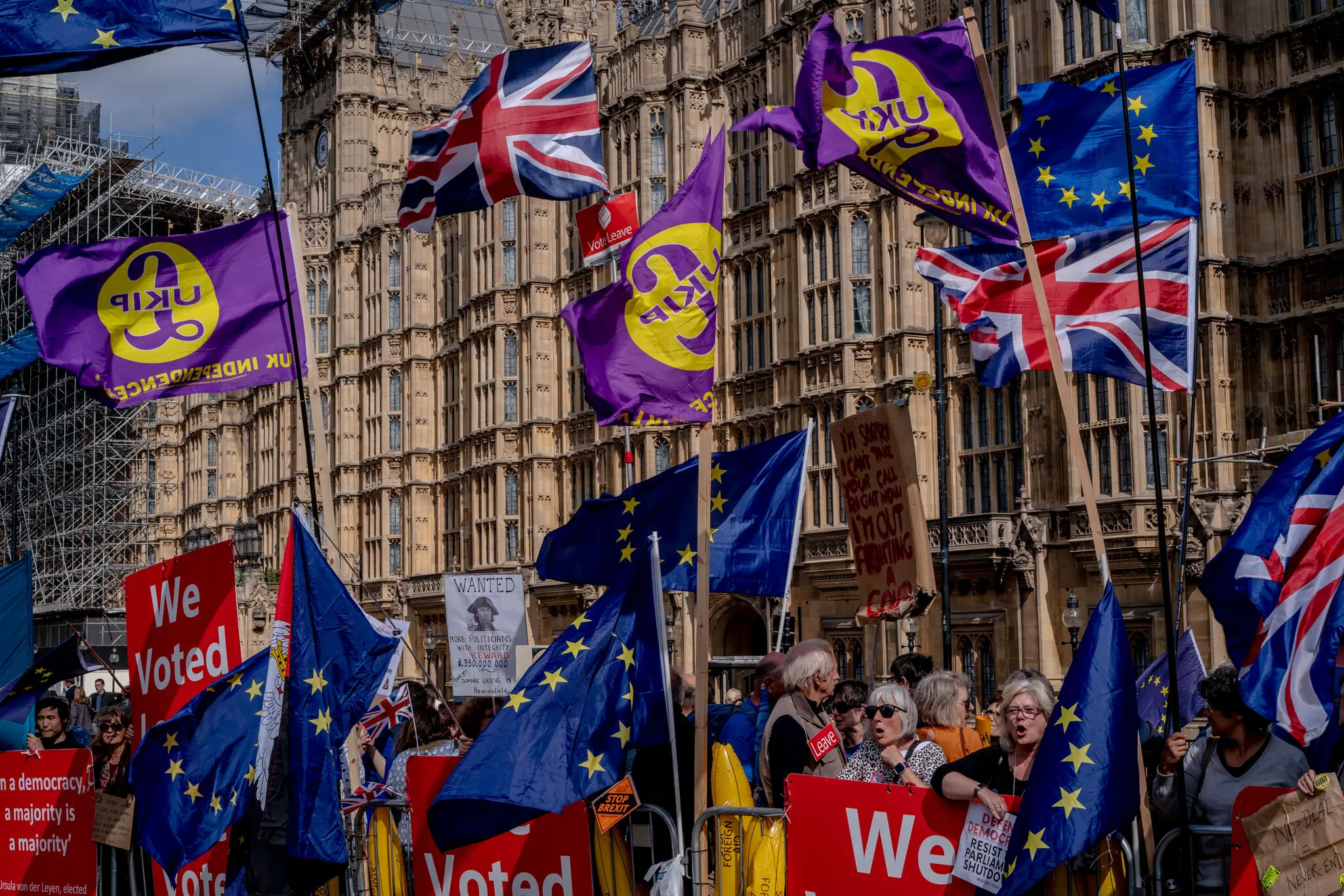
    Britain has watched President Trump’s tariffs with a mix of shock, fascination and queasy recognition. The country, after all, embarked on a similar experiment in economic isolationism when it voted to leave the European Union in 2016. Nearly nine years after the Brexit referendum, it is still reckoning with the costs.

    The lessons of that experience are suddenly relevant again as Mr. Trump uses a similar playbook to erect walls around the United States. Critics once described Brexit as the greatest act of economic self-harm by a Western country in the post-World War II era. It may now be getting a run for its money across the Atlantic.

    Even Mr. Trump’s abrupt reversal last week of some of his tariffs, in the face of a bond-market revolt, recalled Britain, where Liz Truss, a short-lived prime minister, was forced to retreat from radical tax cuts that frightened the markets. Her misbegotten experiment was the culmination of a cycle of extreme policies set off by Britain’s decision to forsake the world’s largest trading bloc.

    “In a way, some of the worst legacies of Brexit are still ahead,” said Mark Malloch Brown, a British diplomat who served as deputy secretary-general of the United Nations. Britain, he said, now faces a hard choice between rebuilding trade ties with Europe or preserving them with Mr. Trump’s America.

    “The fundamental issue remains the breach with our biggest trading partner,” Mr. Malloch Brown said, adding, “If the U.K. ends up in the arms of Europe because neither of them can work with the U.S. anymore, that’s only half a victory.”

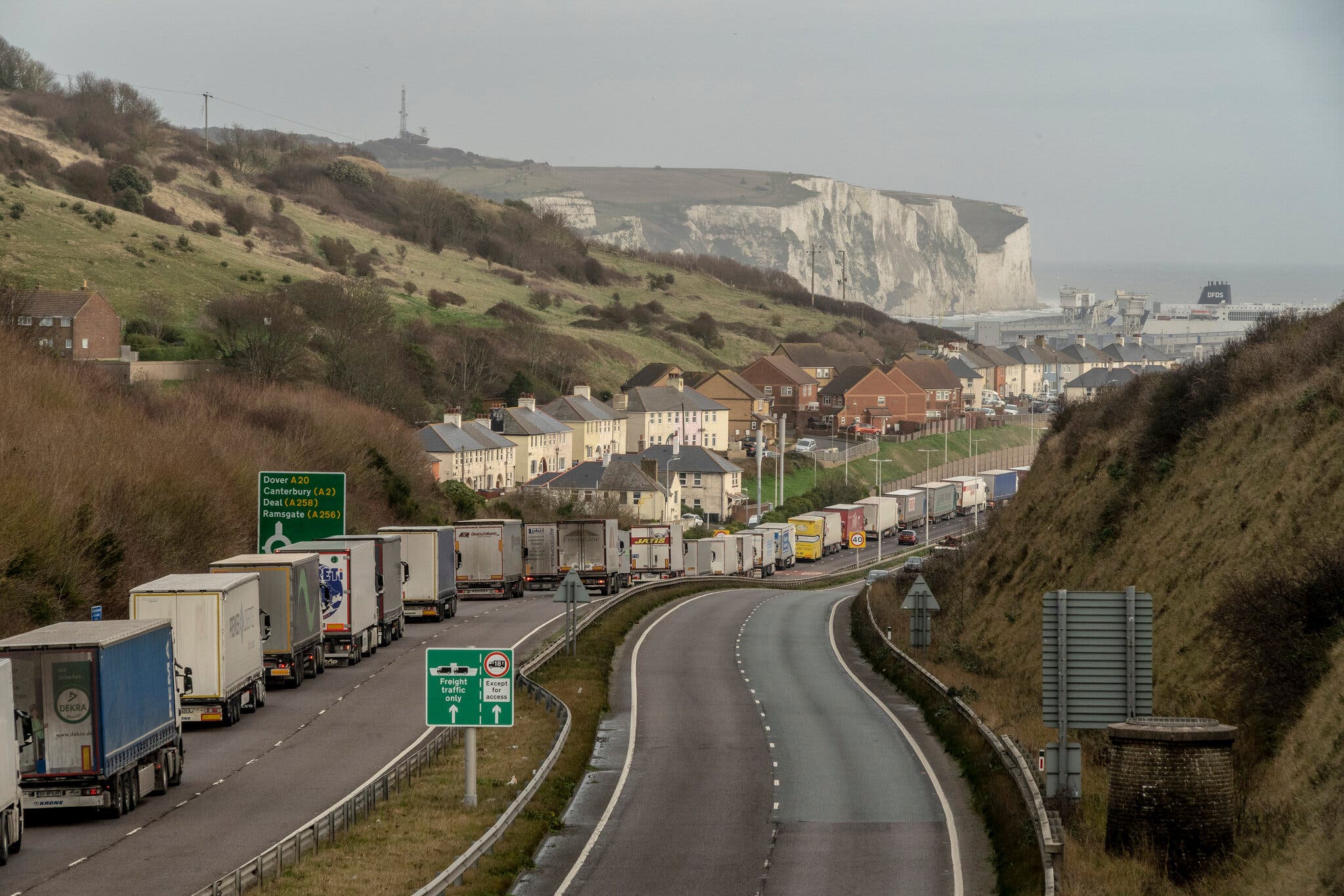
    Trucks waiting to enter the British port of Dover in December 2020. Credit…Andrew Testa for The New York Times

    Mr. Trump was a full-throated champion of Brexit in 2016, drawing explicit parallels between it and the political movement he was marshaling. He initially imposed lower tariffs on Britain than the European Union, which some cast as a reward for Britain’s decision to leave.

    Brexit’s drag on the British economy is no longer much debated, though its effects have been at times hard to disentangle from subsequent shocks delivered by the coronavirus pandemic, the war in Ukraine and, now, Mr. Trump’s tariffs.

    The government’s Office of Budget Responsibility estimates that Britain’s overall trade volume is about 15 percent lower than it would have been had it remained in the European Union. Long-term productivity is 4 percent lower than it would have been because of trade barriers with Europe.

    Productivity was lagging even before Brexit, but the rupture with Europe compounded the problem by sowing uncertainty, which chilled private investment. The years between the referendum and Britain’s formal departure at the end of January 2020 were paralyzed by debate over the terms of its exit.

    By the middle of 2022, investment in Britain was 11 percent lower than it would have been without Brexit, based on a model by John Springford, who used a basket of comparable economies to stand in for a non-Brexit Britain. Trade in goods was 7 percent lower and gross domestic product 5.5 percent lower, according to Mr. Springford, a fellow at the Center for European Reform, a think tank in London.

    Mr. Trump has kicked off even more volatility by imposing, redoubling and then pausing various tariffs. His actions, of course, affect dozens of countries, most dramatically the United States and China. Already, there are predictions of recession and a new bout of inflation.

    Brexit and its aftermath had multiple second-order effects, both economic and political. Ms. Truss’s plan for debt-funded tax cuts, which were driven by a desire to jump-start Britain’s torpid economy, instead triggered a sell-off of British government bonds as investors recoiled from her proposals.

    A similar sell-off of American bonds began last week, with far-reaching implications for the United States. Rising bond yields put pressure on governments because it means they must pay more to borrow funds. Sell-offs are also destabilizing because they signal deeper anxiety about a country’s creditworthiness.

    In Britain’s case, fears of a credit crisis forced Ms. Truss to shelve the tax cuts, and she soon lost her job. While that calmed the markets, it left a residue of doubt among investors about Britain. Mortgage rates remained elevated for months, reflecting what one analyst unkindly labeled a “moron premium.”

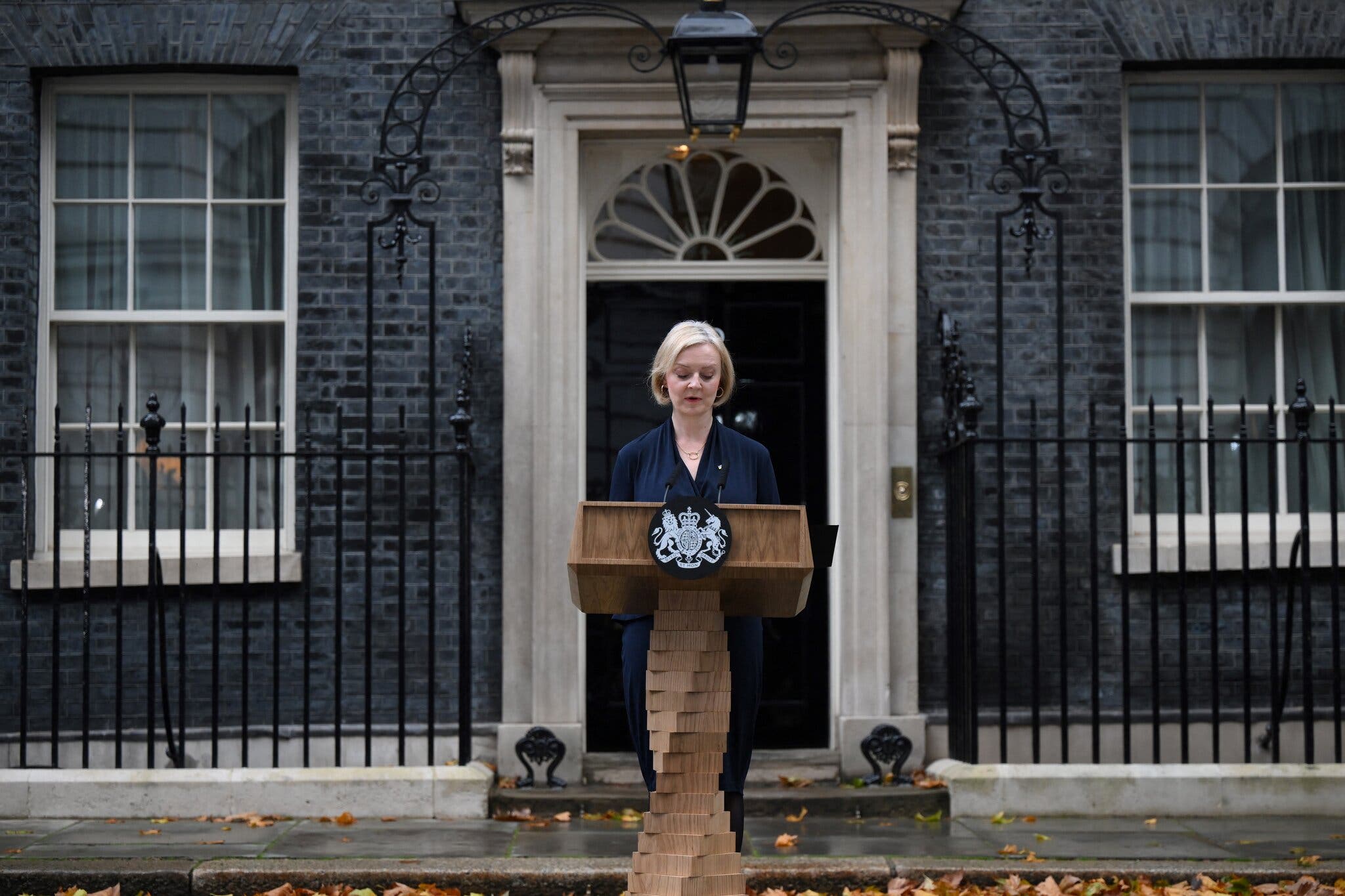
    Liz Truss resigned from her post as prime minister of Britain in October 2022.Credit…Daniel Leal/Agence France-Presse — Getty Images

    This skittishness among investors has constrained Britain’s chancellor of the Exchequer, Rachel Reeves, from taking bolder measures to recharge the economy. Prime Minister Keir Starmer last week ruled out relaxing the government’s self-imposed fiscal constraints, citing the blowback to Ms. Truss’s free-market experiment.

    “I would argue that the reason we have such a small-c conservative chancellor is due to the experience we had with Truss,” Mr. Malloch Brown said. “It is directly related to not wanting to prompt the Truss effect again.”

    Unlike Britain, the United States still has the world’s default currency in the dollar, and until last week, Treasuries remained a haven for investors. But economists predict that both will be subjected to greater pressure under Mr. Trump.

    “Confidence has been shaken, the bond vigilantes are more alert,” said Richard Portes, a professor of economics at London Business School. “People are now much more sensitive to policy inconsistency and policy irresponsibility.”

    Brexit also diminished Britain’s influence on the diplomatic stage, something it has only recently begun to recoup with Mr. Starmer’s efforts to act as a bridge between Europe and the United States.

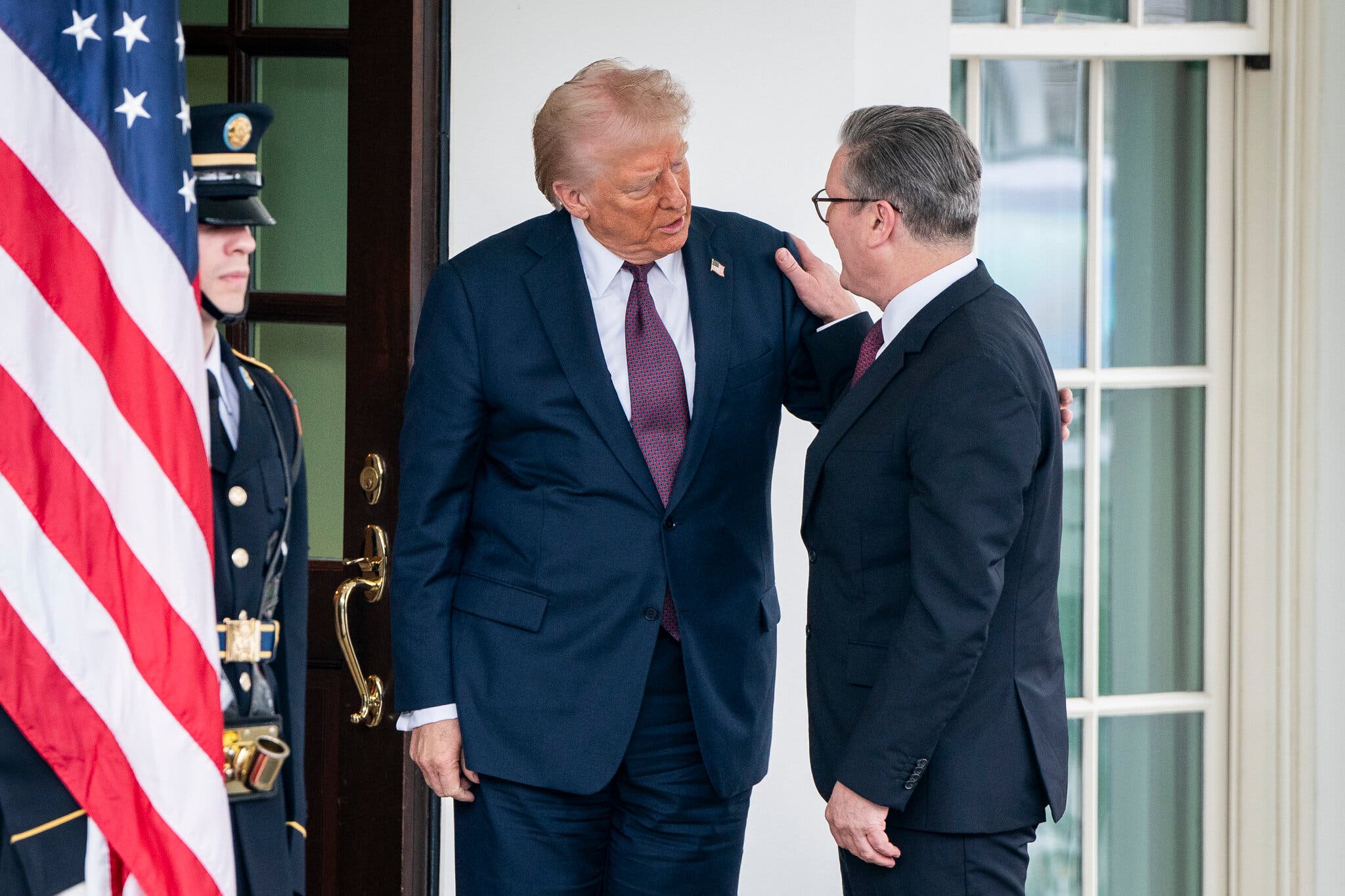
    President Trump greeting Prime Minister Keir Starmer of Britain in February outside the White House.Credit…Haiyun Jiang for The New York Times

    Mr. Trump’s retreat from America’s role as a security umbrella for NATO has driven Britain closer to Europe. But Britons still wrestle with the legacy of Brexit. A defense pact with the European Union, for instance, is being held up by France’s demand that Britain make concessions on fishing rights — an old chestnut from Brexit negotiations.

    The longest-lasting effect of Brexit, analysts say, may have been on politics. The years of bitter debate divided and radicalized the Conservative Party, which governed from 2010 to 2024 with a patchwork of policies on immigration and trade that reflected the unwieldy coalition behind Brexit.

    Some Brexiteers pushed a vision of Britain as a low-tax, lightly regulated, free-trading nation — Singapore-on-Thames, in their catchphrase. Others wanted a stronger state role in the economy to protect workers in the left-behind hinterland from open borders and the ravages of the global economy.

    These contradictions resulted in policies that often seemed at odds with the message of Brexit. Britain, for example, experienced a record surge of net migration in the years after it left the European Union. The difference was that more of these immigrants were from South Asia and Africa, and fewer from Central and Southern Europe.

    Brexit’s backers sold the project as a magic bullet that would solve the problems caused by a globalizing economy — not unlike Mr. Trump’s claims that tariffs would be a boon to the public purse and a remedy for the inequities of global trade. In neither case, experts said, does such a panacea exist.

    “The truth is, Brexit did not correct any of the problems caused by deindustrialization,” said Tony Travers, a professor of politics at the London School of Economics. “If anything, Brexit made them worse.”

    Frustrations over the economy and immigration were among the reasons that voters swept out the Conservatives in favor of Mr. Starmer’s Labour Party last year. But his government has kept grappling with these issues, as well as with the bruised aftermath of Britain’s divorce from Europe.

    Mr. Trump’s MAGA coalition has some of the same ideological fault lines as the Brexiteers, pitting economic nationalists like Stephen K. Bannon against globalists like Elon Musk. That has led analysts to wonder if post-Trump politics in the United States will look a lot like post-Brexit politics in Britain.

    “Brexit caused profound damage to the Conservative Party,” Professor Travers said. “It has been rendered unelectable because it is riven by factions. Will the Republican Party be similarly factionalized after Trump?”

    A countdown clock displayed on 10 Downing Street showed the moment the United Kingdom left the European Union at the end of January 2020.Credit…Mary Turner for The New York Times

  • The big trade fight with China doesn’t look like it’s going to get better anytime soon.

    The big trade fight with China doesn’t look like it’s going to get better anytime soon.

    President Trump’s rapidly escalating trade war with China has resulted in eye-watering tariffs on products exchanged between the countries and scrambled prospects for many global businesses that depend on the trade. And there is no end in sight.

    The Trump administration has been waiting for the Chinese leader, Xi Jinping, to call Mr. Trump personally, but Beijing appears wary of putting Mr. Xi in an unpredictable and potentially embarrassing situation with the U.S. president.

    With the two governments at an impasse, businesses that rely on sourcing products from China — varying from hardware stores to toymakers — have been thrown into turmoil. The triple-digit tariff rates have forced many to halt shipments entirely.

    Mr. Trump has rapidly ratcheted up tariffs on Chinese products, from 54 percent on April 2 to 145 percent just one week later. The Chinese government has argued that the actions are unfair and closely matched his moves, raising its tariffs on American goods to 125 percent on Friday.

    But on Friday night, the administration created a significant carve out to its tariffs on China when it exempted some electronics, including smartphones, laptops and televisions. Those products will still be subject to other tariffs that Mr. Trump has put in place, like a 20 percent fee he added to Chinese goods in response to the country’s role in the fentanyl trade.

    Mr. Trump has said he would like to speak with Mr. Xi, but he has stopped short of requesting a phone call, believing that it is the Chinese government’s turn to ask for such a call, according to people familiar with the matter. Trump officials say that dozens of countries have reached out to the administration about negotiations since the levies were imposed. China did not, and instead responded with harsh words and tariffs of its own.

    Across the Trump administration, some officials are concerned that the trade war could soon escalate into a national security crisis, potentially causing the Chinese to move up plans for a military invasion of Taiwan.

    The Pentagon is assessing the impact of China potentially cutting off rare earth exports to the United States and possibly blocking certain critical components used in U.S. weapons systems, according to a person with knowledge of the preparations. The aim is to fully ascertain what harm the Chinese could inflict on America’s ability to produce and maintain certain weapons and ammunition.

    Mr. Trump continues to express optimism, saying that he has always gotten along with Mr. Xi and that “something positive” will come out of the relationship. But analysts have suggested that the situation may already have spiraled out of control.

    Julian Evans-Pritchard, the head of China economics for the research firm Capital Economics, said the fact that the Chinese authorities had repeatedly matched U.S. tariff hikes suggested that they were in no rush to negotiate.

    “A partial rollback of tariffs still seems likely at some point,” he said. “But it is hard to envisage a meaningful reset in the U.S.-China relationship.”

    At a briefing on Friday, Karoline Leavitt, the White House press secretary, declined to say whether the countries were in communication.

    “I’m not going to comment on communications that are happening, or may not be happening, or either way, we’ll leave it to our national security team to get these discussions underway,” she said. She said the president was optimistic, and that he had “made it very clear he’s open to a deal with China.”

    Speaking last week at the White House, Mr. Trump said that “China wants to make a deal. They just don’t know how quite to go about it.” He added that the Chinese were “proud people.”

    Mr. Trump’s moves have taken tariffs to a level far past what would be prohibitive for trade, creating crises for many American businesses that depend on imports from China.

    Rick Woldenberg, who runs Learning Resources, an Illinois-based maker of educational toys, said the latest tariffs had already forced him to pause some shipments from China. He called the rates that Mr. Trump had imposed “a joke” and said that even concessions from his suppliers could not make a dent in the fees he would owe to the U.S. government.

    Learning Resources contracts with factories in Taiwan, India, Vietnam and other countries to make its products, but China is by far its biggest supplier, as it is for most toymakers. China accounted for two-thirds of all imports of toys and sporting goods to the United States last year.

    Learning Resources employs about 500 people, most of them in the United States. It had planned to hire more this year to keep up with its fast-growing business, but has now abandoned some of those plans.

    “We’re being asphyxiated by our very own government,” Mr. Woldenberg said.

    Mr. Woldenberg said he paid about $2.3 million in tariffs and duties in 2024. This year, he would end up paying more than $100 million if sales somehow kept up with his projections from before the trade war. That’s more than he could pay if he cut every expense in the company other than base payroll.

    At this point, Mr. Woldenberg said, the number hardly matters — beyond a certain level, the tariff is simply no longer something anyone in his business can afford to pay.

    “He could raise it to 100 billion percent — it doesn’t matter,” he said. “It’s like a legal ban.”

    Christophe Lavigne, the president of Highfield, which manufactures boats in China and the United States, said he expected to be subject to 198 percent tariffs on some of his imports, and that he has decided to simply stop his shipments for now.

    He said his entire company, and the jobs of his employees and his dealers, was on the line. The pace of change was too fast and unpredictable, he added.

    “We cannot adjust our production lines quickly enough,” he said. “Converting our entire supply chain in just two months is not feasible.” 

    Major multinational corporations have been in a better position to source products from countries besides China, but they too are reeling. Hobby Lobby, the crafting retailer, told vendors on Thursday that it was delaying shipments from China as a result of the escalating trade war, according to correspondence viewed by The New York Times.

    The retailer told vendors that the back-and-forth tariffs had resulted in “a rapidly shifting and unpredictable landscape” and that it hoped diplomacy between the United States and China would “yield a more stable and balanced outcome.”

    The implications of disrupting business with one of the country’s biggest trading partners have ricocheted through the economy. The dollar fell to a three-year low on Friday, while Treasury yields continued to swing. A measure of consumer sentiment also tumbled, indicating that Americans were becoming nervous about how higher tariffs might affect them.

    Mr. Trump abruptly announced on Wednesday a 90-day pause on the “reciprocal” tariffs that he had unveiled the previous week on countries around the world, and which had gone into effect just hours earlier. But the threat of those tariffs, and of retaliation against U.S. exports, continues to hang over the global economy.

    It remains to be seen if the United States and China might try to reach some agreement soon. People familiar with the conversations said that members of the White House National Security Council were in touch with counterparts at the Chinese Embassy, and that Cui Tiankai, the former Chinese ambassador, had held meetings in Washington and New York over the past several weeks to discuss the relationship. But there has been little sign of communication between higher-ranking officials in the Trump administration and the Chinese government.

    Early in Mr. Trump’s first term, Mr. Xi flew to his Mar-a-Lago estate in Florida to meet with Mr. Trump for hours, sharing what Mr. Trump later referred to as “the most beautiful piece of chocolate cake you’ve ever seen.” But that did not stop the countries from entering into a bruising trade war. And in his second term, Mr. Trump has been even more emboldened and unpredictable.

    Mr. Trump has given few indications publicly of what he wants the Chinese to do. But Trump officials say the issues are well known. In an annual report released March 31, the Office of the United States Trade Representative detailed the trade barriers that U.S. businesses face when selling abroad, dedicating almost 50 of its nearly 400 pages to China.

    In recent weeks, in addition to countering Mr. Trump’s tariff threats, China has added some U.S. companies to an unreliable entity list that essentially bars them from doing business in the country. It has also imposed licensing systems to restrict exports of rare earth elements, which are essential for electric cars and other products.

    On Friday, as it announced its latest increase in tariffs on American products, the Chinese government said it would not raise the rate further because it was already so high that the number no longer made any difference.

    China’s Ministry of Commerce said that the United States had used tariffs “for bullying and coercion” and had ultimately become “a laughingstock.”

    “If the U.S. continues its tariff numbers game, China will ignore it,” it said.

    China also ratcheted up pressure on U.S. companies as it issued new regulations on Friday that will subject semiconductors made by U.S. firms overseas to higher tariffs.

    The move will put pressure on companies like Intel, Global Foundries and others that have U.S. chip factories. It may also encourage chip companies to shift manufacturing out of the United States to maintain access to the Chinese market, where the bulk of global electronics are made.

  • Why aren’t the democrats fighting harder against Trumps trade problems?

    Why aren’t the democrats fighting harder against Trumps trade problems?

    This has been the mealymouthed critique of President Donald Trump’s trade wars from many Democrats this past week. They awkwardly triangulate between bashing Trump’s catastrophic ideas and touting support for their own similarly spirited, if scaled-down, ideas. No wonder their message is falling flat.

    Trump’s current tariff regime — including “only” 10 percent levies on 70 countries, plus 145 percent on China — will devastate the U.S. economy. His tariffs imposed so far are estimated to raise a typical household’s annual costs by $2,700, with lower-income Americans shouldering the biggest burden. That’s only a subset of the damage. Recession risks have surged, companies have begun furloughing workers, and our once-close allies are flipping us the bird.

    If this is a curse to the U.S. economy, it should be a windfall for Democratic politicians. Instead, Democrats are blowing their good fortune.

    Rather than shouting from the rooftops that trade wars are bad, Democrats babble in “yes, buts.” Yes, these particular tariffs are costly and regressive, they say, but when Democrats impose tariffs, somehow they present no such downsides.

    The most obvious cognitive dissonance relates to Trump’s first-term tariffs. Democrats assailed these policies in the 2018 midterms and 2020 presidential election — shortly before adopting them as their own.

    For instance, in 2019, then-presidential candidate Joe Biden said Trump’s China tariffs led to “American farmers, manufacturers and consumers losing and paying more.” The 2020 Democratic platformsaid Trump had “launched reckless, politically-motivated tariff wars that have punished American workers, antagonized our allies, and benefited our adversaries.” They were right!

    But as president, Biden extended (nearly) all of Trump’s existing tariffs. In some cases, he expanded them or replaced them with slightly different trade barriers. He did so with vigorous support from his party.

    Given this checkered record, it’s no wonder Democrats struggle to articulate a clear, credible critique of Trump’s (now much worse) tariff policy.

    In a social media video this month, House Democrats opened with an awkward defense of protectionism: “I think a wrong-for-decades consensus on ‘free trade’ has been a race to the bottom,” Rep. Chris Deluzio (D-Pennsylvania) said, adding that we need “a better trade approach” that is “pro-worker.”

    Deluzio clarified that he didn’t mean Trump’s trade approach, per se — even though Republicans likewise claim Trump’s approach is “pro-worker.”

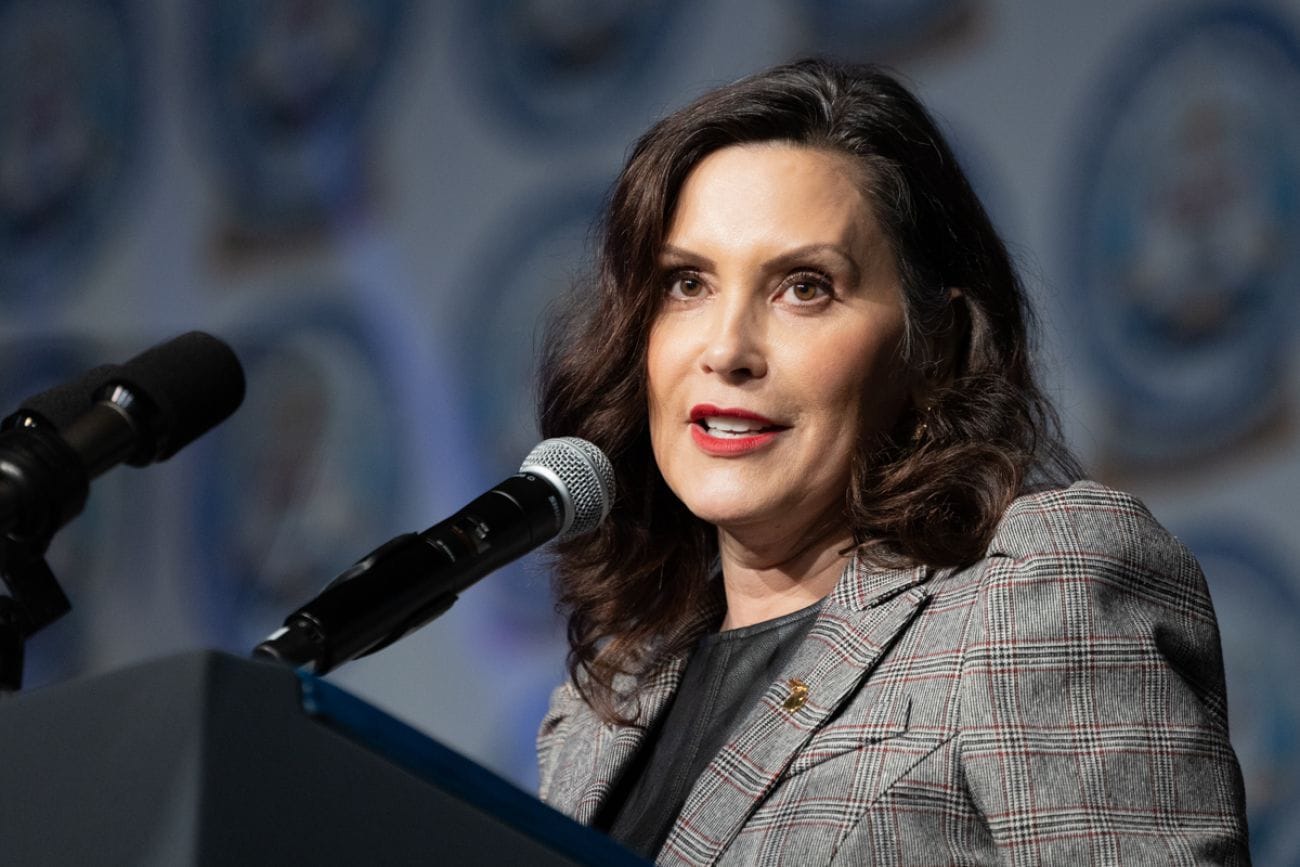
    On Wednesday, Michigan Gov. Gretchen Whitmer (D) gave a speech criticizing Trump for wielding tariffs like a “hammer.” When asked how she would deploy tariffs differently, Whitmer could not answer. “I don’t know how I would have enacted them differently,” she said. “I haven’t really thought about that. What I have thought about, though, is, you know, tariffs are, need to be used like a scalpel, not a hammer.”

    Other Democrats, such as Massachusetts Sen. Elizabeth Warren, assert that the real problem with Trump’s tariffs is that companies will use them as an excuse for “price gouging” and profiteering. The stock market massacre suggests investors don’t agree tariffs will be profitable. But even if Warren’s critique were true, the same logic should apply to the Biden-née-Trump tariffs Warren backed.

    Elsewhere, lefty populist thinkers explain that Trump’s tariffs are bad but tariffs could be good if only the resulting revenue were used for things Democrats like. (Never mind that whole poor-people-bear-the-costs problem.) Both they and their horseshoe-theory-demonstrating conservative counterparts contend that Trump’s execution might be lousy, but the underlying premise — that America must build higher economic walls — remains correct.

    Real trade wars, it seems, have never been tried.

    To be clear, there are some limited circumstances in which tariffs (or sanctions) could be an appropriate way to build U.S. capacity or punish bad behavior. For example, if an adversarial country has a stranglehold on some technology critical to national defense. Or if an exporter is using slave labor.

    But that’s not what either party has endorsed. Both Trump and his Democratic critics have supported broad tariffs on our allies and on random consumer goods (tiki torches, guitars, toothbrushes) with no plausible security or “resiliency” justification.

    How did Democrats back themselves into this corner? Partly they’re pandering to pro-tariff constituencies (i.e., unions, once reliable Democratic allies). Populist, anti-“neoliberal” think tanks have also overtaken the party. These often employ political operatives churning out pseudo-scholarly research, which the media then credulously cites. (Republicans invented and perfected this model more than a decade earlier, though it doesn’t seem to have served Democrats as well politically.)

    That’s how you end up with Democratic leaders embracing such quackery as “greedflation” and price controls — both of which, by the way, the Trump administration is also now flirting with. This Trump blunder should be yet another layup for Democrats, but they can’t really dunk on it now, can they?

    The political calculus on all this is changing. Aggressive trade barriers, no longer abstract hypotheticals, are proving as disastrous as “neoliberal” economists predicted. Americans hate Trump’s tariffs. Even most manufacturing workers think they’re a bad idea, according to a Post poll.

    Democrats should stop pulling their punches. What the country needs is an unequivocal, full-throated condemnation of pandering protectionism. Let this be the moment that liberates the Democratic Party from the populists tying them to the same mercantilist, regressive, costly command-and-control economic policies that so often drive Trump’s agenda.