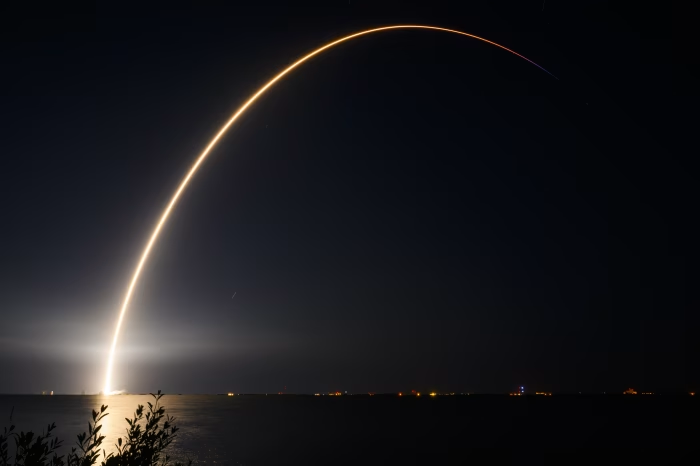
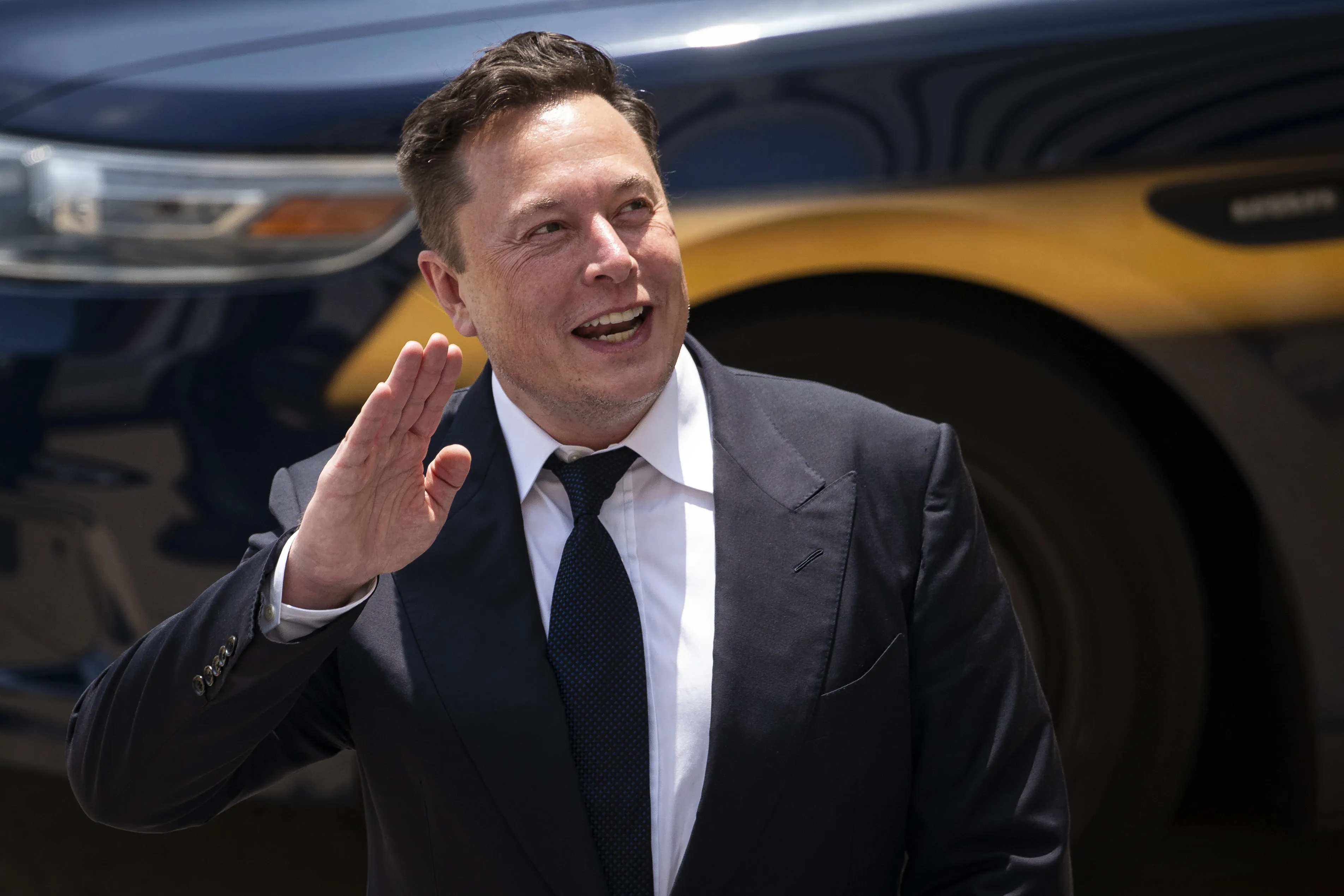
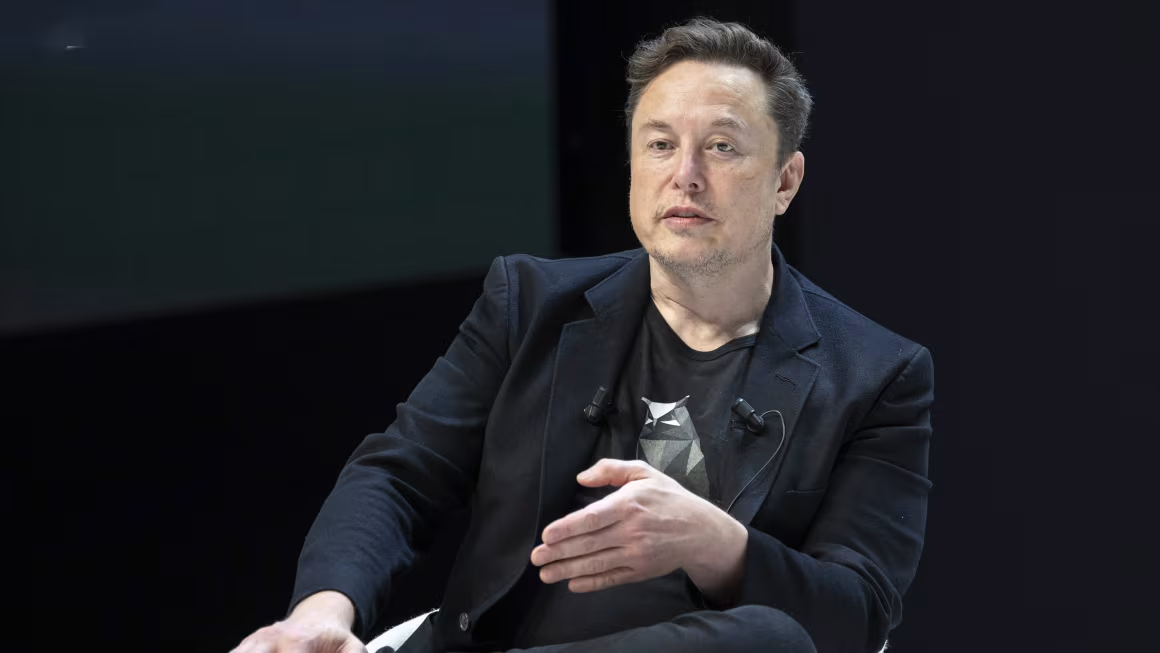
Elon Musk’s SpaceX is seeking an early boost for shares after the rocket-and-satellite business makes its stock market debut later this year.
Advisers for the company, which recently merged with xAI, have reached out to major index providers, including Nasdaq, to discuss how SpaceX and this year’s other hot startups might join key indexes sooner than normal, according to people familiar with the matter.
Companies typically must wait several months or a year after their public debut before gaining inclusion in a major index such as the S&P 500 or the Nasdaq 100. Inclusion unlocks access to retail and institutional capital from funds, particularly those mimicking the performance of indexes that have to hold the companies in the index.
The traditional waiting period is intended to give the companies time to demonstrate that they are stable and liquid enough to handle extensive buying from index funds.
SpaceX hopes to skirt traditional rules in an effort to bring liquidity to its shareholders sooner as part of its planned IPO. SpaceX advisers have sought index policy changes that would fast-track its entry into major indexes for the company and benefit other highly-valued private companies, the people said.
Last valued at $800 billion, SpaceX is targeting a valuation of more than $1 trillion, a listing that would become the largest-ever U.S. IPO.
Investors and advisers to companies planning to go public this year are concerned not only about initial trading, but also that the standard six-month lockup period—which prevents early investors, executives and employees from selling their stock—might prompt significant selling that pressures shares. After Meta went public in 2012, shares sank when early investors unloaded all at once.
SpaceX is exploring ways to better balance supply and demand to avoid that outcome, some of the people said.
Advocates of index methodology changes have said that by allowing newly public companies earlier entry to key indexes, individual investors, who have famously missed out on the big gains in private markets, could secure earlier exposure via popular exchange-traded funds and index funds.
Earlier this week, the Nasdaq Stock Market shared proposals to update some of the Nasdaq 100 index methodology and asked for feedback from market participants.
Among the proposals is a potential “fast entry” process. Under this option, companies whose market capitalizations rank in the top 40 of the Nasdaq 100’s constituents could be added to the index after 15 trading days. Companies typically now must wait at least three months to be added to the index. At their current valuations, SpaceX, OpenAI and Anthropic would all qualify.
The S&P Total Market Index and MSCI indexes have fast-track options, which some advisers to SpaceX are also exploring in an effort to ensure the IPO trades well, some of the people familiar with the matter said.
The one index where there is now no fast-entry option is also one of the most important: The S&P 500. To join the index, a company must be U.S.-based, profitable and have a market capitalization of at least $22.7 billion. Joining gives it access to a steadier index-fund investor base.
OpenAI is laying the groundwork for a fourth-quarter IPO as it races rival Anthropic to list shares publicly. OpenAI is aiming to raise $100 billion before the IPO at a valuation of more than $800 billion, while Anthropic is raising billions more at a valuation of $350 billion.
On Monday, Elon Musk announced that he was merging two of his companies, SpaceX and xAI, in a deal said to be worth $1.25 trillion. The reason, Musk said in an announcement, was that in order for AI to grow, it needed to go to space.
AI relies on “large terrestrial data centers” that run on “immense amounts of power and cooling,” he said, which comes at great expense to the environment and community opposition. The solution: data centers in space. “In the long term, space-based AI is obviously the only way to scale,” Musk said.
Musk isn’t the only one looking to launch data centers into orbit. Google has Project Suncatcher to build solar-powered AI data centers in space. China is looking into space-based data centers, as is Europe. As we reported last year, space-based data centers — in the form of satellites with solar panels — are Big Tech’s latest fad and Silicon Valley’s newest investable venture.
On the surface, it sounds like a logical solution to the unique problem presented by power-hungry data centers. Local communities are rising up against data center projects over concerns about electricity demand, water usage, and rising utility rates. Launching those data centers into space means they are not taking up any space on Earth, and in a sun-synchronous orbit there is the availability of solar energy.
AI relies on “large terrestrial data centers” that run on “immense amounts of power and cooling,” Musk said, which comes at great expense to the environment
But there’s another, simpler way of looking at Musk’s merger: SpaceX is profitable, and xAI is not. Not only is xAI not profitable, it’s in the midst of a serious cash burn as it races to compete with well-financed rivals like Google and OpenAI. As Bloomberg recently reported, the AI company is burning about $1 billion a month as it spends heavily to build data centers, recruit talent, and run the social media platform X.
Meanwhile, SpaceX generated about $8 billion in profit on an estimated $16 billion of revenue last year, Reuters reported. The main revenue driver is Starlink, which accounts for up to 80 percent of the company’s revenue. Since 2019, SpaceX has launched over 9,500 satellites and boasts up to 9 million broadband internet users. The company is also a major government contractor, having secured over $20 billion in NASA and Defense Department deals since 2008. When it goes public later this year, SpaceX is expected to raise up to $50 billion in investment.
Meanwhile, xAI has it own government tie-ups. The Department of Defense is using Grok, in addition to other chatbots, to analyze information that flows through its military intelligence networks.
It’s not clear how investors will feel about merging the cash-burning xAI with the profitable SpaceX. But it’s important to note that Musk has done this before, when he merged the debt-ridden SolarCity with Tesla in 2016. Since Musk was the largest shareholder and chairman of both Tesla and SolarCity, shareholders sued to block the merger, alleging it was a $2.6 billion “bailout” of a cash-strapped, struggling company. Musk eventually won the lawsuit, with a judge ruling that he did not force Tesla to overpay for SolarCity.
Musk now faces a new lawsuit from Tesla shareholders over his creation of xAI. The lawsuit alleges that Musk breached his fiduciary duty to Tesla by forming xAI, which competes with the automaker for AI talent, resources, and Musk’s attention. The news that SpaceX is acquiring xAI certainly won’t settle those concerns; if anything, it makes it more chaotic and complex.
So where does this all leave Tesla? In the most recent earnings report, Tesla said it was investing $2 billion into xAI “to enhance Tesla’s ability to develop and deploy AI products and services into the physical world at scale.” Grok, xAI’s chatbot that’s currently under investigation in multiple countries for generating nonconsensual sexualized images of people, including children, was recently integrated into certain Tesla vehicles as a voice assistant. Grok also lags behind OpenAI’s ChatGPT, Google’s Gemini, Anthropic’s Claude, and other large language models in several key metrics.
Data centers in space is pure Musk futurism that has no guarantee of success. It’s not as simple as just strapping a GPU to a rocket and hitting “launch.” First off, GPUs are total power hogs. Unless you’ve got a nuclear reactor floating up there, you’re going to need a massive solar arrays to power it. Then there’s the communication situation; even if you’re hitching a ride on Starlink, you still have to figure out the budget for sending info back and forth to Earth. Eventually, the numbers start to look pretty scary.
Musk says merging SpaceX and xAI is the way to make it happen. And perhaps one day he’ll take the suggestion of bullish investors to combine all his companies, including Tesla, Neuralink, and the Boring Company, into one massive, Musk-run mega-corporation: Musk Inc., if you will. How will Tesla shareholders react?
“Tesla is Musk’s liquid piggy bank, since it’s publicly traded; his other companies are not,” Tesla investor James McRitchie said during a prevote presentation before the company’s 2024 shareholder meeting, according to The Wall Street Journal. “Either he sticks around long enough to use our shareholder capital to fund his other ventures, or he shifts his attention sooner if we reject his pay package and turn off the money tap.”
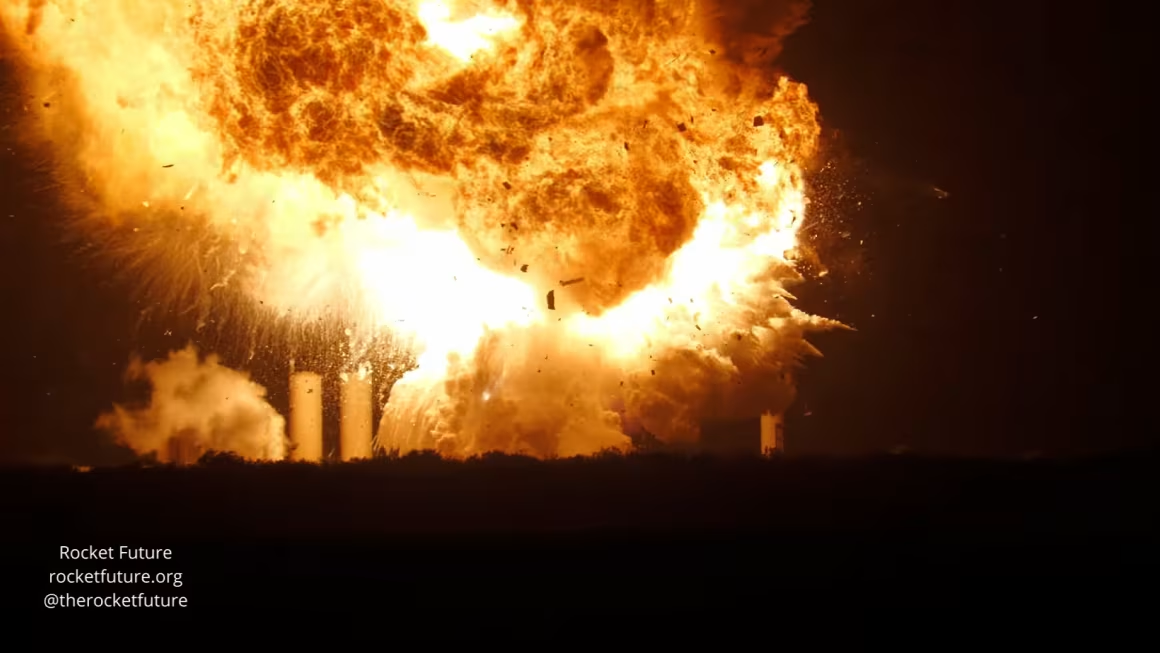
The explosion of a SpaceX Starship vehicle during a routine ground test Wednesday sent out a shock wave of fire and smoke that appeared to engulf the company’s testing facilities in Starbase, Texas. The mishap raised questions about the company’s ability to hash out significant design and engineering challenges on a vehicle considered crucial to SpaceX’s founding goal of eventually carrying convoys of people to Mars.
When SpaceX CEO Elon Musk spoke to employees in South Texas in late May, aiming to once again stoke support for his Mars ambitions, he emphasized the metric by which he would gauge success: “Progress is measured by the timeline to establishing a self-sustaining civilization on Mars.”
Later in his speech — which Musk gave two days after the company’s most recently launched Starship prototype failed upon reentry, marking the third premature ending for a test flight this year — he spelled out the exact timeline SpaceX would chase. The road map hinges on specific deadlines dictated by the laws of physics, thanks to just how far Earth is from the red planet.
The distance between Earth and Mars can range from about 35 million miles to 250 million miles (56 million kilometers to 400 million kilometers), depending on where each planet lies in its orbital path around the sun. To save time and fuel costs, missions aiming to visit the red planet must wait until it’s at its ideal point relative to Earth — prime alignment opportunities, otherwise known as a “Mars transfer windows,” that span a few weeks and occur only about every 26 months.
Missions save time and fuel costs by launching when Mars is at its ideal point relative to Earth. (SpaceX)
The next window, during which the travel time to Mars is cut down from over a year to just six to nine months, is coming up in late 2026. Musk’s road map suggests SpaceX hopes to send up to five uncrewed Starship vehicles loaded with cargo to Mars during that time. But there are several major concerns that SpaceX will need to address before its first cargo ship sets out for the red planet, and Wednesday’s explosion — Starship’s fourth so far this year — may be evidence of that.
Anticipated upgrade for Starship
Musk spoke to the feasibility of reaching Mars in 2026 during that May speech, saying that he imagined there was only a “50/50 chance” SpaceX could get a Starship spacecraft to Mars next year.
Before the 2026 Mars transfer window opens, SpaceX plans to debut another upgraded version of the Starship spacecraft and Super Heavy rocket booster — which together make up the most powerful launch system ever constructed.
On the new Starship system, both the first-stage booster and upper-stage ship will be slightly larger and together will be able to carry 661,387 pounds (300 metric tons) of propellant.
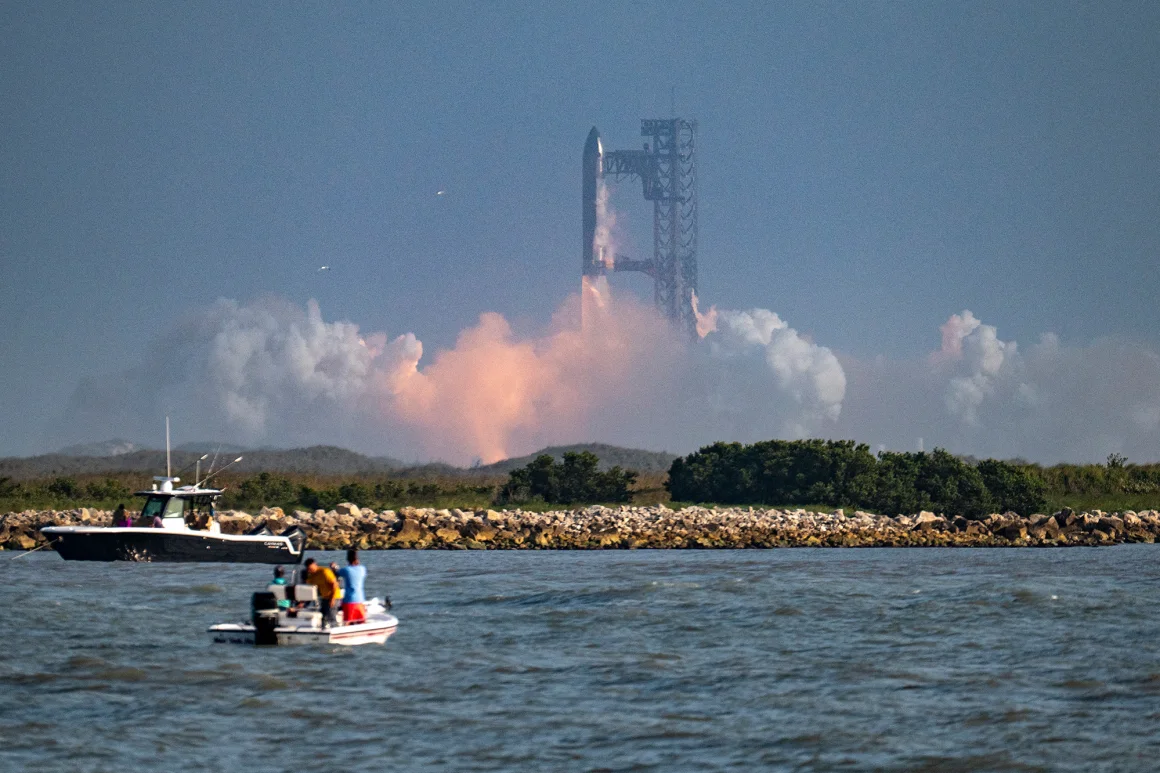
The SpaceX Starship rocket launches on its ninth uncrewed test flight from Starbase, Texas, on May 27. (Sergio Flores/AFP/Getty Images)
It’s a substantial upgrade similar to the one SpaceX debuted earlier this year, Starship Version 2, which added 25% more propellant capacity compared with earlier test flight models.
And SpaceX has struggled to get Version 2 to perform as expected: The first two test flights, carried out in January and March, each failed minutes after takeoff, raining debris near populated islands east of Florida.
The last test flight in May made it farther into flight, but the Starship spacecraft lost control before reentry, leading to a nail-biting, uncontrolled descent into the Indian Ocean.
And Wednesday’s explosion during a routine ground test raises even more concerns about how long it will take SpaceX to fine-tune Starship’s design and guarantee it can transport cargo or humans safely. The company hasn’t revealed how much of a setback it might be for the vehicle or its launch facilities.
Preliminary data suggested the explosion was caused by a gas tank that exploded, Musk said in a social media post. The tank “failed below its proof pressure,” he said, meaning that prior stress tests and the known properties of the tank suggested it should have survived the scenario. It’s potentially a unique problem that has never been observed before.
During his May 29 speech, Musk emphasized that introducing even more upgrades and further stretching Starship’s size is crucial to long-term success.
“It takes three major iterations of any major new technology to have it really work well,” Musk told employees during his Starship update.
An unprecedented challenge
Musk has said he hopes the updated Starship will make its flight debut by the end of the year.
But even if the new version pulls off a pristine test flight along the same suborbital route where SpaceX has carried out previous Starship test missions, it won’t guarantee the vehicle is ready for an interplanetary excursion.
That’s because, even with added fuel capacity, Starship must be topped off with more propellant after it reaches space to make the long trip to Mars.
SpaceX plans to do this by launching a series of tankers, or Starship vehicles designed to carry batches of fuel and oxidizer. Those tankers would rendezvous with the Starship while it idles in Earth’s orbit, transferring thousands of pounds of propellant and delivering the fuel the vehicle needs to continue its journey deeper into the solar system.
Notably, transferring fuel between two vehicles in space has never been done before.
“We’ve never done that. Nobody’s done that — transferring fuel from one spacecraft to another in orbit autonomously,” said Bruce Jakosky, a professor emeritus of geological sciences at the University of Colorado Boulder’s Laboratory for Atmospheric and Space Physics.
“That’s difficult,” Jakosky added, especially considering the Starship vehicle runs on cryogenic fuels — essentially oxygen and methane that are kept at temperatures so cold they liquify. And in the microgravity environment of orbit, that fuel can float about in its tank rather than settling in one place. So, among myriad other technical difficulties, SpaceX will likely have to devise pumps or motors that can effectively funnel the fuel from one ship to another.
Currently, it’s not even clear how many tankers SpaceX would need to launch to give one Starship vehicle enough gas for a trip to Mars. (In prior estimates, NASA personnel and third-party experts projected it may take roughly one dozen Starship tankers for a moon mission.)
In his speech, Musk said that he believed in-space fuel transfer would be “technically feasible.”
SpaceX will not attempt to carry out its first tanker flight test before next year, Musk added.
Barriers to reentry
Even after SpaceX sorts out the propellant transfer problem, they’ll face another significant technological question: How will Starship survive the trip down to the surface of Mars?
Musk last month called this issue “one of the toughest problems to solve.”
“No one has ever developed a truly reusable orbital heat shield so that is extremely difficult to do,” he said. “This will be something that we’ll be working on for a few years, I think, to keep honing.”
Vehicles that need to safely land on planetary bodies while traveling at orbital speeds must have a component called a heat shield — a special coating on the vehicle’s exterior that serves as a buffer to the scorching temperatures generated by the process of entering a planet’s atmosphere.
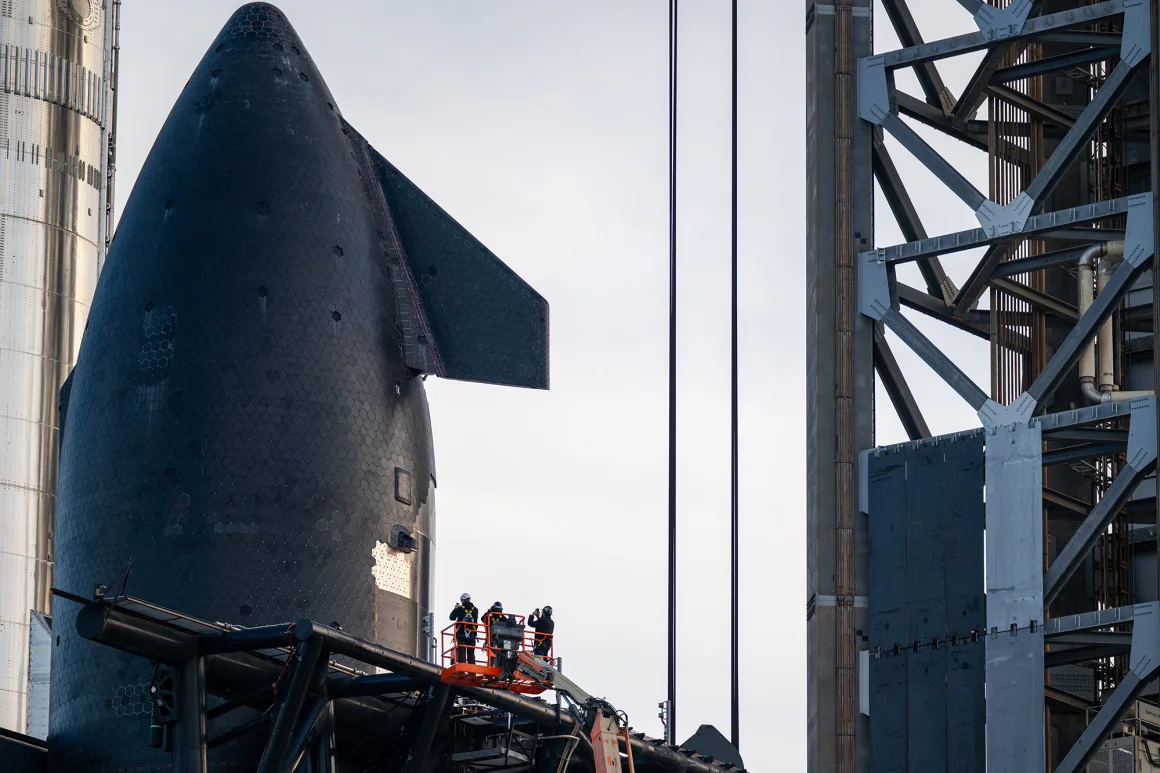
Workers survey the SpaceX Starship rocket on March 3 ahead of its eighth uncrewed test flight. (Brandon Bell/Getty Images)
On Mars, one crucial problem is the air: It’s almost entirely made up of carbon dioxide.
When Starship slams into Mars’ atmosphere, it will violently compress the air in front of it and create searing temperatures. And the conditions of reentry are so intense that the process literally rips electrons away from atoms and splits molecules, turning the carbon dioxide into carbon and oxygen — the latter of which may start to “oxidize” or essentially incinerate the spacecraft’s heat shield, Musk said.
Reentry on Mars will actually produce more heat–shield-destroying oxygen than the process of returning to Earth, Musk noted. Starship’s heat shield will ultimately need to be durable enough to survive both types of reentry, potentially multiple times.
The human problem
While the odds of SpaceX solving all the necessary technical quandaries in time to send a cargo-filled Starship to Mars at the end of next year are likely small, even larger problems must be solved later down the road.
If SpaceX wants to send humans to the red planet, for example, the company must figure out how to ensure Starship’s exterior can keep people safe from the deadly radiation that will shower down throughout the six-month journey. Life support systems with plenty of breathable air would need to be on board.
As Musk put it, every single human need must be accounted for. “You can’t be missing even, like, the equivalent of vitamin C,” he said.
Once a Starship vehicle reaches its destination, it would likely need to top off its fuel at a Martian depot before returning home — another feat that presents enormous technological challenges.
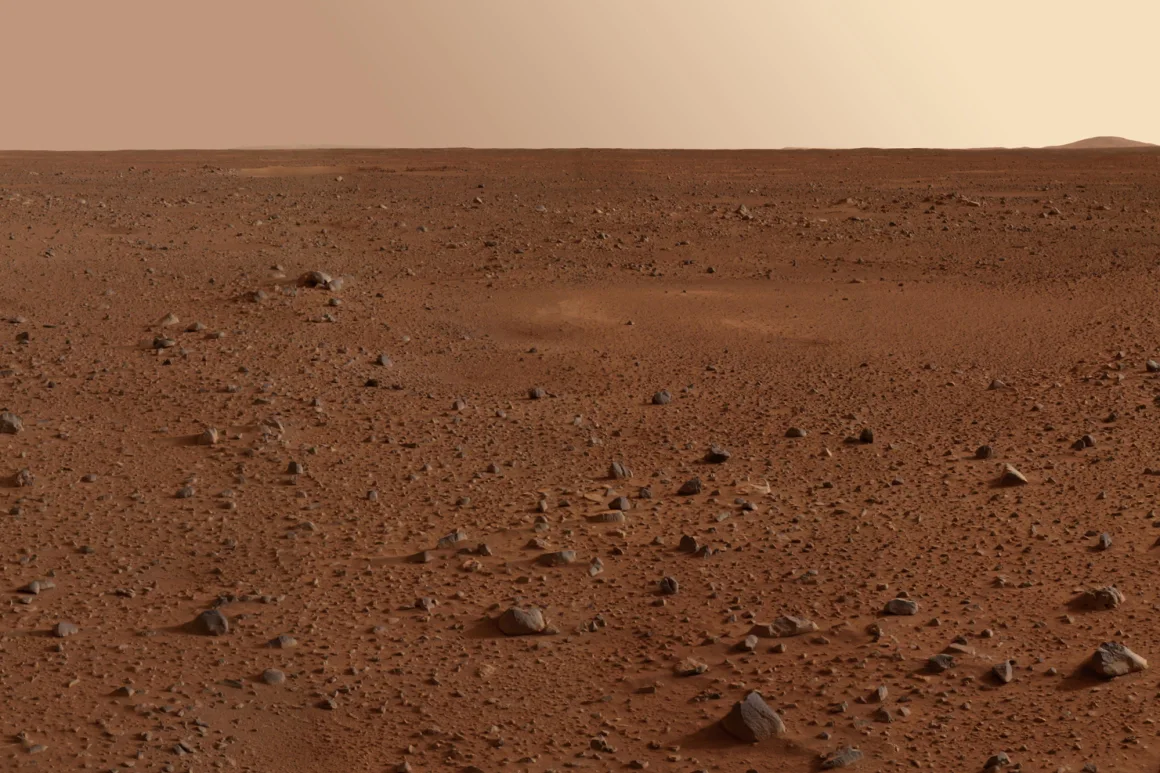
Starship’s heat shield will need to be durable enough to survive a trip to the surface of Mars. (NASA/JPL/Cornell)
The idea that enough infrastructure will exist on Mars by 2029 — or 2031, as Musk has said in prior social media posts — to make such a crewed mission possible is outlandish.
Still, industry experts say SpaceX’s bold ambitions spark both excitement and skepticism.
“I am a fan of what SpaceX is trying to do. I totally subscribe to this vision of a multi-planetary society,” said Olivier de Weck, the Apollo Program Professor of Astronautics and Engineering Systems at the Massachusetts Institute of Technology. “But it’s a logistical problem first and foremost. And what’s lacking to me is the thought about the cycling, the fuel production — and the return to Earth.”
But Phil Metzger, a planetary physicist with the Florida Space Institute, emphasized that SpaceX does tend to deliver on its promises, even if it’s a few years behind schedule.
“I feel like they got unlucky on some of their (Starship test flight failures), having the types of failures they had the last three in a row,” Metzger said. “Considering their design and development philosophy, I think they’re still within the window of expected outcomes.”
But, Metzger added, “we’re reaching the point where you start to worry.”
Cookie Consent
We use cookies to improve your experience on our site. By using our site, you consent to cookies.
Contains information related to marketing campaigns of the user. These are shared with Google AdWords / Google Ads when the Google Ads and Google Analytics accounts are linked together.
90 days
__utma
ID used to identify users and sessions
2 years after last activity
__utmt
Used to monitor number of Google Analytics server requests
10 minutes
__utmb
Used to distinguish new sessions and visits. This cookie is set when the GA.js javascript library is loaded and there is no existing __utmb cookie. The cookie is updated every time data is sent to the Google Analytics server.
30 minutes after last activity
__utmc
Used only with old Urchin versions of Google Analytics and not with GA.js. Was used to distinguish between new sessions and visits at the end of a session.
End of session (browser)
__utmz
Contains information about the traffic source or campaign that directed user to the website. The cookie is set when the GA.js javascript is loaded and updated when data is sent to the Google Anaytics server
6 months after last activity
__utmv
Contains custom information set by the web developer via the _setCustomVar method in Google Analytics. This cookie is updated every time new data is sent to the Google Analytics server.
2 years after last activity
__utmx
Used to determine whether a user is included in an A / B or Multivariate test.
18 months
_ga
ID used to identify users
2 years
_gali
Used by Google Analytics to determine which links on a page are being clicked
30 seconds
_ga_
ID used to identify users
2 years
_gid
ID used to identify users for 24 hours after last activity
24 hours
_gat
Used to monitor number of Google Analytics server requests when using Google Tag Manager