Category: Pharmaceutical

  • Johnson & Johnson Adjusts Its AI Strategy

    Johnson & Johnson Adjusts Its AI Strategy

    Johnson & Johnson has shifted its generative AI strategy away from broad experimentation across the healthcare conglomerate to a more focused approach.

    Chief Information Officer Jim Swanson said the move ensures that the company allocates resources only to the highest-value generative AI use cases, while it cuts projects that are redundant or simply not working, or where a technology other than GenAI works better.

    “That was a pivot we made after about a year of learning,” Swanson said. “Now we’ve moved from the thousand flowers to a really prioritized focus on GenAI.”The “thousand flowers” approach involved a number of use case ideas germinating from across the company, which made their way through a centralized governance board. At one point, employees were pursuing nearly 900 individual use cases, many that were redundant or simply didn’t work, he said. And as the company tracked the broad value of AI, including generative AI, data science and intelligent automation, it found that only 10% to 15% of use cases were driving about 80% of the value, he added.

    Now J&J is drilling down into high-value generative AI use cases around drug discovery and supply chains, as well as an internal chatbot to answer questions on company policy.

    “We’re prioritizing, we’re scaling, we’re looking at the things that make the most sense,” he said. “That was part of the maturation process we went through.”

    Since ChatGPT’s 2022 debut, companies have been grappling with where and how to start applying generative AI. Many, including J&J, encouraged experimentation, a strategy that set employees up to learn and test the technology and build applications that could see wider adoption across the enterprise.

    Yet in some cases, they are finding that too much experimentation can be at odds with actually finding business value and as a result are looking to forge a new strategy

    J&J began its pivot last year, removing a centralized governance board responsible for vetting employee GenAI ideas. It then distributed governance responsibilities to various corporate functions, including commercial, supply chain and research, that had a better handle on whether the use cases were actually driving value in their area. Those groups were able to shut down or consolidate redundant use cases and focus resources into the ones that were working.

    One example that is working is a “Rep Copilot,” which helps coach sales representatives on how to engage with healthcare professionals about new treatments. The company is piloting this in its Innovative Medicine business segment, which develops new treatments for oncology and other areas, and is now working to expand that pilot to its MedTech segment, which sells robotics and hardware like hip replacements and lenses.

    GenAI also is being used for an internal chatbot that ingests information about company policies and benefits to help reduce the some 10 million interactions employees have every year with the services team.

    In drug discovery, the company is looking at whether GenAI can help researchers find the optimal moment to add a solvent to turn a liquid molecule into a solid. Swanson said J&J also is testing how AI can help identify and mitigate supply-chain risks, including the impact of a shortage of a given raw material.

    The company is tracking progress in three buckets: first, the ability to successfully deploy and implement use cases; second, how widely they are adopted; and third, the extent to which they deliver on business outcomes.

    Swanson said the broad experimentation phase was necessary to learn about the technology and what it was good at. “You had to take an iterative approach to say, ‘Where are these technologies useful and where are they not?’ And I’m still a believer that there’s a lot more hype than there is substance,” he said.

    “We had the right plan three years ago, but we matured our plan based on three years of understanding,” he said. “This is the better way to run now.”
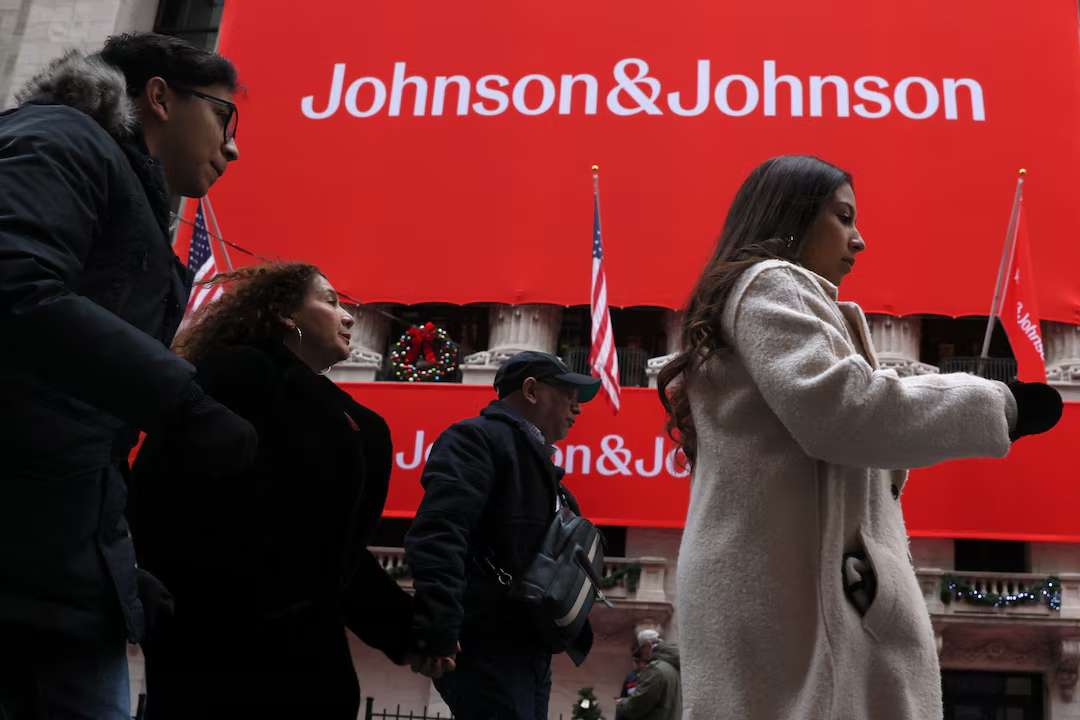
  • Johnson & Johnson’s loss regarding its talc liabilities marks the culmination of bankruptcy courts pushing back against tort claims

    Johnson & Johnson’s loss regarding its talc liabilities marks the culmination of bankruptcy courts pushing back against tort claims

    In a landmark ruling that underscores rising judicial resistance to corporate attempts at using bankruptcy to manage mass tort liabilities, a U.S. bankruptcy judge on Friday rejected Johnson & Johnson’s third attempt to use Chapter 11 protection to resolve tens of thousands of lawsuits tied to its talc-based products. The decision marks a decisive blow not only to J&J but to a broader legal strategy increasingly deployed by large companies facing waves of personal injury claims.

    The judge’s opinion, issued in the U.S. Bankruptcy Court for the District of New Jersey, concluded that the pharmaceutical giant’s latest bankruptcy filing lacked the financial distress necessary to justify protection under Chapter 11. “This court cannot permit solvent, profitable entities to access bankruptcy courts simply as a litigation strategy,” the ruling stated.

    At the heart of J&J’s legal maneuvering is its long-running battle over allegations that its iconic Johnson’s Baby Powder and other talc-based products caused ovarian cancer and mesothelioma due to asbestos contamination. Though the company denies wrongdoing and insists its products are safe, more than 50,000 lawsuits have been filed over the past decade.

    Facing escalating legal costs and several billion-dollar verdicts, J&J adopted a controversial bankruptcy tactic in 2021 known as the “Texas two-step.” The strategy involved spinning off its talc liabilities into a new subsidiary—LTL Management—which then filed for bankruptcy, halting litigation and attempting to resolve claims through the bankruptcy process.

    The first two filings were dismissed in 2021 and 2023 respectively, with courts finding that LTL was not in true financial distress—a prerequisite for Chapter 11 eligibility. J&J’s third attempt, filed earlier this year, added new arguments and increased proposed settlement offers, but Judge Michael Kaplan found it similarly lacking.

    The ruling is being hailed by plaintiff attorneys and consumer advocates as a turning point in efforts to prevent corporations from shielding themselves from jury trials through what critics call “bankruptcy abuse.”

    “Today’s decision sends a loud message that solvent companies cannot manipulate bankruptcy law to avoid accountability,” said Rachel Abrams, a lead attorney representing thousands of talc plaintiffs. “Our clients want their day in court, not a forced settlement behind closed doors.”

    Legal scholars say the ruling fits within a broader trend of skepticism from bankruptcy courts, particularly when wealthy parent companies try to offload legal liabilities into thinly capitalized subsidiaries.

    “This case is the capstone to a growing judicial pushback against the ‘Texas two-step’ and similar schemes,” said Adam Levitin, a Georgetown law professor specializing in bankruptcy. “The courts are reasserting that bankruptcy is a tool for financial reorganization—not for escaping the consequences of harmful conduct.”

    J&J, one of the most valuable pharmaceutical companies in the world, has consistently defended its actions as a good-faith effort to equitably compensate claimants while preventing prolonged, costly litigation. The company had offered $8.9 billion in a global settlement in its latest filing—a dramatic increase from previous offers.

    “We remain committed to resolving these claims in a fair and efficient manner,” the company said in a statement following the ruling. “We are evaluating all options, including appeal.”

    Yet the court’s decision may force J&J back into the civil litigation arena, where it faces numerous pending jury trials and the possibility of more multimillion- or even billion-dollar verdicts.

    J&J is not alone. Several major companies, including 3M (earplug litigation), Purdue Pharma (opioid litigation), and Georgia-Pacific (asbestos claims), have sought to use bankruptcy as a shield from mass tort liability in recent years. Many of these efforts have stalled or failed entirely under legal and political pressure.

    Earlier this year, the Supreme Court halted Purdue Pharma’s bankruptcy deal over concerns it improperly protected the Sackler family from future civil liability, despite their non-bankrupt status. Meanwhile, 3M’s own bankruptcy strategy around its military earplug litigation was dealt a significant blow when a judge denied its attempt to resolve over 200,000 claims through a similar subsidiary bankruptcy.

    Analysts say these defeats signal a new era of scrutiny over how large corporations use financial engineering to avoid full-scale legal exposure.

    With bankruptcy judges tightening their interpretation of Chapter 11 eligibility, some legal experts believe legislative reform may be next. The House Judiciary Committee has already held hearings examining corporate manipulation of the bankruptcy system in mass torts.

    “Public trust in the courts is eroded when billion-dollar companies use legal loopholes to avoid accountability,” said Rep. Jerry Nadler (D-NY) during a 2024 hearing. “Congress must act to close these doors for good.”

    In the meantime, J&J’s talc litigation appears poised to return to the civil court system, where plaintiffs will once again seek individual trials—or a large-scale settlement—outside of the bankruptcy arena.

    Friday’s ruling doesn’t just impact Johnson & Johnson. It could reshape the landscape of corporate liability and the tools available to address mass tort claims. For now, the message is clear: bankruptcy court is not a backdoor to avoid the jury box.