Author: Ryan McNom

  • Hobby Lobby to Open First Store in Manhattan — But It’s Stirring Controversy.

    Hobby Lobby to Open First Store in Manhattan — But It’s Stirring Controversy.

    In the Lower Manhattan neighborhood of TriBeCa, known for its liberal politics and sky-high rents, a new retailer, known for its conservative Christian convictions, rock-bottom prices and steadfast customers in rural America, is moving in.

    Now the question is, can this retailer, Hobby Lobby, make it in Manhattan?

    The retailer, which is expected to open this spring and is taking over 75,000 square feet that used to be a Bed Bath & Beyond and Barnes & Noble for its first Manhattan store, should have prompted an enthusiastic response given the surge of Americans who picked up crafts hobbies during the pandemic.

    Instead, the reaction has been mixed, with some residents feeling affronted that Hobby Lobby is opening in their neighborhood. Local groups and forums that are protesting the company’s arrival in TriBeCa point to Hobby Lobby’s work with organizations that oppose gay and transgender rights. They haven’t forgotten the private company’s lawsuit in 2014 to fight against having to provide insurance coverage for contraception for employees.

    Over a decade later, it remains to be seen whether low prices and a staggering selection of products are enough to make residents in an area that has long been a liberal stronghold look past the company’s conservative bent. The neighborhood, known for cobblestone streets and converted loft buildings that are now home to affluent families and A-list celebrities, is solidly Democratic, but, like much of New York, it shifted to the right during the 2024 election.

    Heide Fasnacht, an artist who has lived and worked in TriBeCa for five decades, said she felt “angry” about the arrival of a company that promotes the evangelical Protestant convictions of its founder.

    “I moved to New York to get away from things like that,” said Ms. Fasnacht, who was calling for a boycott of the store.

    00Hobby Lobby 05 pgwz superJumbo
    “There are probably a lot of people here who do crafts, I’m sure,” says Heide Fasnacht, an artist who lives in TriBeCa. While she appreciates increased access to materials, she strongly opposes the new store.Credit…Oliver Farshi for The New York Times

    Madeline Lanciani, the owner of Duane Park Patisserie, a couple of blocks from Hobby Lobby’s location in TriBeCa, also considers herself part of the resistance. “I will gladly go out of my way to shop somewhere else,” she said.

    Hobby Lobby is no stranger to protests against its business. Its owners, David and Barbara Green, are outspoken about their Christian faith, which has infused the culture of the retailer. The company has said its guiding principle is “honoring the Lord in all we do by operating the company in a manner consistent with biblical principles.” The stores remain closed on Sunday and sell Christian-themed goods.

    Despite backlash from residents like Ms. Fasnacht and Ms. Lanciani, Hobby Lobby is making inroads in New York at what appears to be an opportune time: One of its main competitors, Joann, which sold fabrics and crafts supplies for over 80 years, said in February that it was going out of business and closing all of its roughly 800 stores, including 30 in New York. Another competitor, Michaels, went through a leveraged buyout in 2021.

    Hobby Lobby, by contrast, has been the model of stability. The company, which has about 1,040 stores across the country, including 28 in New York State, brought in $8 billion in revenue and opened 37 new stores last year.

    Visits to its stores increased nearly 17 percent from 2019 to 2024, according to an analysis of foot traffic by Placer.ai, a data provider, while Michaels had a decline of over 9 percent and Joann a loss of over 5 percent.

    Hobby Lobby opened its first store in New York City last year, in Staten Island, the most suburban and conservative-leaning of the city’s boroughs, and is eyeing possible locations in other neighborhoods.

    As for the TriBeCa location, just blocks from the World Trade Center site, which attracts millions of visitors annually, Neil Saunders, managing director at GlobalData, a research and consulting firm, said, “There will be some people who boycott it and some who adore it and people in the middle who just want a ball of yarn.”

    Lidia Curto, a Staten Island resident who was indeed loading blue yarn in her car after shopping at the store there on a recent afternoon, said Hobby Lobby’s low prices were why she shopped there.

    Hobby Lobby did not respond to requests for comment for this article.

    The reaction to the retailer’s coming to TriBeCa harks back to Chick-fil-A’s arrival in Lower Manhattan in 2018 on Fulton Street, not far from Hobby Lobby’s new space. The purveyor of fried-chicken sandwiches — with an ethos that has also been colored by its Christian founder, who has publicly maligned same-sex marriage — had caused its own uproar.

    Protesters greeted Chick-fil-A when it opened there, but were soon replaced by long lines of customers who seem to have since put aside their political concerns for a crispy, well-seasoned chicken sandwich.

    Chick-fil-A did not respond to requests for sales figures for the Fulton Street store, but the chain’s non-mall locations generated average revenues of $9.3 million in 2023, according to the company’s 2024 franchise disclosure document, an 8.1 percent increase over 2022. Chick-fil-A has 26 stores in New York City, according to its website.

    00Hobby Lobby 07 pgwz superJumbo
    Chick-fil-A, which opened on Fulton Street in 2018 near the new Hobby Lobby, similarly embeds its founder’s Christian faith into aspects of its corporate identity.Credit…Oliver Farshi for The New York Times

    Jonnie Weeden called the food he had just bought at the Fulton Street restaurant on a recent afternoon “a guilty pleasure.” He said he was aware of what he called the founder’s “homophobic views,” which he said didn’t align with his own, but pointed out that “many other companies have flawed world views, and people turn a blind eye.”

    Founded in 1972, Hobby Lobby started as a 300-square-foot space in Oklahoma City, an outgrowth of a miniature picture frame business that the Greens had started in their home. They later added crafts supplies, home goods and seasonal decorations to their offerings.

    Mr. Green, 83, is still Hobby Lobby’s chief executive. One of his sons is president of the retailer, and another started an affiliate company that sells Christian books and church supplies.

    Today, Hobby Lobby stores are as big as 90,000 square feet and filled with tens of thousands of items.

    00Hobby Lobby 02 pgwz superJumbo
    At Hobby Lobby’s Staten Island location, shoppers can browse a wide selection of crosses. Credit…Oliver Farshi for The New York Times

    The retailer’s Christian principles may seem like an odd fit for Manhattan, let alone TriBeCa. Hobby Lobby, like Joann and Michaels, has typically favored suburban and rural areas.

    But Steven Soutendijk, an executive managing director and retail specialist at the real estate firm Cushman & Wakefield, said he thought Hobby Lobby’s lease in TriBeCa had less to do with the neighborhood than with the space itself, a rarity in Manhattan.

    “There are very few superlarge-format big boxes that actually even physically exist” in the borough, he said.

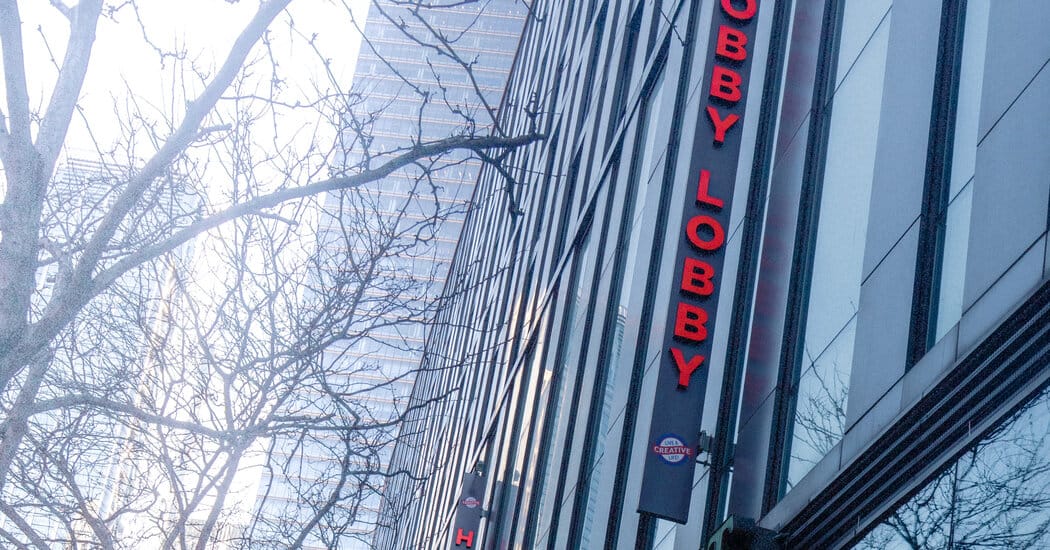
    00biz HOBBYLOBBY street jvph superJumbo
    An executive at the real estate firm Cushman & Wakefield said he thought Hobby Lobby’s lease in TriBeCa had less to do with the neighborhood than with the space itself.Credit…Oliver Farshi for The New York Times

    The company’s real estate strategy involves leasing big-box facilities previously occupied by another retailer, avoiding the high costs of new construction. Its 42,000-square-foot space in Staten Island was a former Babies “R” Us. It also typically funds its own renovations, unlike many other retailers that rely on their landlords to help cover those costs and are thus locked into higher rents, said Daniel Taub, the national director of retail at Marcus & Millichap, a commercial real estate brokerage.

    As to what extent Hobby Lobby’s politics might affect how well the store performs, James Cook, the senior director of Americas retail research for JLL, a real estate services company, said, “At the end of the day, I don’t think it matters.”

    00Hobby Lobby 03 pgwz superJumbo
    Chris Panayiotou, the owner of the Gee Whiz Diner in TriBeCa just across from the Hobby Lobby building on Greenwich Street, said he was hoping to benefit from the foot traffic the retailer would bring.Credit…Oliver Farshi for The New York Times

    Chris Panayiotou, the owner of the Gee Whiz Diner, a TriBeCa mainstay just across from the Hobby Lobby building on Greenwich Street, said he was hoping to benefit from the foot traffic the retailer would bring and possibly make up for the customers he lost when Bed Bath & Beyond and Barnes & Noble closed.

    “People, once they’re done shopping, they’re going to be tired,” Mr. Panayiotou said. “Once they pop out and see us on the corner, they might want a cup of coffee or something to eat.”

  • U.S. Bond Sell-Off Raises Questions About ‘Safe Haven’ Status

    U.S. Bond Sell-Off Raises Questions About ‘Safe Haven’ Status

    A sharp sell-off in U.S. government bond markets has sparked fears about the growing fallout from President Trump’s sweeping tariffs and retaliation by China, the European Union and others, raising questions about what is typically seen as the safest corner for investors to take cover during times of turmoil.

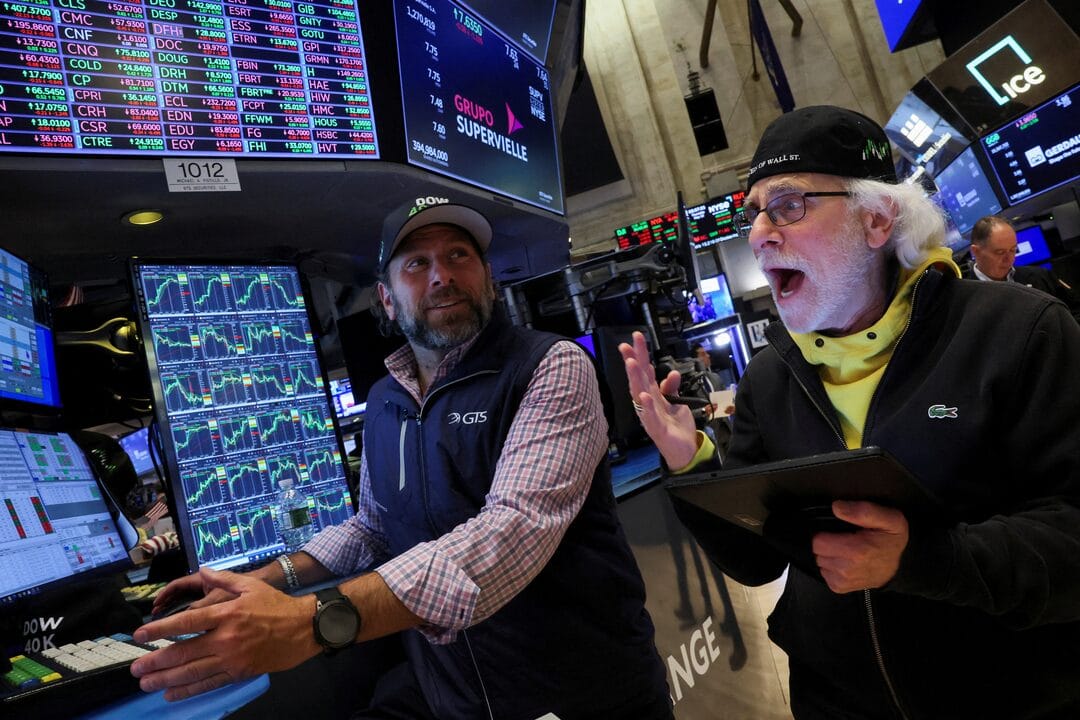
    Yields on 10-year Treasuries — the benchmark for a wide variety of debt — shot 0.2 percentage points higher on Wednesday, to 4.45 percent, a big move in that market. Just a few days ago, it had traded below 4 percent. Yields on the 30-year bond rose significantly as well, at one point on Wednesday topping 5 percent. Borrowing costs globally have also shot higher.

    The sell-off comes as investors have fled riskier assets globally in what some fear has parallels to what became known as the “dash for cash” episode during the pandemic, when the Treasury market broke down. The recent moves have upended a longstanding relationship in which the U.S. government bond market serves as a safe harbor during times of stress.

    Volatility has surged as stock markets have plummeted amid fears that the U.S. economy is hurtling toward stagflation, in which economic growth contracts while inflation surges. The S&P 500 is now on the verge of entering a bear market, meaning it has dropped 20 percent from its recent high.

    “The global safe-haven status is in question,” said Priya Misra, a portfolio manager at JPMorgan Asset Management. “Disorderly moves have happened this week because there is no safe place to hide.”

    Scott Bessent, the U.S. Treasury secretary, sought to tamp down concerns on Wednesday, brushing off the sell-off as nothing more than investors who bought assets with borrowed money having to cover their losses.

    “I believe that there is nothing systemic about this — I think that it is an uncomfortable but normal deleveraging that’s going on in the bond market,” he said in an interview with Fox Business.

    But the moves have been significant enough to raise broader concerns about how foreign investors now perceive the United States, after Mr. Trump decided to slap onerous tariffs on nearly all of its trading partners. Some countries have sought to strike deals with the administration to lower their tariff rates. But China retaliated on Wednesday, announcing an 84 percent levy on U.S. goods after Mr. Trump raised the tariff rate on Chinese goods to 104 percent.

    In a social media post on Wednesday, the former U.S. Treasury secretary Lawrence H. Summers said the broader sell-off suggested a “generalized aversion to US assets in global financial markets” and warned about the possibility of a “serious financial crisis wholly induced by US government tariff policy.”

  • Singer and ex-MLB players among 113 dead in Santo Domingo nightclub collapse

    Singer and ex-MLB players among 113 dead in Santo Domingo nightclub collapse

    At least 113 people were killed and more than 155 injured when a nightclub’s roof collapsed in the Dominican Republic’s capital city early Tuesday, local officials saidincluding a prominent local singer, a governor, and two former Major League Baseball players.

    Juan Manuel Méndez, director of the Center for Emergency Operations, told reporters that more than 155 people were hospitalized after the collapse at the Jet Set nightclub in Santo Domingo.

    One of those killed was prominent Dominican singer Rubby Pérez, who was known as “the highest voice in merengue” and had been performing with his band when the roof collapsed, his manager, Enrique Paulino, confirmed to The Washington Post on Tuesday night. Earlier in the day, Pérez’s daughter had told local media that Pérez was rescued from the wreckage and hospitalized, but Paulino said the account was inaccurate. Pérez was 69.

    Dominican Republic President Luis Abinader said that Nelsy Milagros Cruz, governor of Montecristi province, was among those killed. The governor, the sister of seven-time Major League Baseball all-star Nelson Cruz, was rescued from the wreckage but died at a hospital, according to local media.

    Former major league pitcher Octavio Dotel died on his way to a hospital after being recovered by emergency workers, according to local and sports media. Tony Blanco, who played in the minor leagues from 2000 to 2008 and spent 56 games with the Washington Nationals in 2005, was killed in the collapse, with the Dominican Republic Ministry of Sports and Recreation confirming his death to ESPN.

    Emergency services were working to clear debris Tuesday in search of survivors trapped under the rubble, Méndez said.

    The cause of the collapse, which happened at 12:44 a.m., according to local media, was not immediately clear.

    Abinader offered his condolences in a statement on social media.

    “We deeply regret the tragedy that occurred at the Jet Set nightclub,” Abinader said. “All relief agencies have provided the necessary assistance and are working tirelessly in the rescue efforts. Our prayers are with the affected families.”

    “Major League Baseball is deeply saddened by the passings of Octavio Dotel, Tony Blanco, Nelsy Cruz, and all the victims of last night’s tragedy in Santo Domingo,” Commissioner Rob Manfred said in a statement. “We send our heartfelt condolences to the families and friends of all those who have been affected and to our colleague Nelson and his entire family. The connection between baseball and the Dominican Republic runs deep, and we are thinking of all the Dominican players and fans across the game today.”

    The family of Nelsy Cruz posted a funeral announcement on Nelson Cruz’s Instagram stories and thanked “all those who have expressed their love and solidarity at this difficult time. Her legacy of service and love for others will live forever in our hearts.”

    The collapse happened during a busy night for the club, which hosts live shows — including local and international acts — on Monday nights, according to Jet Set’s website.

    H62VVPXV2MIY2JJ2VW2IQLQXZ4
    People check the lists of victims outside the Jet Set nightclub after the collapse of its roof in Santo Domingo on Tuesday. (Francesco Spotorno/AFP/Getty Images)

    Footage apparently filmed inside the club during the collapse, which was shared on social media and by local media outlets and could not immediately be verified, showed Pérez performing with his band as a crowd milled around in front of the stage. Suddenly, a glass ceiling fixture in the background lurches downward, and the footage abruptly turns dark. Screams can be heard.

    Paulino, Pérez’s manager, told reporters that the group’s saxophonist had been killed, the Associated Press reported. Paulino said that when the ceiling fell, he initially thought there had been an earthquake.

    Outside the club, Manuel Olivo Ortiz awaited more information about his missing son, who attended the Pérez performance. “We’re holding on only to God,” Olivo said, according to the AP.

    Videos of the aftermath — shot from above, through the destroyed roof — showed rescuers and firefighters clambering around the wreckage of the club, illuminated by floodlights.

    The U.S. Embassy in the Dominican Republic offered its “deepest condolences” in a statement on social media.

    “We stand in solidarity with the families of the victims, the injured, and all the Dominican people during this difficult time,” said Patricia Aguilera, chargé d’affaires at the embassy.

  • German Billionaire Eyes Wall Street Journal Buyout

    German Billionaire Eyes Wall Street Journal Buyout

    In the cutthroat arena of global media mergers, few names evoke the blend of ambition and audacity quite like Mathias Döpfner, the silver-haired CEO and co-owner of Axel Springer SE. The 62-year-old German billionaire, a board member at Netflix and a self-proclaimed Elon Musk confidant, has long harbored designs on American journalism’s crown jewels. In a candid Financial Times interview this week, Döpfner openly acknowledged his interest in acquiring The Wall Street Journal from Rupert Murdoch’s News Corp empire—a tantalizing prospect that could catapult Axel Springer into the elite echelon of U.S. media powerhouses, even as he navigates a high-stakes corporate breakup and a frosty family feud at News Corp.

    Döpfner’s flirtation with the Journal comes at a pivotal juncture. He’s on the cusp of sealing a €13.5 billion ($14.2 billion) divorce from private equity giant KKR & Co., which will hand him and the widow of Axel Springer’s founder, Friede Springer, a commanding 98% stake in the company’s vaunted media portfolio. The deal, expected to finalize in early 2026, severs the classifieds arm—home to sites like StepStone and Aviv—leaving Döpfner with unencumbered control over tabloid juggernauts like Bild and Die Welt, alongside U.S. darlings Business Insider (acquired for $343 million in 2015) and Politico (snapped up for $1 billion in 2021). “This split gives us new freedom and opportunity,” Döpfner told the FT, though he candidly admitted the “higher risk” of ditching KKR’s financial ballast. To offset that, he’s slashing costs at his German titles amid a print ad slump, while doubling down on transatlantic growth.

    The Wall Street Journal, with its 3.8 million subscribers and a digital paywall that’s become a Wall Street must-read, represents the ultimate prize. Valued at $5.6 billion when Murdoch scooped it up in 2007, the paper’s worth has likely swelled to $8-10 billion today, fueled by a 15% revenue bump to $1.2 billion in fiscal 2025, per News Corp filings. For Döpfner, who unsuccessfully bid for the Financial Times a decade ago, it would crown his U.S. foray: Axel Springer’s American revenue has tripled to €800 million since the Politico buy, driven by premium subscriptions and event tie-ins like the Semafor World Economy Summit. Yet, caveats abound. Döpfner stressed the Journal “doesn’t appear to be up for sale,” pegging his odds at “close to zero.” Insiders at News Corp, however, whisper of opportunity amid the octogenarian Murdoch’s acrimonious succession battle. With eldest son Lachlan at the helm but siblings James and Elisabeth chafing at the conservative tilt, a sale could sidestep inheritance woes—especially if it nets billions to fund pet projects or buy peace.

    Financing the deal? That’s the rub. Axel Springer’s media unit was pegged at €3.5 billion in the KKR split, leaving scant dry powder for a blockbuster bid without debt or equity partners. Döpfner, ever the networker, has wooed U.S. tech titans—Musk dined at his Mar-a-Lago wedding last year—and sits on Netflix’s board, but skeptics question his firepower. “He’s a charmer with connections from Berlin to Silicon Valley, but €10 billion? That’s Musk money, not Springer scale,” quipped one media banker at a London drinks bash. Still, underestimation is folly: Döpfner’s track record includes outmaneuvering rivals for Politico during a bidding war and pivoting Bild to a profitable digital fortress despite Germany’s ad woes.

    Mounting Woes at Wood Group: CFO Exit Amid Takeover Ghosts and Cash Crunch

    As Döpfner’s empire eyes blue-sky expansion, across the Channel, Scotland’s Wood Group PLC is mired in a cautionary tale of M&A mishaps and executive missteps. The FTSE 250 engineering firm, a North Sea oil survivor turned renewables hopeful, saw its shares crater another 8% to 45p on Wednesday—valuing it at a mere £170 million—after chief financial officer Arvind Balan abruptly resigned, admitting to “misstating” his professional qualifications. The board, tipped off by an FT inquiry, accepted his immediate departure, leaving CEO Ken Gilmartin to steady a ship already listing from two botched buyouts and a grim cash outlook.

    Balan’s exit, just weeks after Wood’s bombshell November warning of up to $200 million in negative free cash flow for 2025 (flipping prior positivity), piles fresh ignominy on a company once hailed as Britain’s engineering export success. Apollo Global Management ditched a £2.2 billion ($2.9 billion) takeover in 2023 over valuation spats, followed by Dubai’s Sidara bailing on a £1.7 billion pact last year—each time sending shares into freefall. Now, with a market cap slashed 70% from 2024 highs, takeover whispers abound anew: Analysts at Peel Hunt speculate a third suitor could emerge at 150-200p a share, lured by Wood’s 40,000-strong workforce and contracts in LNG and hydrogen. “To lose one bid is misfortune; two, carelessness; three? Opportunity,” one investor quipped, channeling Oscar Wilde.

    Yet, the rot runs deeper. Wood’s pivot from fossil fuels—amid a 20% drop in oilfield services demand—has faltered, with Q3 revenue flat at $1.8 billion and debt ticking up to $1.2 billion. Balan’s fibs, reportedly inflating his CFA credentials, erode trust at a firm already under UK Listing Rules scrutiny. Investors, nursing 40% losses since Sidara’s snub, demand clarity: Will the board launch an qualifications audit? And could this nadir finally seal a deal, perhaps with a U.S. PE player eyeing Europe’s green transition?

    In broader dealmaking ripples, Howard Lutnick’s ascension to U.S. Commerce Secretary has reshuffled Cantor Fitzgerald, with sons Brandon (a DJ) and Kyle named chair and vice-chair, respectively—nepotism headlines be damned. Meanwhile, AlbaCore Capital elevated Davide Chiesa to partner, and Weil Gotshal tapped Michael Aiello for a new leadership committee ahead of Barry Wolf’s 2027 retirement.

    As media titans like Döpfner chase legacies and industrials like Wood grapple with survival, 2026 looms as a year of bold bets—and brutal reckonings—in tech-infused dealmaking.