

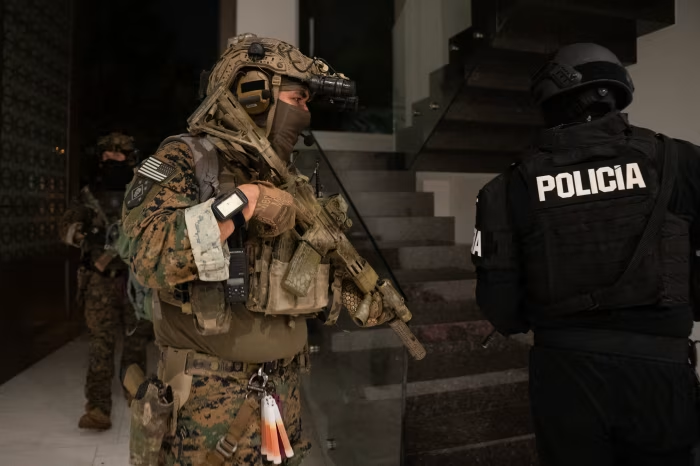
Ecuador’s security forces carried out a series of raids this week around the country, killing three alleged drug traffickers and capturing dozens more. At their side was a contingent of heavily armed American soldiers.
The operations, which were announced by the Ecuadorean government, signal a deepening of U.S. military involvement in Latin America’s drug wars as the Trump administration pledges to go after criminal groups it has labeled narcoterrorists.
On Thursday in the city of Guayaquil and several other locations, 50 U.S. military personnel joined more than 300 national police officers in raids against a drug network that Ecuadorean officials said has ties to Mexico’s Jalisco New Generation Cartel. Images posted by the interior minister showed police inside a home in an upscale Guayaquil neighborhood accompanied by masked American soldiers wearing U.S. flags stitched onto the shoulder of their uniforms. More than 30 people were detained.
A day earlier, Ecuadorean soldiers, in cooperation with the U.S. Southern Command, which oversees U.S. forces in Latin America, killed a local drug boss known by the alias Charlie and his two security guards in the coastal province of Manabí. Charlie was a member of Ecuador’s Choneros gang and also had ties to Mexico’s Jalisco cartel, officials said.
“We said it was either prison or hell, and this one didn’t make it to prison,” Ecuador’s defense minister, Gian Carlo Loffredo, said in a video on X, where he and other officials posted pictures showing three men sprawled out on a bloodstained road beside a bullet-riddled truck.
The U.S. has long provided Ecuador and other Latin American governments with intelligence, equipment and training to help fight powerful criminal groups that send drugs north and unleash violence at home.
But until now, U.S. military personnel have mostly played a peripheral role in local operations, rather than participating directly in drug raids, said Adam Isacson, a security expert at the Washington Office on Latin America, a think tank.
“What we are seeing in Ecuador is unlike anything we’ve seen even during the Cold War,” he said. “If it is the model that gets replicated in the region, we are going to see U.S. troops on the ground very close to or participating in combat.”
U.S. Southern Command said in an emailed statement that the Ecuador-led joint operations “demonstrate Ecuador’s steadfast resolve to defeat hemispheric threats.” It declined to provide details on the operations.
Under President Daniel Noboa, Ecuador has become a key player in the Trump administration’s Shield of the Americas security alliance that includes other right-wing Latin American governments.
Nestled between the world’s two biggest cocaine producers, Colombia and Peru, Ecuador has been overwhelmed by drug-fueled violence as it has become a major cocaine transshipment point. Today, Ecuador has one of Latin America’s highest homicide rates.
Noboa has called for greater international support, saying his country is under siege by narcoterrorist organizations.
“No state alone can defeat an enemy that knows no borders,” he said this week at the United Nations General Assembly. “For a long time, organized crime was treated as a police problem. Today, we know it is more than that.”
In March, the U.S. helped Ecuador bomb suspected drug traffickers on its border with Colombia. In the past month, the U.S. military has also blown up several Ecuadorean fishing vessels in the Pacific Ocean that were allegedly used to help traffic drugs north.
In a visit to the Ecuadorean capital of Quito earlier this month, Secretary of State Marco Rubio said elite U.S. forces are now operating alongside Ecuadorean personnel to go after drug traffickers.
“That’s an incredible development, and that’s an important development,” he told reporters. “That’s the only way you’re going to beat these narcotrafficking terrorists.”