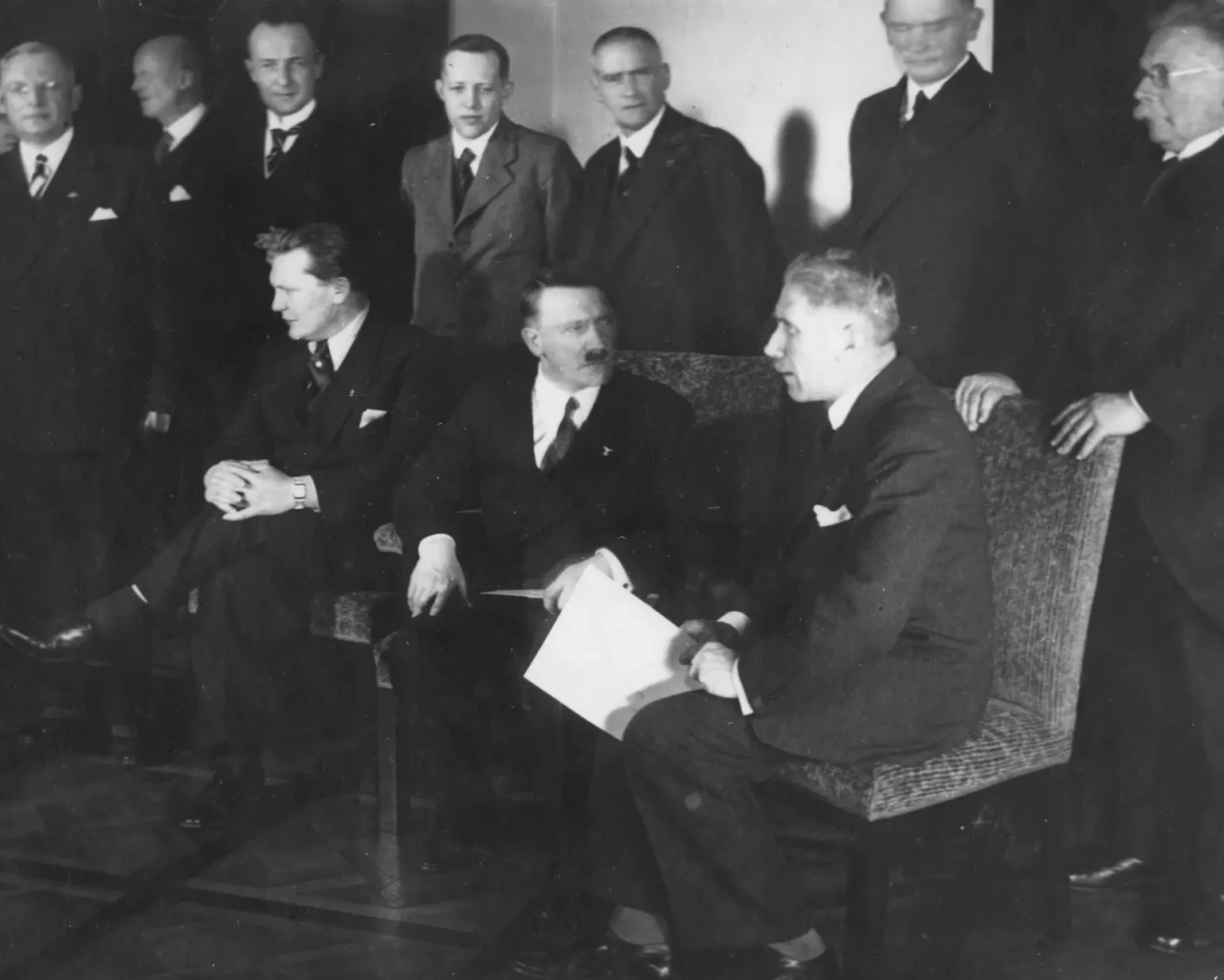
We tend to remember fascism in its flourishing, at the height of its power: societies marked by dictatorship, a total war machine and the absence of individual rights. But it is an irreducible feature of fascism that it begins as a democratic phenomenon.
“The big joke on democracy,” the Nazi propaganda minister Joseph Goebbels wrote in May 1928, “is that it provides its mortal enemies the means to its own destruction.” The Harvard historian Peter E. Gordon agrees. Fascism’s “trademark,” he recently observed, is to deploy “democratic procedure even as it seeks to destroy the substantive values of democracy from within.”
In the 21st century, as liberal societies teeter, journalists and scholars have taken an interest in earlier moments of democratic sabotage. Two years ago, the historian Timothy W. Ryback published “Takeover: Hitler’s Final Rise to Power,” an account — in minute and often thrilling detail — of the six months leading up to Adolf Hitler’s appointment to the chancellorship of Germany in January 1933.
His book focused especially on the hubris of two of Hitler’s enablers: Gen. Kurt von Schleicher, the former chancellor and conservative institutionalist who hoped Hitler’s brownshirts would crush the left on his behalf; and Alfred Hugenberg, the media magnate who published Hitler’s propaganda and eventually joined his cabinet. Both men hoped to contain and usurp Hitler’s movement, assuming it would be them and their patrician ilk, not a common thug like Hitler, who would reap the rewards of the Nazi assault on democracy.
These themes and characters return in Ryback’s “53 Days: How Hitler Dismantled a Democracy.” The new book serves as something of a coda to “Takeover,” extending the timeline to Hitler’s first seven weeks in office — providing, as Ryback writes, “a step-by-step account of how Hitler disabled and then dismantled his country’s democratic structures and processes in less than two months’ time.”
In “53 Days,” we see Hitler’s war on the press, his purging of the civil service, his elimination of civil liberties and his crushing of resistance by the federated German states. It all culminates on March 23, 1933, with the Reichstag’s approval of the aptly named “Enabling Act,” which suspended the Weimar Constitution and handed Hitler unfettered power. As a pat New York Times headline reported the next day: “Quick Action in the Reichstag: Vote Dictatorship for Hitler Regime.”
To a remarkable degree, Ryback’s brisk narrative titrates the exact proportion of detail and context to enliven these moments and never dawdles over any single standoff; the book, which is a short 244 pages, really moves. While Ryback’s prose is mostly taut and interesting, he does sometimes indulge in needless adverbs: Hitler is “fiercely anti-democratic, belligerently nationalistic and viciously racist”; Goebbels, “fiercely, possessively, viciously loyal”; and the Nazi Party, “belligerently” nationalistic and “assertively” socialist.
These occasional tics are less distracting, however, than Ryback’s frequent, at times gratuitous, winks at the Trumpian present. To be clear, Ryback rarely if ever compares Donald Trump and Adolf Hitler explicitly. Instead, he summons and summarizes details from the Nazi past that unmistakably rhyme with the present, leaving it to his discerning readers to make the connection.
Between “Takeover” and “53 Days,” Ryback has made something of a hobby out of these allusions in articles he’s written for The Atlantic, the first of which, titled “How Hitler Dismantled a Democracy in 53 Days,” inspired the new book. Other entries include “What Happened When Hitler Took On Germany’s Central Banker,” “Hitler’s Greenland Obsession” and “Hitler’s Edifice Complex,” the last of which explored Hitler’s obsession with “adding an expensive new wing to the Reich chancellery.”
It would appear these historical set pieces have achieved their intended effect: We learn in the acknowledgments that the California governor Gavin Newsom provided Ryback with an “unexpected impetus” to write “53 Days” when he told the former Texas representative Beto O’Rourke that the author’s original Atlantic piece “scared the hell” out of him.
That this trick can be performed so effectively, again and again — by a capable historian — is evidence enough that the analogy is not completely tendentious.


Like Trump, Hitler was known for his coarse manners, “oversensitive vanity” and need to be the center of attention. Like Trump, he campaigned against the “parliamentarian swamp.” He sued to have the results of the April 1932 elections annulled, subjected the civil service to a DOGE-style loyalty purge, justified his most extreme actions as “retribution” and mass-amnestied violent National Socialist agitators, just as Trump did the insurrectionists of Jan. 6.