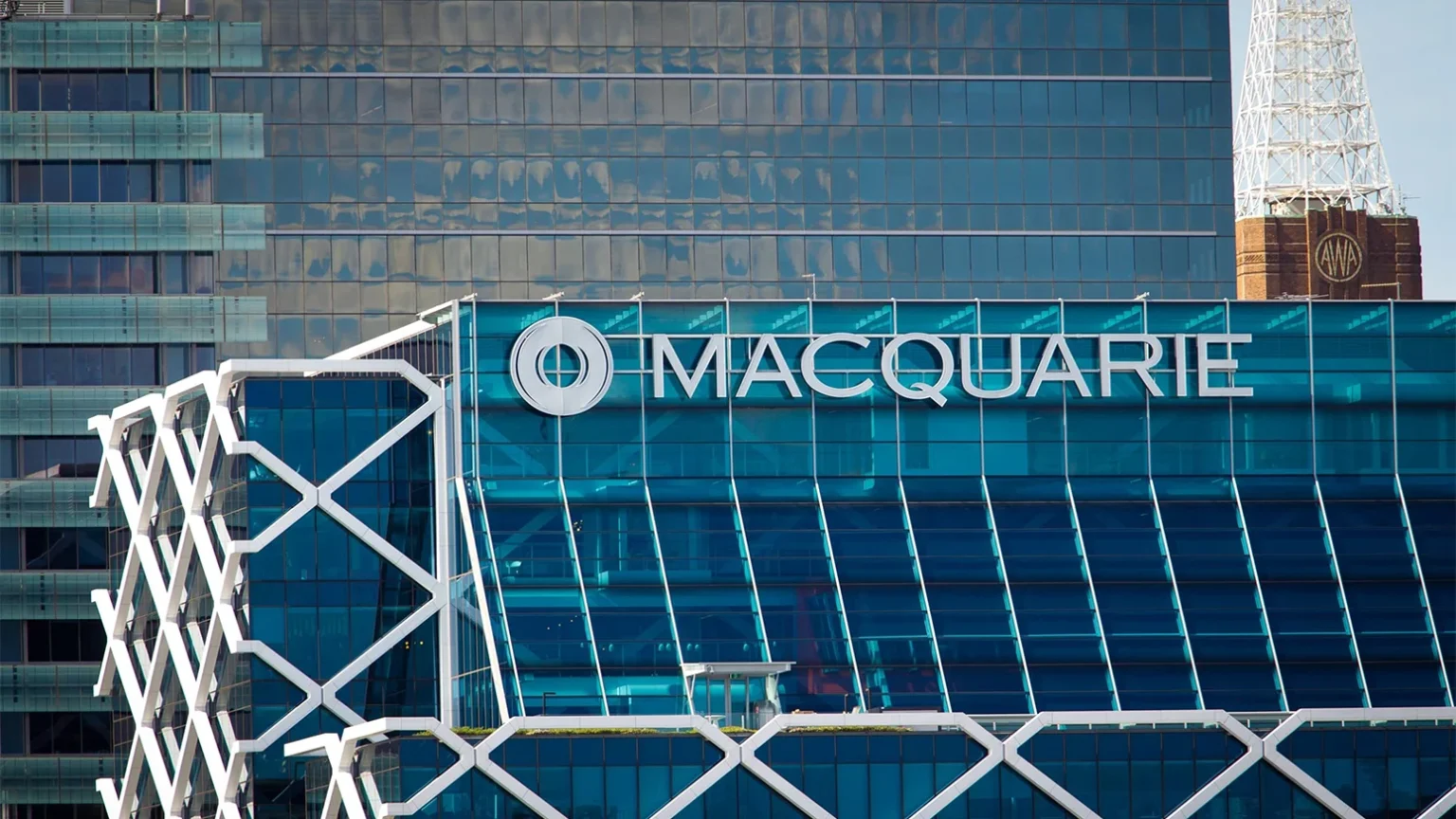
SYDNEY — Macquarie Group Ltd. is hitting pause on major divestments from its renewable energy portfolio as global market volatility continues to cloud valuations and temper investor appetite. The Australian financial giant, one of the world’s largest infrastructure investors, signaled during its fiscal 2025 earnings announcement that it will take a “disciplined and patient” approach before unloading further renewable energy assets.
The decision comes despite a robust performance from Macquarie Asset Management (MAM), which posted a 33% increase in annual profit, driven by higher performance fees, steady base management fees, and a growing pipeline of infrastructure mandates. Group-wide, Macquarie reported a full-year profit of A$5.4 billion (approx. $3.5 billion USD), largely in line with analyst expectations.
Macquarie had been expected to divest several high-profile renewable energy holdings this year—including stakes in wind and solar platforms across Europe, North America, and Asia—but said current market conditions are “not conducive” to achieving fair value.
“While we remain committed to recycling capital, we will only do so when market conditions support optimal outcomes for our investors and shareholders,” said Macquarie CEO Shemara Wikramanayake during Friday’s earnings call. “The volatility in interest rates, policy uncertainty, and inflationary pressure on construction costs are causing significant dislocations in asset pricing.”
Industry observers have noted that the renewable energy sector, once red-hot, has cooled in recent quarters as higher rates have increased the cost of capital and compressed valuations. Investors are also more cautious amid delays in grid connections, permitting hurdles, and inconsistent government incentives across markets.
Despite the strategic pause in divestments, Macquarie’s asset management business remains a powerhouse. MAM reported A$2.1 billion in annual profit, up 33% year-over-year, supported by:
- AUM Growth: Assets under management reached A$910 billion, bolstered by fundraising across infrastructure and green energy funds.
- Strong Mandates: Macquarie secured multiple new mandates from sovereign wealth funds and pension clients seeking to increase exposure to climate-aligned investments.
- Performance Fees: Realizations from select mature assets—mainly in digital infrastructure and logistics—contributed to outsized performance fee revenue.
“Long-duration investors are still backing the energy transition, but they’re more selective,” said Asha Kapoor, infrastructure analyst at AMP Capital. “Macquarie is wise to wait for a more stable pricing environment before executing exits.”
Macquarie’s renewables platform spans more than 50 countries, with projects ranging from offshore wind farms in Taiwan to solar installations in Texas and Chile. The firm has also been a leading investor in hydrogen infrastructure and battery storage.
Among the assets originally rumored to be up for sale were:
- A controlling stake in Cero Generation, a European solar developer.
- Interests in Blueleaf Energy, focused on Southeast Asia.
- Select North American onshore wind assets, held via partnerships with local developers.
Instead of rushing to sell, Macquarie is leaning into operations and value creation. Wikramanayake emphasized the group’s focus on “development-led growth” and “platform build-out,” with active investments continuing across key climate and energy security themes.
The broader renewables market has faced headwinds in recent quarters. The IEA cut its 2025 global renewables deployment forecast by 5%, citing permitting delays and input cost pressures. In the U.S., rising Treasury yields and Inflation Reduction Act implementation delays have added uncertainty, while European markets have seen policy rollbacks and auction failures.
Against this backdrop, Macquarie is choosing to bide its time.
“The opportunity set hasn’t disappeared—it’s just temporarily mispriced,” said Rory Bell, a partner at Macquarie Green Investment Group. “We’re not in the business of forced exits. Our investors expect discipline, not haste.”
Looking ahead, Macquarie says it will continue to originate and grow clean energy platforms globally, supported by $25 billion in dry powder across its infrastructure and energy funds. The firm’s upcoming secondaries strategy may also provide liquidity without requiring outright asset sales.
Meanwhile, the group remains open to divestitures when market sentiment rebounds, possibly later in 2025 or early 2026, depending on macro conditions.
“We remain optimistic about long-term fundamentals in the energy transition,” Wikramanayake said. “But this is a cycle that requires patience. Our approach has always been to take the long view—and that hasn’t changed.”
Key Figures – Macquarie Fiscal Year Highlights:
- Group Profit: A$5.4 billion (flat YoY)
- Macquarie Asset Management Profit: A$2.1 billion (↑33%)
- Assets Under Management: A$910 billion (↑6%)
- Dry Powder for Infrastructure/Energy: A$25 billion
- Renewables Investment Markets: 50+ countries